We Compared 4 Portable Power Stations for Christmas Lights

Off-grid power editor
Published
Updated
Last fact-checked
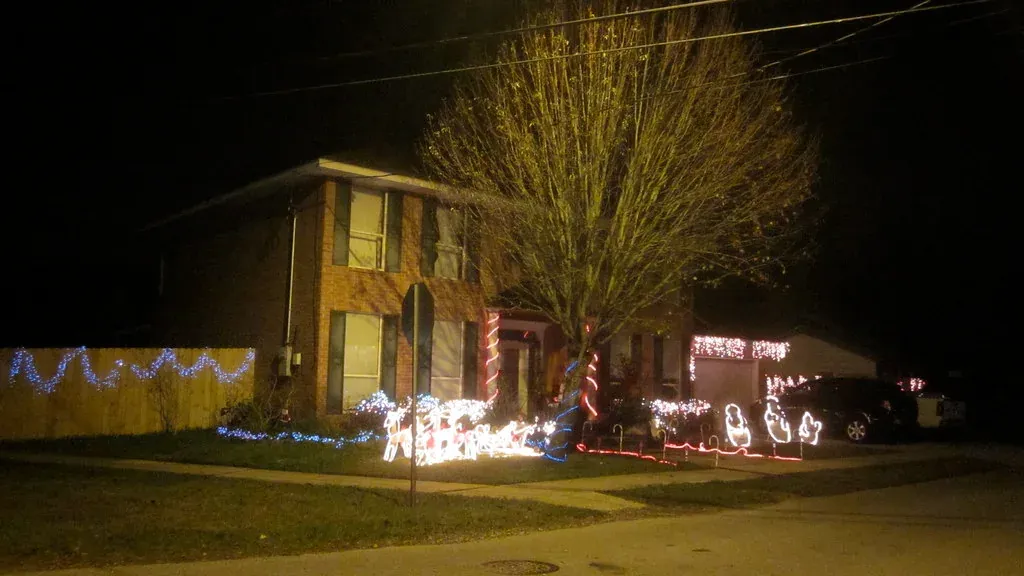
This guide is for people who want lights somewhere the house has no outdoor outlet: a detached tree, a fence line, a front lawn, a balcony rail. It is a job with an unusual shape. The load is tiny, but it has to be held for five or six hours a night, thirty nights in a row, in the cold. That makes stored watt-hours the specification that decides the purchase and inverter size almost an afterthought, which is the opposite of how these units are normally sold. We compared four on capacity, weight, port layout, recharge speed and cycle life. None were tested by us, and every review says what its judgement is based on. What you will get here is the arithmetic: how to turn your actual display into a wattage figure, and how many hours each unit gives you once conversion loss is taken off.
What is the best portable power station for Christmas lights?
The Anker SOLIX S2000 fits this job best. It stores 2010Wh, enough for about 8.5 hours of a 200W display after conversion loss, and it does it in 35.7 lb, which is the lightest way to carry that much energy out to the yard each evening. For a porch or balcony display drawing under 30W, the Goal Zero Yeti 300 does the same job for a fraction of the weight.
Key takeaways
- Add up your display in watts first; capacity divided by that number is your runtime, and nothing else on the spec sheet changes it
- LED strings draw so little that inverter size almost never matters here, which is why capacity per pound is the ratio to compare
- Expect to lose roughly 15% of rated capacity to inverter conversion, so treat the headline watt-hour figure as a ceiling
- One 25-bulb incandescent C9 string draws around 175W, more than an entire LED yard, so replacing old strings beats buying a bigger battery
- A display runs about 30 nights, so cycle life ratings of 3,000 and up are all equally irrelevant to this purchase
Our picks at a glance
Every unit below wins a specific situation rather than a place in a ranking. Pick the row that matches how you will actually use it.
-
Best for a full-yard display carried out each evening
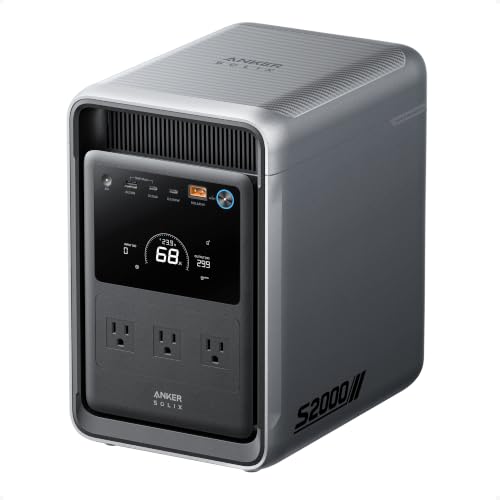
Anker SOLIX S2000
A full front-yard display of LED strings, a projector and one or two inflatables, carried out from the garage at dusk and brought back in overnight.
-
Best for turning the display around between nights

EcoFlow DELTA 2 Max
A large display run every night of December where the unit stays near the house and gets a wall or solar top-up during the day rather than an overnight charge.
-
Best for splitting a display into separate switched zones

ALLPOWERS R1500 LITE
A display built in zones, where the tree, the roofline and the inflatables get switched on and off separately rather than all running the whole evening.
-
Best for a porch, balcony or single-window display

Goal Zero Yeti 300
A porch, balcony, window or single small tree where the total load is under about 30W and there is no outdoor outlet within reach of a cord.
How they compare
Scroll the table sideways to see every column.
| Product | Where to buy | Award | Capacity | AC output | Weight | Ports | AC recharge time | Rated cycle life | Best for |
|---|---|---|---|---|---|---|---|---|---|
| Anker SOLIX S2000 | Best for a full-yard display carried out each evening | 2010Wh | 1500W (3000W peak) | 35.7 lb (16.2 kg) | 8 outlets, front and rear, no 12V DC port | -- | 10,000 cycles | A full front-yard display of LED strings, a projector and one or two inflatables, carried out from the garage at dusk and brought back in overnight. | |
| EcoFlow DELTA 2 Max | Best for turning the display around between nights | 2048Wh | 2400W (3400W X-Boost) | 50.7 lb (23.0 kg) | 15 outlets total | 1.1 hours to 80% on AC, 43 minutes with AC plus solar | 3,000 cycles to 80% | A large display run every night of December where the unit stays near the house and gets a wall or solar top-up during the day rather than an overnight charge. | |
| ALLPOWERS R1500 LITE | Best for splitting a display into separate switched zones | 1056Wh | 1600W (3200W surge) | 33 lb (15.0 kg) | 4 AC outlets, 2x USB-C 100W, 2x USB-A 18W, 120W car outlet, XT60 solar input | About 1 hour, 1000W standard or 1200W fast AC charging | 3,500+ cycles | A display built in zones, where the tree, the roofline and the inflatables get switched on and off separately rather than all running the whole evening. | |
| Goal Zero Yeti 300 | Best for a porch, balcony or single-window display | 297Wh | 350W (600W surge) | 13.7 lb (6.2 kg) | -- | About 50 minutes from 0% to 100% in high-speed charging mode | 4,000+ cycles | A porch, balcony, window or single small tree where the total load is under about 30W and there is no outdoor outlet within reach of a cord. |
The full reviews
Best for a full-yard display carried out each evening
Anker SOLIX S2000
Anker
The S2000 holds 2010Wh in 35.7 lb, which is the most stored energy per pound on this shortlist and the difference between a one-hand carry and a two-person lift across a frozen lawn. Its modest 1500W inverter costs it nothing here, because a yard of LED strings never gets near that ceiling.
What we like about the Anker SOLIX S2000
- 2010Wh in 35.7 lb works out to 56.3 watt-hours per pound, the best carry ratio here by a wide margin
- Switches over in under 10ms, so lights left plugged through it do not blink when the pack takes over
- Rated 10,000 cycles, which is over 300 seasons at 30 nights a year, so seasonal wear never enters the decision
- At 8.19 by 11.1 by 12.7 in it stores on a garage shelf for eleven months of the year
Where it falls short for the Anker SOLIX S2000
- Solar input caps at 400W, so refilling 2010Wh needs at least five hours at full nameplate, and a December sun angle will not supply that
- Anker publishes no AC recharge time for this unit, so an afternoon top-up before dusk cannot be planned against a stated figure the way the DELTA 2 Max's 1.1 hours to 80% can
- The port panel has no 12V DC output, so low-voltage rope light controllers that expect a car socket need their own adapter
- 2010Wh still only covers about a night and a half of a 200W display, so a large yard needs a nightly recharge routine, not a weekly one
Key specifications
- Capacity
- 2010Wh
- AC output
- 1500W (3000W peak)
- Weight
- 35.7 lb (16.2 kg)
- UPS switchover
- Under 10ms
- Max solar input
- 400W
- Rated cycle life
- 10,000 cycles
Most people buying a battery for Christmas lights start by asking how many watts they need. That is the wrong end of the problem. LED strings draw so little that almost any modern unit can run them. What decides the purchase is how many watt-hours you can store and how willing you are to carry them.
The carry is the specification nobody lists
This unit goes out to the yard at dusk and comes back in before bed, roughly thirty times a season. At 2010Wh and 35.7 lb it stores 56.3 watt-hours per pound. The EcoFlow DELTA 2 Max, the closest thing to it on capacity, holds 38Wh more and weighs 15 lb more.
Fifteen pounds does not sound like much until you are carrying it down icy porch steps in the dark with one hand free. That single ratio is why this unit leads the guide rather than the higher-capacity option.
How long it actually lasts
Take a typical mid-size display: six LED mini strings on the roofline, four C9 LED strings on a tree, two inflatables and a projector. Roughly 200W.
Allowing 15% conversion loss through the inverter, 2010Wh delivers about 1708Wh to the outlet. Divide by 200W and you get about 8.5 hours. A 5pm to 11pm run consumes 1200Wh, so one charge covers a night and a bit of the next.
That is the honest figure. It is also more than any other unit here manages on a display of that size.
Where the small inverter stops mattering
1500W continuous is the sort of number that rules a unit out of a home backup guide. For this job it is irrelevant. The 200W display above uses 13% of it. You would need eight full LED displays running at once to trouble the inverter.
The one thing that changes this is old incandescent strings. A single 25-bulb C9 incandescent string draws around 175W on its own, and four of them will use half the inverter and drain the pack in about two and a half hours.
The recharge problem
Anker caps solar input at 400W. Refilling 2010Wh at that rate takes five hours at nameplate, and nameplate assumes a summer sun angle. In December, with short days and low light, this is not a unit you leave outside topping itself up.
Plan on bringing it in and charging it from the wall overnight. Anker publishes no AC recharge time, so you cannot pin that to a number, which is the one real gap in an otherwise well-matched unit.
- Best for
- A full front-yard display of LED strings, a projector and one or two inflatables, carried out from the garage at dusk and brought back in overnight.
- Choose something else if
- You want to leave the unit outside and refill it from panels through the day, because 400W of solar input is not enough to do that in December.
Best for turning the display around between nights
EcoFlow DELTA 2 Max
EcoFlow
Where the S2000 wins on what you can carry, the DELTA 2 Max wins on how fast you can refill it. 1.1 hours to 80% from the wall and 1000W of solar input mean a pack emptied by Saturday night is ready again on Sunday afternoon. You pay for that in 50.7 lb and a 20-inch-tall case.
What we like about the EcoFlow DELTA 2 Max
- 1000W maximum solar input is two and a half times the S2000 figure, so daylight top-ups are at least plausible rather than pointless
- Reaches 80% in 1.1 hours from the wall, which is one film-length charge between an afternoon and dusk
- 2048Wh runs a 200W display for about 8.7 hours after conversion loss, the longest single-charge evening here
- Expands from 2kWh to 6kWh with extra batteries, which covers four nights of a 200W display on one fill
Where it falls short for the EcoFlow DELTA 2 Max
- At 50.7 lb it weighs 15 lb more than the Anker SOLIX S2000 for only 38Wh more capacity, which makes it a two-hand carry over a frozen lawn
- X-Boost reaches 3400W by lowering output voltage, so it does nothing for an inflatable's blower motor; the figure that applies to motors is the 2400W continuous rating
- The case stands 20 in tall, the tallest here, and it is top-heavy to sit on a porch step or a garden bench
- The 1.1 hour headline is to 80%, and no time to a full charge is published, so the last 410Wh of the pack has no stated refill time; on a nightly display that missing fifth is about 1.7 hours of a 200W run you cannot plan against
Key specifications
- Capacity
- 2048Wh
- AC output
- 2400W (3400W X-Boost)
- Weight
- 50.7 lb (23.0 kg)
- Max solar input
- 1000W
- AC recharge time
- 1.1 hours to 80% on AC, 43 minutes with AC plus solar
- Ports
- 15 outlets total
The awkward thing about running a Christmas display from a battery is that the display runs every night for a month. One charge is not the problem. Thirty charges are. That is the case for this unit.
Recharge speed is what a month-long display needs
A 200W display running from 5pm to 11pm consumes 1200Wh a night. Whatever you buy, you have to put that back the next day.
At 1.1 hours to 80%, the DELTA 2 Max puts roughly 1638Wh back into the pack before dinner. The Anker SOLIX S2000, which is otherwise the better-matched unit here, publishes no AC recharge figure at all and caps solar at 400W. If your routine is a daytime top-up rather than an overnight charge, that difference decides the purchase.
What solar input is worth in December
The 1000W solar ceiling is genuine and it is the highest here. On paper, 2048Wh divided by 1000W is about two hours of full sun.
December does not supply full sun. Short days and a low sun angle mean panels deliver a fraction of nameplate, and a fraction of 1000W is still meaningfully more than a fraction of 400W. Treat solar as a supplement that shortens the wall charge, not as a replacement for it.
Read the X-Boost figure carefully
The headline says 3400W. That number is reached by reducing output voltage so current stays inside limits, which works for a resistive load like a heater element and does not work for a motor, which needs voltage to make torque.
Inflatable decorations run on blower motors. For those the figure that applies is 2400W continuous, which is still far more than any yard of inflatables will ask for. The point is not that the unit is short of power. It is that the boost number is not the reason to buy it.
The size penalty is real
50.7 lb and a 12.2 by 9.7 by 20 in case is a lot of equipment to shuffle around a porch. If the unit lives in one spot near an outlet and gets topped up in place, none of that matters. If it goes out and comes back every evening, the S2000 holds almost the same energy for 15 lb less and is the better buy.
- Best for
- A large display run every night of December where the unit stays near the house and gets a wall or solar top-up during the day rather than an overnight charge.
- Choose something else if
- You have to carry the unit any distance or up steps each evening, because 50.7 lb and a 20-inch case make that a two-hand job in the dark.
Best for splitting a display into separate switched zones
ALLPOWERS R1500 LITE
ALLPOWERS
Four AC outlets, a 120W car outlet and a 15ms switchover make this the unit to buy if your display is really three or four displays that you want to control separately. The catch is capacity: 1056Wh is half what the S2000 stores for only 2.7 lb less weight.
What we like about the ALLPOWERS R1500 LITE
- Four AC outlets let the roofline, the tree, an inflatable and a projector each take their own socket instead of stacking splitters on one outlet
- A 120W car outlet covers 12V rope light and low-voltage controllers without an extra adapter
- 15ms switchover means a display left plugged through it does not drop out when the pack takes over from the wall
- Refills in about an hour at 1000W standard charging, so it can be turned around between an afternoon and dusk
Where it falls short for the ALLPOWERS R1500 LITE
- 1056Wh in 33 lb is 32 watt-hours per pound, well behind the two larger units here; the Anker SOLIX S2000 stores 954Wh more for only 2.7 lb more weight, so you carry almost the same load for half the energy
- After conversion loss it carries a 200W display for about 4.5 hours, which falls short of a 5pm to 11pm run and forces you to trim the display or add a timer
- The published specification lists an XT60 solar input but no maximum solar wattage, so there is no figure to plan a daylight top-up against
- At 12.3 by 10.4 by 16.3 in it takes as much shelf space as units holding twice the energy
Key specifications
- Capacity
- 1056Wh
- AC output
- 1600W (3200W surge)
- Weight
- 33 lb (15.0 kg)
- Ports
- 4 AC outlets, 2x USB-C 100W, 2x USB-A 18W, 120W car outlet, XT60 solar input
- UPS switchover
- 15ms
- AC recharge time
- About 1 hour, 1000W standard or 1200W fast AC charging
Most Christmas displays are not one load. They are a roofline that goes on at dusk, a tree that stays on later, inflatables that only run when someone is home to look at them, and a projector that is off half the time. Four separate outlets is worth more to that setup than a bigger battery.
Why four outlets changes how you run a display
With one or two outlets you end up daisy-chaining splitters and running the whole display as a single switch. Everything is on, or everything is off.
With four you can put each zone on its own socket and its own timer. The inflatables run from six to nine, the roofline runs until eleven, the projector runs when you want it. That is not a convenience feature. It is the cheapest way to make a small battery last, because the load you never switch on costs nothing.
The capacity ceiling, plainly
1056Wh, less 15% conversion loss, leaves about 898Wh at the outlet.
- A 200W display: about 4.5 hours
- A 100W display: about 9 hours
- A 50W porch and tree: about 18 hours
A full-yard display run continuously from 5pm to 11pm needs 1200Wh. This unit does not have it. Zoning the display down to an average of 130W across the evening brings it inside range, which is exactly the setup it is built for.
Surge headroom for blower motors
Inflatables start on a blower motor, and a motor draws a brief spike well above its running figure. The published 1600W continuous with 3200W surge gives real headroom for that, and it is the sort of rating that matters far more than the continuous number in this category.
We have not watched it start a blower, and the surge figure is the manufacturer’s, not ours. But 1600W continuous is already eight times a typical 200W display, so the risk here is not power. It is watt-hours.
Who should buy something else
If your display is one big circuit that runs all evening, buy on capacity instead. The S2000 stores almost twice as much for 2.7 lb more, and the extra outlets on this unit will not make up the difference.
- Best for
- A display built in zones, where the tree, the roofline and the inflatables get switched on and off separately rather than all running the whole evening.
- Choose something else if
- Your whole display runs at once for six hours a night, because 1056Wh will not cover a 200W load for that long without a mid-evening swap.
Best for a porch, balcony or single-window display
Goal Zero Yeti 300
Goal Zero
Not every display is a yard. If yours is a wreath, a garland and a couple of LED strings on a balcony rail, 297Wh in a 13.7 lb case that recharges in about 50 minutes is the right shape of product. Ask it to carry a lawn full of inflatables and it will be flat before nine.
What we like about the Goal Zero Yeti 300
- 297Wh delivers roughly 252Wh at the outlet, which runs a 25W porch set for about ten hours, a full night with margin
- At 13.7 lb it is a genuine one-hand carry, so putting it out and bringing it in is not a chore you start skipping in week three
- Recharges from empty to full in about 50 minutes in high-speed mode, which fits inside a morning coffee
- Rated over 4,000 cycles and built on LiFePO4, so a decade of seasonal use never touches the rating
- The 11.32 by 7.84 by 6.78 in case hides behind a planter or under a bench instead of dominating the porch
Where it falls short for the Goal Zero Yeti 300
- 297Wh is a tenth of what a full yard needs, lasting barely 1.25 hours against a 200W display after conversion loss, and the published specification lists no expansion battery option to fix that later
- 350W continuous is the lowest inverter ceiling here, and two old 25-bulb incandescent C9 strings at roughly 175W each already use all of it
- The published specification lists no maximum solar input, so this is a unit you recharge indoors from the wall rather than top up from a panel
- No published UPS switchover figure, so lights run through it during a wall charge may drop out at handover
Key specifications
- Capacity
- 297Wh
- AC output
- 350W (600W surge)
- Weight
- 13.7 lb (6.2 kg)
- AC recharge time
- About 50 minutes from 0% to 100% in high-speed charging mode
- Rated cycle life
- 4,000+ cycles
- Dimensions
- 11.32 x 7.84 x 6.78 in
This is the only unit here chosen for being small. It is on the list because plenty of people searching for a battery to run Christmas lights do not have a yard to light, and buying 2kWh for a wreath is a waste of both money and back.
What 297Wh actually covers
Allow 15% for conversion loss and 297Wh leaves about 252Wh at the outlet. Set that against real loads:
- A balcony rail with two 100-bulb LED mini strings, roughly 10W: about 25 hours
- A porch with strings, a lit wreath and window candles, roughly 25W: about 10 hours
- A small tree and a garland, roughly 50W: about 5 hours
- A full front yard at 200W: about 1.25 hours
The first three are a full evening or better. The fourth is why this unit sits last in the guide rather than first.
The inverter ceiling is the real limit
350W continuous sounds tiny next to the 1600W and 2400W units above it, and for LED lighting it is not. Modern LED strings are so light on power that a whole porch draws less than a laptop charger.
The exception is old stock. A 25-bulb incandescent C9 string pulls around 175W. Two of those is 350W, the entire inverter, and they would flatten the pack in about 43 minutes. If you have inherited boxes of incandescent lights, replacing the strings costs less than any battery that could run them.
Recharging is the part it gets right
Fifty minutes from empty to full in high-speed mode is faster than anything else here in absolute terms, simply because there is less to fill. A porch display using 150Wh a night can be topped up in half an hour each morning without thinking about it.
There is no published solar input figure, so treat it as a wall-charged unit. For a porch that is usually fine, because the porch is attached to a house.
Who should skip it
Anyone whose display might grow. Goal Zero publishes no expansion battery for this model, and a second unit would still be two small units. If you think you will add inflatables next year, start at 1000Wh or above.
- Best for
- A porch, balcony, window or single small tree where the total load is under about 30W and there is no outdoor outlet within reach of a cord.
- Choose something else if
- Your display includes inflatables, a projector or more than a few strings, because 297Wh and a 350W inverter both run out well before a yard-sized load is covered.
How we researched this guide
Four units were compared on published manufacturer specifications, port listings and electrical documentation, then ranked against a load profile built from typical LED and incandescent string wattages. None of these units were tested by us. All runtime figures on this page are our own arithmetic from rated capacity with an assumed 15% conversion loss, and every review states what its judgement rests on.
The full process is on our how we test portable power stations page, including what counts as hands-on use.
- Units evaluated
- 4
- Used hands-on
- 0
- Assessed from documentation and owner reports
- 4
Evaluation methods used: specification comparison
Which one should you buy?
Match your situation on the left to the recommendation on the right.
-
You light a full front yard and carry the unit out from the garage each evening
Recommendation: Buy the Anker SOLIX S2000, which stores 2010Wh at 56.3 watt-hours per pound
-
The unit can stay put near the house and get topped up during the day
Recommendation: Buy the EcoFlow DELTA 2 Max for its 1.1 hour recharge to 80% and 1000W solar input
-
Your display is three or four zones you want to switch separately
Recommendation: Buy the ALLPOWERS R1500 LITE, which gives each zone its own AC outlet across four sockets
-
You are lighting a porch, a balcony or one window
Recommendation: Buy the Goal Zero Yeti 300 at 13.7 lb, which covers a 25W set for about ten hours
-
You expect the display to grow every year
Recommendation: Buy the EcoFlow DELTA 2 Max and add batteries to reach 6kWh rather than replacing the unit
Mistakes buyers make
- Sizing by the inverter rating, which is the specification that matters least here, instead of by stored watt-hours
- Reading the rated capacity as usable energy, when roughly 15% is lost turning DC into AC for the strings
- Keeping incandescent C9 strings and buying a bigger battery to feed them, when one string draws around 175W
- Assuming winter daylight will refill the pack, when short days and a low sun angle mean panels deliver a fraction of nameplate
- Leaving the unit outside overnight in a freeze, because a LiFePO4 pack will refuse to charge until it warms up
- Running the whole display on one switch when zoning it with timers would cut the average nightly draw by around a third
Our final recommendation
If you want one answer rather than a shortlist, this is the unit that suits the widest range of readers in this category.
Best for a full-yard display carried out each evening
A full front-yard display of LED strings, a projector and one or two inflatables, carried out from the garage at dusk and brought back in overnight.
Questions buyers ask
How many watts do Christmas lights actually use?
A 100-bulb LED mini string is typically around 5W and a 25-bulb LED C9 string around 10W, so a whole LED roofline often lands between 30W and 60W. An inflatable's blower is roughly 50W. Old incandescent C9 strings are the exception at about 175W each. Add your own strings up rather than guessing, and count only what is switched on at the same time.
How long will a power station run my Christmas lights?
Divide capacity by your display's wattage, then take about 15% off for conversion loss. A 2010Wh unit against a 200W display gives roughly 8.5 hours. The same unit against a 25W porch set gives days. Manufacturer runtime charts assume a single small appliance and will not match a mixed display.
Can a portable power station run an inflatable decoration?
Yes. A blower motor draws roughly 50W running and a brief spike at start-up, and every unit here has continuous headroom well beyond that. Ignore boost modes such as X-Boost when you check this: they reach their headline wattage by lowering voltage, which works for a heating element and not for a motor.
Can I leave the unit outside in the cold and rain?
Bring it in. None of these four publishes an ingress rating, so treat them as indoor equipment used outdoors under cover. Cold matters too: LiFePO4 packs lose usable capacity in the cold and their protection circuits refuse to charge below freezing, so a unit left out overnight may not accept a charge in the morning until it warms up.
Can I recharge it from solar during the day in December?
Only partly. Nameplate solar input is a ceiling measured in ideal conditions, and December has short days and a low sun angle. The DELTA 2 Max accepts up to 1000W against the S2000's 400W, so it recovers more from the same weak light, but plan on a wall charge as the main source and treat panels as a supplement.
Would an extension cord from the house be cheaper?
Almost always, and if you have a covered outdoor outlet within reach you should use it. A battery earns its place when the cord run would cross a path or a driveway, when the display is on a detached tree or fence, or when you have no exterior outlet at all.
About the author