We Compared 4 Portable Power Stations for a Shed, Garage or Workshop

Off-grid power editor
Published
Updated
Last fact-checked
This guide is for people who want to work in a shed, a garage bay or a backyard workshop that has no usable circuit, and who would rather buy a battery than pay an electrician to trench one. We shortlisted four units rated 1500W or more, because that is the floor for anything with a motor in it, and then did the arithmetic the product pages leave out: inverter headroom measured against the amperage plate on your tool, watt-hours divided by a realistic tool duty cycle, watt-hours per pound for the units you actually carry, and rated cycle life turned into years of shop use. We did not test these units, and every review states what its judgement rests on. What you get here is a way to rule three of them out in about a minute.
What is the best portable power station for a shed or workshop?
The Goal Zero Yeti 1500 suits most workshops, because its 2000W continuous rating is the only one here with real margin over the roughly 1800W a 15A corded tool draws, and its 3600W surge covers a compressor start. If you carry the unit between the house and the shed, the Anker SOLIX S2000 stores nearly twice the energy per pound and is the better buy for benchtop tools.
Key takeaways
- Size the inverter against the amperage plate on your heaviest tool first; watt-hours only decide how long you work afterwards
- A 15A corded tool is about 1800W at 120V, which is above the 1500W continuous rating on two of these four units
- A peak or surge figure covers the instant a motor spins up, not a saw held in a two-second cut
- Watt-hours per pound matters in a shed and not at all in a utility room, and the spread here runs from 28.4 to 56.3
- Divide rated cycle life by your charges per year before comparing capacity, because one of these units is rated for a tenth of the cycles of another
Our picks at a glance
Every unit below wins a specific situation rather than a place in a ranking. Pick the row that matches how you will actually use it.
-
Best for surge-heavy corded tools
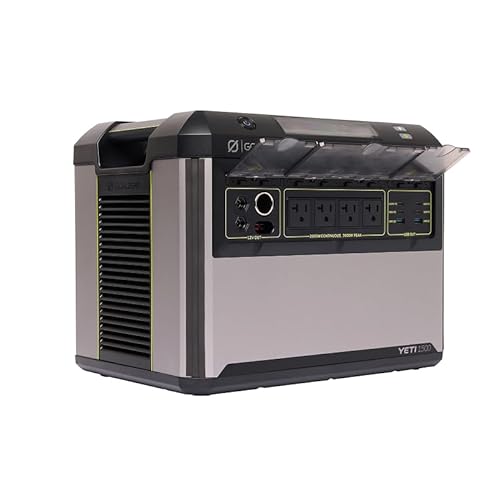
Goal Zero Yeti 1500 (6th Gen)
A fixed workshop bench where the unit stays put and runs corded tools with real motor starts, such as a table saw, a compressor or a bench grinder.
-
Best for a full shed workday you can still carry
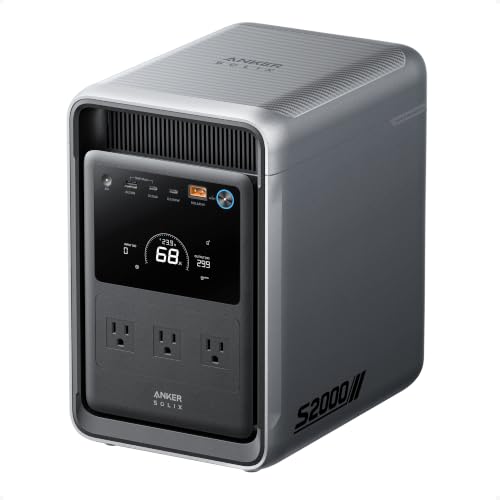
Anker SOLIX S2000
A detached shed or garage bay where you charge cordless packs, run lighting and benchtop tools, and carry the unit back to the house to recharge.
-
Best for a lunch-break turnaround

VTOMAN FlashSpeed 1500
A workshop used in two or three short sessions a day, where the unit can sit on a wall socket between them and be full again before you go back out.
-
Best for growing into a two-unit bench supply

Generac GB2000
A workshop that expects to add tools and is prepared to buy a second matching unit and the parallel kit rather than replace what it already owns.
How they compare
Scroll the table sideways to see every column.
| Product | Where to buy | Award | Capacity | AC output | Weight | AC recharge time | Rated cycle life | Battery chemistry | Best for |
|---|---|---|---|---|---|---|---|---|---|
| Goal Zero Yeti 1500 (6th Gen) | Best for surge-heavy corded tools | 1505Wh | 2000W (3600W surge) | 52.9 lb (24.0 kg) | Under 1 hour from 0% to 80% from the wall | 4,000 cycles | LiFePO4 | A fixed workshop bench where the unit stays put and runs corded tools with real motor starts, such as a table saw, a compressor or a bench grinder. | |
| Anker SOLIX S2000 | Best for a full shed workday you can still carry | 2010Wh | 1500W (3000W peak) | 35.7 lb (16.2 kg) | -- | 10,000 cycles | LFP | A detached shed or garage bay where you charge cordless packs, run lighting and benchtop tools, and carry the unit back to the house to recharge. | |
| VTOMAN FlashSpeed 1500 | Best for a lunch-break turnaround | 1548Wh | 1500W (3000W peak) | 41.5 lb (18.8 kg) | 1 hour to full on 1500W AC input, 45 minutes with AC, solar and DC combined | 3,000+ cycles to 80% | LiFePO4 | A workshop used in two or three short sessions a day, where the unit can sit on a wall socket between them and be full again before you go back out. | |
| Generac GB2000 | Best for growing into a two-unit bench supply | 2106Wh | 1600W (3200W peak) | 48.8 lb (22.1 kg) | 3.3 hours from 0% to 80% | 1,000 cycles to 80% | Lithium-ion NMC | A workshop that expects to add tools and is prepared to buy a second matching unit and the parallel kit rather than replace what it already owns. |
The full reviews
Best for surge-heavy corded tools
Goal Zero Yeti 1500 (6th Gen)
Goal Zero
The Yeti 1500 carries the highest continuous rating on this shortlist at 2000W, with a 3600W surge above it. That headroom is what lets a shop vac, a bench grinder and a 15A saw share the same battery without you rationing which one runs when. You pay for it in weight: 52.9 lb is a two-hand carry every time.
What we like about the Goal Zero Yeti 1500 (6th Gen)
- 2000W continuous is 500W above the two 1500W units here, which covers a 15A tool plate with margin rather than by a whisker
- The 3600W surge is the largest of the four, so an induction-motor compressor start has room before the inverter cuts out
- Four AC outlets let a saw, a vacuum and a charger stay plugged in at once without a power strip on the shed floor
- 4,000 rated cycles works out to roughly 16 years at one full charge per working day
Where it falls short for the Goal Zero Yeti 1500 (6th Gen)
- At 52.9 lb for 1505Wh it stores 28.4Wh per pound, the worst ratio of the four, so it is the heaviest unit here carrying the least energy
- No expansion battery is listed in the specifications, so 1505Wh is a hard ceiling and a longer shed session means a second unit rather than a bolt-on pack
- No maximum solar input is published, which makes it hard to plan a permanent panel feed for a shed with no mains supply
- The 1505Wh pack gives only about 50 minutes of continuous cutting at 1800W, so a full day of heavy ripping needs a mid-day recharge
Key specifications
- AC output
- 2000W (3600W surge)
- Capacity
- 1505Wh
- Weight
- 52.9 lb (24.0 kg)
- Rated cycle life
- 4,000 cycles
- AC recharge time
- Under 1 hour from 0% to 80% from the wall
- Ports
- 4 AC outlets, 6 USB outlets (including a 140W USB-C), 12V vehicle outlet, HPP output, 2 x 6mm outlets
Most shed buyers pick a unit on watt-hours and discover the problem at the inverter. The Yeti 1500 is the answer to that specific mistake.
The 2000W rating is the whole argument
A 15A corded tool is a 1,800W tool at 120V. That is the plate on most full-size circular saws and contractor table saws. Routers and shop vacuums usually draw less, often 8A to 12A, so read yours first. Against a 1500W continuous inverter you are 300W over the line the moment the blade loads up, and the unit protects itself by shutting down mid-cut.
At 2000W continuous the Yeti has about 200W of margin on that same tool. Not generous, but enough that a saw bogging in wet stock does not end the session. The 3600W surge above it is the largest peak rating of the four units here, which matters for an induction motor: a compressor or a small dust collector pulls several times its running draw for a fraction of a second at start-up, and that spike is what trips undersized inverters.
What 1505Wh buys at the bench
Run the arithmetic with a stated assumption: a saw is actually in the cut for about five per cent of a shop session, and draws roughly 1,800W while it is.
At that draw, 1505Wh divides into 50 minutes of continuous cutting. Spread across a five per cent duty cycle, that is a bench day of roughly 16 hours before the pack is empty, which is longer than anyone works. A shop vacuum is the harder load, because it runs constantly while it runs: at 1,000W the same pack gives an hour and a half of unbroken suction.
Neither figure is a weekend. If your shed session is one build, this covers it. If it is a whole Saturday of ripping sheet goods, plan on a top-up.
The weight problem, plainly
1505Wh in 52.9 lb is 28.4Wh per pound. The Anker SOLIX S2000 on this same list holds 2010Wh in 35.7 lb, which is 56.3Wh per pound, very nearly double. That is the trade you are making for the bigger inverter.
If the unit lives on a shelf beside the bench and never moves, the number is irrelevant. If it commutes between a garage and a house on a hand truck, it is the first thing you will notice and the reason to read the S2000 entry instead.
Who should skip it
Anyone whose heaviest load is a cordless-tool charger and a work light. That job does not need 2000W, and buying it here means carrying 52.9 lb for an inverter you will never load past a small fraction of its rating.
- Best for
- A fixed workshop bench where the unit stays put and runs corded tools with real motor starts, such as a table saw, a compressor or a bench grinder.
- Choose something else if
- You carry the unit between the house and the shed regularly, or you need a capacity path beyond 1505Wh without buying a whole second unit.
Best for a full shed workday you can still carry
Anker SOLIX S2000
Anker
The S2000 stores 2010Wh in 35.7 lb, which is the most energy per pound on this shortlist by a wide margin, and its 10,000-cycle rating means the pack will outlast the shed. The catch is the 1500W continuous inverter, which sits below the draw of a 15A corded saw.
What we like about the Anker SOLIX S2000
- 2010Wh in 35.7 lb works out to 56.3Wh per pound, nearly double the Goal Zero Yeti 1500 on the same list
- 10,000 rated cycles is roughly 40 years at one charge per working day, so daily shop cycling will not be what retires it
- Under 10ms UPS switchover means a shed freezer or a benchtop CNC controller rides through a grid dropout without restarting
- 400W of solar input supports a permanent panel on the shed roof rather than a temporary lead from the house
- The 8.19in footprint is the narrowest here, which matters on a crowded bench
Where it falls short for the Anker SOLIX S2000
- The 1500W continuous inverter is 500W below the Yeti 1500 and sits under the roughly 1800W a 15A circular saw draws in the cut, so a full-size saw is out of scope
- No 12V DC port at all, so a 12V shop light, a tyre inflator or a car-socket accessory needs an AC adapter and a second conversion loss
- No AC recharge time is published, which makes lunch-break turnaround impossible to plan for
- No expansion battery is listed in the specifications, so 2010Wh is a hard ceiling while the VTOMAN FlashSpeed 1500 reaches 3096Wh and a paired Generac GB2000 reaches 4212Wh
Key specifications
- Capacity
- 2010Wh
- AC output
- 1500W (3000W peak)
- Weight
- 35.7 lb (16.2 kg)
- Rated cycle life
- 10,000 cycles
- UPS switchover
- Under 10ms
- Max solar input
- 400W
The S2000 answers a question the rest of this shortlist ignores: what happens when the power station has to move.
Energy per pound is the shed specification
A home backup unit sits in a utility room and never travels. A shed unit gets carried out in the morning, carried back to a wall socket at night, or hauled across a garden path on a hand truck.
At 2010Wh and 35.7 lb, the S2000 stores 56.3Wh for every pound you lift. The Yeti 1500 on this same list manages 28.4Wh per pound, the Generac GB2000 43.2Wh and the VTOMAN FlashSpeed 1500 37.3Wh. Nothing else here is close, and the narrow 8.19in footprint means the space it takes on a bench is proportionate too.
What the capacity covers
Take a realistic shed workday as a stated assumption: an LED bar at 40W for six hours is 240Wh; a cordless charger averaging 100W for three hours is 300Wh; a sander or drill averaging 500W at a twenty per cent duty cycle over four hours is another 400Wh. That is roughly 940Wh.
2010Wh divides into a little over two of those days. If you work a shed two evenings a week, one charge covers the week.
Where the 1500W ceiling bites
This is the reason it is not the top pick. A 15A tool plate means about 1,800W at 120V, which is above the continuous rating. The 3000W peak figure covers the instant a motor spins up; it does not cover a saw held in a two-second rip. If a full-size circular saw or a contractor table saw is your main tool, the inverter will trip and you want the Yeti’s 2000W instead.
Benchtop tools are a different story. A router, a jigsaw, a scroll saw, a soldering station, a dust extractor on a small port and a charger bank all sit comfortably under 1500W.
The cycle life is the quiet win
10,000 cycles divided by roughly 250 working days is about 40 years. The Generac on this list is rated to 1,000 cycles, which is nearer four years at the same usage. In a shop that drains and refills a pack most days, that gap decides which unit you buy twice.
- Best for
- A detached shed or garage bay where you charge cordless packs, run lighting and benchtop tools, and carry the unit back to the house to recharge.
- Choose something else if
- Your main load is a full-size corded circular saw or table saw drawing near 15A, or you rely on 12V accessories that plug into a car socket.
Best for a lunch-break turnaround
VTOMAN FlashSpeed 1500
VTOMAN
The FlashSpeed 1500 refills 1548Wh to full in an hour on a 1500W AC input, which is the fastest complete turnaround here and roughly three times the Generac GB2000's charge rate. If your shed work is two sessions a day with a break in between, that specification is worth more than a bigger pack.
What we like about the VTOMAN FlashSpeed 1500
- One hour from empty to full, not to 80%, so a lunch break returns the whole 1548Wh rather than a partial charge
- Drops to 45 minutes when AC, solar and DC inputs run together, which suits a shed with a roof panel already fitted
- Expandable to 3096Wh with one extra battery, so the ceiling doubles without replacing the unit
- 12 ports including three AC outlets and a car port, enough to leave a charger, a light and a vacuum connected
Where it falls short for the VTOMAN FlashSpeed 1500
- The 1500W continuous inverter sits below the roughly 1800W a 15A corded circular saw draws in the cut, so full-size saw work will trip it
- Only three AC outlets, so a saw, a shop vac and a charger fill every socket and anything else needs a strip
- At 41.5 lb for 1548Wh it holds 37.3Wh per pound, well behind the Anker SOLIX S2000's 56.3Wh, so it is a heavier carry for less stored energy
- The one-hour charge needs a 1500W AC input, so on a shared 15A household circuit you cannot refill it at full rate and run a 1,000W shop vacuum at the same time
Key specifications
- AC recharge time
- 1 hour to full on 1500W AC input, 45 minutes with AC, solar and DC combined
- Capacity
- 1548Wh
- AC output
- 1500W (3000W peak)
- Expandable
- Yes, to 3096Wh with one extra battery
- Weight
- 41.5 lb (18.8 kg)
- Rated cycle life
- 3,000+ cycles to 80%
Recharge speed gets treated as a home backup concern. In a shed it is arguably more useful, because a workshop day has natural gaps built into it and a home outage does not.
Turn the charge claim into watt-hours per hour
Manufacturer charge figures are quoted on different bases, which makes them hard to compare. Convert them all to energy returned per hour and the picture is plain.
The FlashSpeed 1500 puts 1548Wh back in one hour, so about 1,548Wh per hour. The Generac GB2000 reaches 80 per cent in 3.3 hours; 80 per cent of 2106Wh is 1,685Wh, which is roughly 511Wh per hour. That is a threefold difference, and it is the reason this unit earns its place rather than the bigger pack.
In practice a 45-minute break returns most of the pack, assuming the rate holds. It usually will not hold exactly, because charge current tapers as cells fill, so treat three-quarters as the honest expectation rather than the full 1548Wh.
The expansion path matters more here than elsewhere
One extra battery takes the system to 3096Wh. A shed is the use case where that actually gets used: winter lighting, a small heater on a thermostat, a dehumidifier running unattended overnight. Those are steady low draws that eat watt-hours without ever troubling the inverter, and doubling capacity solves them directly.
Where it stops
The 1500W continuous rating is the same ceiling the Anker SOLIX S2000 has, and it lands in the same place: a 15A tool is about 1,800W at 120V, which is over the line. The 3000W peak figure covers a motor spinning up, not a blade held in a long rip. If a contractor saw is the centre of your shop, this is the wrong unit and the Goal Zero Yeti 1500’s 2000W rating is the reason to read that entry.
Three AC outlets is the other practical limit. It sounds like plenty until a charger, a light and a vacuum are already in and you want to plug in a router.
The carry test
1548Wh in 41.5 lb is 37.3Wh per pound. That is better than the Yeti’s 28.4 but well short of the S2000’s 56.3. If this unit lives in the shed and only the charging cable travels, that is fine. If you carry it in every night, you are lifting more for less.
- Best for
- A workshop used in two or three short sessions a day, where the unit can sit on a wall socket between them and be full again before you go back out.
- Choose something else if
- Your heaviest tool is a full-size corded saw near 15A, or the shed has no mains socket to exploit the fast charge with.
Best for growing into a two-unit bench supply
Generac GB2000
Generac
The GB2000 is the only unit here that can raise its own continuous ceiling: add a second unit and the 30A parallel kit and you get 4212Wh at 3200W, which is more than a single 20A shop circuit delivers. As a single unit it is the slowest to recharge and has by far the shortest rated cycle life on this shortlist.
What we like about the Generac GB2000
- Parallels to 3200W continuous and 4212Wh with a second unit and the optional 30A kit, the only expansion here that lifts output rather than just capacity
- 2106Wh is the largest single pack on this shortlist, giving roughly 2.2 shed workdays on one charge
- 468W of solar input is the highest here, which suits a shed roof array rather than a portable folding panel
- Ten outputs including a 120W car port and a Qi pad cover the small charging jobs without a strip on the bench
Where it falls short for the Generac GB2000
- Rated at 1,000 cycles to 80 per cent, which is about four years at one charge per working day against roughly 40 years for the Anker SOLIX S2000
- 3.3 hours to reach 80 per cent works out to about 511Wh returned per hour, a third of the VTOMAN FlashSpeed 1500's rate, so it cannot turn around over a break
- The commercial warranty is one year against three for residential use, which is the shorter term if the shed is a business workspace
- 1600W continuous is still under the roughly 1800W a 15A corded saw draws, so a single unit does not solve full-size saw work either
Key specifications
- Expandable
- Yes, to 4212Wh and 3200W continuous with a second unit and the optional 30A parallel kit
- Capacity
- 2106Wh
- AC output
- 1600W (3200W peak)
- AC recharge time
- 3.3 hours from 0% to 80%
- Rated cycle life
- 1,000 cycles to 80%
- Max solar input
- 468W
Every other unit on this list expands capacity. The GB2000 is the only one that expands output, and in a workshop those are different problems.
What 3200W actually unlocks
Adding watt-hours makes a session longer. It does not let you start a tool the inverter could not start before. The parallel kit changes that: two GB2000s on the 30A kit give 3200W continuous.
Put that in shop terms. 3200W at 120V is 26.7A. A 20A shop circuit at 120V is 2,400W at its absolute limit, and a continuous load on it is held to 80 per cent of that, or 1,920W. A paired GB2000 supplies more than the outlet you would have run to the shed in the first place. That is the only configuration here that reaches a contractor table saw and a dust collector running together.
It also means committing to a second unit. If you are not prepared to do that, the argument for this one largely evaporates, because a single GB2000 at 1600W continuous is still under the roughly 1,800W a 15A corded saw pulls in the cut.
The cycle life is the real cost
This is a lithium-ion NMC pack rated to 1,000 cycles at 80 per cent capacity. Divide by an assumed 250 working days a year and you get four years of near-daily cycling before the pack is meaningfully down.
The three LiFePO4 units on this shortlist sit at 3,000, 4,000 and 10,000 cycles, which is roughly 12, 16 and 40 years on the same assumption. If your shed sees weekend use only, say 50 cycles a year, 1,000 cycles is twenty years and this stops mattering. If it is a working shop, it matters more than any other number on the page.
Recharge is slow by this shortlist’s standards
3.3 hours to 80 per cent means 1,685Wh of the 2106Wh pack returned across those hours, about 511Wh per hour. The FlashSpeed 1500 manages roughly three times that rate. In a shed that is charged overnight, the difference is invisible. In one where you want it back before the afternoon, it is decisive.
Who it suits
The buyer who already knows the shop is going to grow, wants a single brand to scale with, and charges overnight from a mains socket. That is a narrower description than the other three entries here, and it should be.
- Best for
- A workshop that expects to add tools and is prepared to buy a second matching unit and the parallel kit rather than replace what it already owns.
- Choose something else if
- You cycle the battery most days of the week, or you need the pack full again within an hour of running it flat.
How we researched this guide
Four units rated 1500W or higher were compared on published manufacturer specifications, with tool draw estimated from standard nameplate amperage ratings. None were tested by us. Every runtime, per-pound and years-of-service figure on this page is arithmetic on rated specifications with the assumptions stated, and each review names the sources its judgement rests on.
The full process is on our how we test portable power stations page, including what counts as hands-on use.
- Units evaluated
- 4
- Used hands-on
- 0
- Assessed from documentation and owner reports
- 4
Evaluation methods used: specification comparison
Which one should you buy?
Match your situation on the left to the recommendation on the right.
-
Your heaviest tool is a full-size circular saw or contractor table saw near 15A
Recommendation: Buy the Goal Zero Yeti 1500, the only unit here rated 2000W continuous rather than 1500W or 1600W
-
You carry the unit between the house and the shed most days
Recommendation: Buy the Anker SOLIX S2000, which holds 2010Wh in 35.7 lb, about 56.3Wh per pound
-
You work the shed in short sessions with breaks between them
Recommendation: Buy the VTOMAN FlashSpeed 1500, which returns the whole 1548Wh in an hour rather than reaching 80 per cent
-
You expect the shop to grow and will buy a second matching unit later
Recommendation: Buy the Generac GB2000 and plan for the 30A parallel kit, which reaches 4212Wh at 3200W continuous
-
You drain and refill the battery most working days
Recommendation: Buy the Anker SOLIX S2000 at 10,000 rated cycles and skip the 1,000-cycle Generac GB2000
-
The shed has no mains socket and will be fed by a roof panel
Recommendation: Buy the Generac GB2000 for its 468W solar input, the highest on this shortlist
Mistakes buyers make
- Choosing on watt-hours and finding the inverter cannot hold a 15A tool through a cut, which is a shutdown mid-rip rather than a slow discharge
- Reading a 3000W or 3600W peak figure as if a tool can draw it for the length of a cut, when it describes a fraction of a second at motor start-up
- Ignoring rated cycle life on a unit that will be cycled almost daily, which is how a four-year pack gets compared against a forty-year one
- Buying a heavy unit for a shed you walk to, then leaving it in the garage because 52.9 lb is not a casual carry
- Leaving a LiFePO4 unit in an unheated shed through winter and finding it will not accept a charge until it warms up
- Sizing for the tool you own instead of the dust extractor you will add, then discovering only one unit on this shortlist raises its own output ceiling rather than just its capacity
Our final recommendation
If you want one answer rather than a shortlist, this is the unit that suits the widest range of readers in this category.
Best for surge-heavy corded tools
A fixed workshop bench where the unit stays put and runs corded tools with real motor starts, such as a table saw, a compressor or a bench grinder.
Questions buyers ask
Can a portable power station run a table saw?
A 10in contractor saw with a 15A motor draws about 1800W at 120V under load. Only the Goal Zero Yeti 1500, rated 2000W continuous, clears that with margin as a single unit. Two Generac GB2000s on the parallel kit reach 3200W and clear it comfortably. A benchtop saw with a smaller motor is a different question and any of these four will handle it.
Will one of these start an air compressor?
A compressor uses an induction motor, which pulls several times its running draw for a fraction of a second at start-up. That spike is what the peak rating covers, and the Yeti 1500's 3600W is the largest here. The running draw afterwards is much lower, so the start is the whole test. If your compressor plate lists a locked-rotor amperage, compare that figure to the peak rating rather than the continuous one.
How many hours of bench time does a charge actually give?
More than the runtime charts suggest, because tools are intermittent. Assume a saw is in the cut five per cent of a session at 1800W: 1505Wh then gives 50 minutes of actual cutting, spread across a bench day longer than anyone works. Continuous loads are the real limit. A 1000W shop vacuum empties the same pack in an hour and a half.
Can I leave one in an unheated shed over winter?
It will survive, but LiFePO4 packs refuse to charge below freezing to protect the cells, and all lithium chemistries deliver less capacity when cold. A unit stored in a cold shed may work fine once you have been out there a while with a heater on, and may refuse a charge first thing on a frosty morning. Bringing it indoors between sessions avoids the problem entirely.
Is a power station cheaper than running a circuit to the shed?
It depends on the trench. A buried feed to an outbuilding involves permits, an electrician, conduit and a subpanel, and the distance drives the cost. A power station has no installation and moves with you if you move. What it will never do is give you a permanent 20A outlet, so if the shed is becoming a full workshop the wired circuit is still the endpoint.
About the author