Portable Power Stations for a Microwave: 4 Compared on Cooking Minutes

Off-grid power editor
Published
Updated
Last fact-checked
This guide is for anyone who has pressed start on a microwave and watched a power station shut down instead. The cause is almost always the same: the wattage printed on the appliance is cooking output, not the draw at the plug, and the real figure is roughly 70% higher. We compared four units on the one specification that decides this, the continuous inverter rating, and then converted each pack into minutes of magnetron time so the second question has an answer too. We did not cook anything on these units, and every review states exactly what its recommendation rests on. What you get here is the sizing arithmetic, a clear split between compact and full-size microwaves, and the reason surge and boost ratings should play no part in this decision.
What is the best portable power station for a microwave?
The OUPES Mega 1 suits most buyers. Its 2000W continuous inverter clears a full-size microwave drawing around 1,700W with real margin, and it does it in a 27.8 lb case. If the microwave has to share the unit with a refrigerator, the BLUETTI Elite 200 V2 and its 2600W rating is the only pick here with room for both.
Key takeaways
- A microwave labelled 1,000W draws roughly 1,700W at the outlet, because the label describes cooking output rather than input
- The continuous inverter rating decides whether the appliance runs at all; surge and boost figures do not apply to a cycle that lasts minutes
- A 1kWh pack holds about 32 minutes of full-size microwave time, or roughly 16 two-minute reheats
- Choosing a lower power level cycles the magnetron on and off rather than reducing the draw, so the inverter still sees the full load
- A compact 700W-output microwave needs about 1,200W, which changes which half of this shortlist applies to you
Our picks at a glance
Every unit below wins a specific situation rather than a place in a ranking. Pick the row that matches how you will actually use it.
-
Best for a full-size microwave you can still carry

OUPES Mega 1
Someone who wants a standard 1,000W countertop or over-range microwave to work during an outage, in a case light enough to carry to a tailgate or an RV as well.
-
Best for microwaving through a rolling outage

EcoFlow DELTA 3 Plus
Households on rotating or storm-season outages who want the kitchen microwave to keep working without anyone having to run out and plug something in.
-
Best for running the microwave and the fridge together

BLUETTI Elite 200 V2
A kitchen that needs the microwave and the refrigerator alive at the same time, in a house where the unit can sit in one place for the length of an outage.
-
Best for a compact 700W countertop microwave
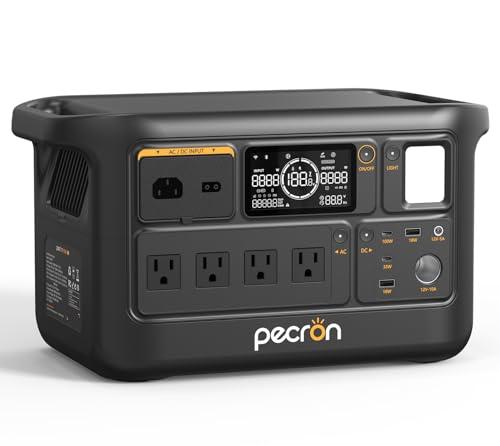
Pecron F1000LFP
A 700W-output compact microwave in a dorm, office, van, RV or workshop, where the unit has to be carried in one hand and stowed in a cupboard.
How they compare
Scroll the table sideways to see every column.
| Product | Where to buy | Award | AC output | Capacity | Weight | AC recharge time | UPS switchover | Rated cycle life | Best for |
|---|---|---|---|---|---|---|---|---|---|
| OUPES Mega 1 | Best for a full-size microwave you can still carry | 2000W (4500W surge) | 1024Wh | 27.8 lb (12.6 kg) | 36 minutes to 80% on AC, 26 minutes with AC and solar together | Under 20ms | 3,500+ cycles to 80% | Someone who wants a standard 1,000W countertop or over-range microwave to work during an outage, in a case light enough to carry to a tailgate or an RV as well. | |
| EcoFlow DELTA 3 Plus | Best for microwaving through a rolling outage | 1800W | 1024Wh | 27 lb (12.2 kg) | 40 minutes to 80% on 1500W AC input | 10ms | 4,000 cycles to 80% | Households on rotating or storm-season outages who want the kitchen microwave to keep working without anyone having to run out and plug something in. | |
| BLUETTI Elite 200 V2 | Best for running the microwave and the fridge together | 2600W continuous (3900W Power Lifting) | 2073.6Wh | 53.35 lb (24.2 kg) | 0-80% in 1 hour on Turbo mode (1800W AC), full in 1.6 hours on Standard mode | -- | Over 6,000 cycles | A kitchen that needs the microwave and the refrigerator alive at the same time, in a house where the unit can sit in one place for the length of an outage. | |
| Pecron F1000LFP | Best for a compact 700W countertop microwave | 1500W pure sine wave | 960Wh | 23.9 lb (10.8 kg) | 50 minutes to 80%, 70 minutes to full at 1000W AC | Within 20ms | -- | A 700W-output compact microwave in a dorm, office, van, RV or workshop, where the unit has to be carried in one hand and stowed in a cupboard. |
The full reviews
Best for a full-size microwave you can still carry
OUPES Mega 1
OUPES
A 1,000W-output countertop microwave asks its outlet for roughly 1,700W and holds it for the whole cycle. The Mega 1 answers with 2000W continuous inside a 27.8 lb case, which is the only combination here that clears a full-size unit without turning into something you slide rather than lift. Capacity is where it gives ground.
What we like about the OUPES Mega 1
- 2000W continuous leaves roughly 300W of margin above a 1,700W full-size microwave, so the cycle finishes instead of tripping halfway
- 72 inverter watts per pound (2000W over 27.8 lb) is the best power-to-weight ratio on this shortlist
- 36 minutes to 80% returns about 26 minutes of cooking, so a short grid window between meals is worth plugging in for
- 3,500+ cycles to 80% on LiFePO4 means daily reheating for years without meaningfully consuming the pack
- Under 20ms switchover lets it sit inline so the microwave clock never resets
Where it falls short for the OUPES Mega 1
- 1024Wh is the smallest pack paired with the largest inverter here, and at 1,700W it works out at roughly 32 minutes of cooking, so this is a reheating unit rather than one you cook a full meal on
- Everything above 2000W comes from a 4500W momentary surge rating, which does nothing for a load that holds its draw for two minutes, so a fridge compressor starting mid-cycle can put you over the continuous limit
- No maximum solar input is published, so the only recharge figure you can plan around is 36 minutes from a wall socket, which is the one thing an outage takes away
- Expanding beyond 1024Wh means adding B2 batteries, and the 5120Wh maximum takes two of them, so more cooking time becomes several boxes to move and store rather than one larger unit
Key specifications
- AC output
- 2000W (4500W surge)
- Capacity
- 1024Wh
- Weight
- 27.8 lb (12.6 kg)
- AC recharge time
- 36 minutes to 80% on AC, 26 minutes with AC and solar together
- UPS switchover
- Under 20ms
- Rated cycle life
- 3,500+ cycles to 80%
Most people who search for this have already tried a 1000W power station and watched it shut down. The reason is a labelling convention nobody explains at the point of sale.
The number on the door is not the number at the plug
A microwave sold as 1,000W is describing cooking output. Converting mains power into microwave energy is roughly 60 to 65% efficient, so the same appliance draws somewhere near 1,500 to 1,700W from the outlet. A 1,100W over-range unit lands higher again.
That single conversion is why 2000W continuous matters more here than any other figure on the spec sheet. Against a 1,700W assumption the Mega 1 keeps about 300W in hand. The 1800W units on this page keep about 100W. Neither number is dramatic in isolation; the difference between them is the difference between a finished cycle and a shutdown.
What the surge rating does and does not buy
The 4500W surge figure is real, and it is irrelevant to this job.
Surge ratings cover milliseconds. A microwave holds its draw for the entire cook time, so the inverter never gets to fall back to a lower number. Treat 2000W as the ceiling, and treat anything that shares the unit during a cycle as coming out of that 300W of margin. A fridge compressor kicking in while the microwave runs will eat most of it.
Thirty-two minutes, and why that is the honest figure
Take the 1024Wh rating, allow around 10% for inverter losses, and roughly 920Wh reaches the appliance. Divide by 1,700W and you get 0.54 hours, or about 32 minutes of magnetron time.
Framed the way people actually cook, a two-minute reheat consumes about 57Wh, so a full charge is around 16 reheats. That is a weekend of leftovers for two people, or one evening for a household treating the microwave as the kitchen.
Refilling between meals
The 36-minute recharge to 80% is the specification that partly rescues the small pack. Eighty percent of 1024Wh is 819Wh, or roughly 737Wh after losses, which buys back about 26 minutes of cooking. Thirty-six minutes is the shortest grid window any unit on this page needs to be worth plugging into, though the BLUETTI returns more cooking per minute on the wall because its pack is twice the size.
If your outages come in blocks with grid windows between them, that changes the maths considerably. If the power is simply gone for two days, it does not, and the BLUETTI Elite 200 V2 further down the page is the better answer.
Who should look elsewhere
Anyone whose microwave is a compact 700W model does not need 2000W and should not carry the weight or complexity for it. Anyone who wants the microwave running alongside a refrigerator needs continuous headroom this unit does not have.
- Best for
- Someone who wants a standard 1,000W countertop or over-range microwave to work during an outage, in a case light enough to carry to a tailgate or an RV as well.
- Choose something else if
- You expect to cook rather than reheat, because 1024Wh caps you at roughly half an hour of magnetron time before the pack is empty.
Best for microwaving through a rolling outage
EcoFlow DELTA 3 Plus
EcoFlow
Where rotating cuts drop the grid for an hour and hand it back for two, this is the unit to wire between the wall and the countertop and leave there. A 10ms changeover keeps a cycle running when the lights go, and a 40-minute refill uses the on-periods properly. The trade-off is that 1800W is a tighter fit over a full-size microwave than the number suggests.
What we like about the EcoFlow DELTA 3 Plus
- 10ms switchover is fast enough that a cycle in progress continues and the clock on the microwave does not reset
- 1800W continuous clears a standard 1,000W-output microwave drawing around 1,700W
- 40 minutes to 80% at 1500W input returns roughly 26 minutes of cooking for every grid window you catch
- 4,000 cycles to 80% is the highest cycle rating among the 1kWh-class units here, which suits a unit left permanently inline
- 27 lb for 1800W works out at 67 inverter watts per pound, so it lives on a counter rather than a trolley
Where it falls short for the EcoFlow DELTA 3 Plus
- 1800W over a 1,700W full-size microwave leaves only about 100W of margin, so an 1,100W-output over-range model or an older transformer microwave can sit at or above the limit
- No surge or peak figure is published for the AC output, so there is no stated allowance for the inrush when the magnetron transformer energises at the start of a cycle
- The 40-minute recharge depends on a 1500W AC input, which on a 15A household circuit leaves almost nothing spare, so charging fast and cooking at the same time needs two circuits
- Getting past 1024Wh means adding a DELTA 3, DELTA Pro 3 or DELTA 2 Max pack, so extending cooking time effectively means buying a second power station
Key specifications
- AC output
- 1800W
- Capacity
- 1024Wh
- UPS switchover
- 10ms
- AC recharge time
- 40 minutes to 80% on 1500W AC input
- Weight
- 27 lb (12.2 kg)
- Rated cycle life
- 4,000 cycles to 80%
The interesting thing about this unit is not the inverter. It is what happens in the ten milliseconds after the grid disappears.
Why switchover matters for a microwave specifically
Most appliances do not care about a brief gap. A microwave does two things when power blinks: it abandons whatever cycle was running, and it resets its clock and settings so the next attempt starts from scratch.
At 10ms, the DELTA 3 Plus takes over faster than the appliance can notice. In practice that means the plate keeps turning through the cut, and nobody has to work out how long the food had left. Left inline permanently, this is the closest thing on the page to the microwave simply not being affected by outages.
The margin problem, stated plainly
A microwave labelled 1,000W is quoting cooking output. Draw at the outlet is nearer 1,700W once conversion losses are counted. Against 1800W continuous, that leaves about 100W.
One hundred watts is enough for a standard countertop microwave and not much else. It is not enough for an 1,100W-output over-range model, and it is not a buffer that absorbs a second appliance on the same outlet. Anyone who cannot find the input rating on their microwave’s nameplate should treat the OUPES Mega 1 and its 2000W as the safer purchase.
What the recharge speed is really for
Forty minutes to 80% is 819Wh returned, or around 737Wh after inverter losses, which is roughly 26 minutes of cooking. On a rotating-outage schedule where power comes back for a couple of hours at a time, that is more cooking than most households will use before the next cut.
The catch is the 1500W input the figure depends on. A standard 15A kitchen circuit supplies about 1,800W total. Drawing 1,500W to charge while a 1,700W microwave runs is not something a single circuit will do, so plan on charging between meals rather than during one.
Where the pack runs out
1024Wh at 1,700W is roughly 32 minutes of magnetron time, or about 16 two-minute reheats. Expansion is possible up to 5kWh, but only by adding another EcoFlow battery pack, which is a considerably larger commitment than a spare battery.
For hours-long cuts this is a comfortable unit. For a multi-day outage where the microwave is the only cooking appliance, the 2073.6Wh BLUETTI further down the page does the job with far less rationing.
- Best for
- Households on rotating or storm-season outages who want the kitchen microwave to keep working without anyone having to run out and plug something in.
- Choose something else if
- Your microwave is an 1,100W-output over-range unit or an older transformer model, because 100W of margin is not enough to absorb a nameplate you have not checked.
Best for running the microwave and the fridge together
BLUETTI Elite 200 V2
BLUETTI
Every other unit on this page assumes the microwave gets the battery to itself. This one does not have to. 2600W continuous leaves roughly 900W above a full-size microwave, which is room for a refrigerator to run and to restart mid-cycle, and 2073.6Wh doubles the cooking time. You pay for that in a 53.35 lb case that stays where you put it.
What we like about the BLUETTI Elite 200 V2
- 2600W continuous leaves about 900W above a 1,700W microwave, enough for a refrigerator to keep running and to restart its compressor mid-cycle
- 2073.6Wh works out at roughly 66 minutes of magnetron time, about double the 1kWh units here
- Over 6,000 cycles is the longest-lived pack on this shortlist, which suits a unit that runs a kitchen daily rather than twice a year
- 0 to 80% in 1 hour on Turbo mode returns around 53 minutes of cooking from a single grid window
- A full charge in 2.4 hours from 1000W of panels means multi-day outages can keep producing hot meals
Where it falls short for the BLUETTI Elite 200 V2
- At 53.35 lb it is more than twice the weight of the Pecron and a two-handed lift, so it stops being a unit you take to a tailgate or move between rooms during a cut
- No UPS switchover time is published, so unlike the DELTA 3 Plus it cannot be relied on to carry a cycle in progress through the moment the grid drops
- The 3900W Power Lifting figure reaches its number by lowering output voltage, which stretches cook times on a magnetron rather than adding usable headroom, so only the 2600W continuous rating should be used for sizing
- The specification publishes no port list or AC outlet count, and this unit is bought precisely to run two appliances at once, so there is no way to confirm before it arrives that the microwave and the refrigerator each get their own socket
Key specifications
- AC output
- 2600W continuous (3900W Power Lifting)
- Capacity
- 2073.6Wh
- Weight
- 53.35 lb (24.2 kg)
- AC recharge time
- 0-80% in 1 hour on Turbo mode (1800W AC), full in 1.6 hours on Standard mode
- Rated cycle life
- Over 6,000 cycles
- Solar input
- Full charge in 2.4 hours with 1000W panels
The question this unit answers is not “will it run my microwave”. It is “what happens when the fridge decides to start halfway through my cycle”.
Two appliances, one inverter
A full-size microwave asks for about 1,700W at the outlet. A refrigerator averages somewhere near 150W across its duty cycle but pulls several times that for a fraction of a second when the compressor kicks in.
Add those and a 1800W inverter is already over. Even 2000W is only comfortable while the compressor happens to be resting. At 2600W continuous there is roughly 900W of genuine margin, which covers the fridge running and gives the start a plausible chance without the microwave being interrupted.
That is a narrow-sounding advantage until you have had a fridge trip a power station mid-meal and then had to work out which appliance to sacrifice.
Ignore the Power Lifting number
BLUETTI publishes 3900W alongside the 2600W continuous rating. Power Lifting reaches its figure by reducing output voltage so current stays inside limits.
For a kettle or a heater that is a fair trade: less voltage, slower boil. For a microwave it is a poor one. The magnetron is fed by a transformer, so lower voltage means a longer cycle and, on some appliances, a refusal to run properly at all. Size against 2600W and treat everything above it as a safety net rather than capability.
Sixty-six minutes, and what that unlocks
Allowing about 10% for inverter losses, 2073.6Wh delivers roughly 1,866Wh to the appliance. Divided by 1,700W that is 1.1 hours, or about 66 minutes of magnetron time. Counted in two-minute reheats it is close to 33.
That crosses a useful line. Thirty minutes is reheating leftovers. Sixty-six minutes is a household of four eating hot food for two days, with the fridge still cold, which is exactly the scenario the 1kWh units on this page cannot cover.
The weight is the honest cost
53.35 lb is not portable in any everyday sense. It is 29 lb heavier than the Pecron for a little over twice the capacity, and it works out at only 48.7 inverter watts per pound against the Mega 1’s 72.
If the unit will live on a kitchen floor or in a utility room and stay there, that is a fair exchange. If it needs to go in a car boot every few weekends, it is the wrong unit and the weight will decide that for you within a month.
- Best for
- A kitchen that needs the microwave and the refrigerator alive at the same time, in a house where the unit can sit in one place for the length of an outage.
- Choose something else if
- You want something one person carries out to a truck or an RV, because 53.35 lb is a deliberate two-handed lift and the case has no wheels.
Best for a compact 700W countertop microwave
Pecron F1000LFP
Pecron
Dorm rooms, offices, vans and RVs mostly hold a small 700W-output microwave that asks for around 1,200W, not the 1,700W a kitchen unit demands. Sized against that appliance the F1000LFP is generous rather than marginal, and at 23.9 lb it is the only pick here one hand will carry. Buy it for the small microwave, not in the hope it stretches to a big one.
What we like about the Pecron F1000LFP
- 1500W pure sine wave leaves roughly 300W above a 700W-output compact microwave drawing about 1,200W, which is real margin rather than a squeeze
- 40.2 watt-hours per pound (960Wh over 23.9 lb) is the best capacity-to-weight ratio on this page and a genuine one-hand carry
- A 15.0 x 8.5 x 8.4 in case fits in the cupboard under an office or dorm microwave instead of taking floor space
- 600W of solar input against a 960Wh pack refills it more than twice over in a good day of sun
- Within 20ms switchover, so a compact microwave left plugged into it keeps its settings when the grid drops
Where it falls short for the Pecron F1000LFP
- 1500W will not run a full-size 1,000W-output microwave drawing around 1,700W, so this only works if you have read your appliance nameplate and confirmed it is a compact model
- No surge or peak figure is published anywhere in the specification, so there is no stated allowance for the inrush as a transformer microwave energises and no way to check it before buying
- 960Wh is the smallest pack here, and about 21 two-minute reheats is the ceiling before it needs the wall or the sun
- No cycle life is published, which is precisely the number that decides whether a unit survives being used for lunch every working day
- The 2+3 year warranty is conditional in structure rather than the flat five years OUPES and EcoFlow publish
Key specifications
- AC output
- 1500W pure sine wave
- Capacity
- 960Wh
- Weight
- 23.9 lb (10.8 kg)
- Max solar input
- 600W
- AC recharge time
- 50 minutes to 80%, 70 minutes to full at 1000W AC
- UPS switchover
- Within 20ms
The two units above this one are sized for a kitchen. This one is sized for the microwave that sits on a filing cabinet, in a van cupboard or on a dorm shelf, and that appliance is a different electrical problem.
A 700W microwave is not a small version of a 1000W one
The relationship between the number on the door and the draw at the plug holds either way: cooking output is roughly 60 to 65% of input. A 700W-output compact therefore asks for somewhere near 1,000 to 1,200W.
Against 1500W continuous that is 300W or more of margin, which is a healthier ratio than the 1800W units on this page manage over a full-size microwave. Sized for the appliance it is actually meant for, the smallest inverter here is not the most stretched one on the page.
What 960Wh buys in that scenario
Take 960Wh, allow about 10% for inverter losses, and roughly 864Wh reaches the appliance. At 1,200W that is 0.72 hours, or about 43 minutes of cooking. A two-minute reheat consumes about 40Wh, so a full pack is close to 21 of them.
Twenty-one reheats is about four working weeks of lunches for one person. Put the same 960Wh behind a full-size microwave and it collapses to about 30 minutes, which is part of why the appliance and not the battery should lead this decision.
The missing number, again
The specification states 1500W pure sine wave continuous and stops. The OUPES Mega 1 publishes 4500W surge, BLUETTI publishes 3900W Power Lifting, and this one publishes nothing.
For a compact microwave the inrush is modest and unlikely to matter. It is still an unknown, and the sensible response is to keep the appliance small and the margin visible rather than to hope. If your microwave’s nameplate says anything above 1,300W input, this is the wrong unit.
Weight and solar are the reasons to choose it
23.9 lb and a 15.0 x 8.5 x 8.4 in footprint mean this goes in a van cupboard or a desk drawer space, which none of the other three do. 40.2 watt-hours per pound is the best ratio on the page.
The 600W solar input then does something disproportionate. Assume five usable sun hours at 70% of rating and that is roughly 2.1kWh in a day against a 960Wh pack, so a small folding array keeps a compact microwave in service indefinitely. For off-grid lunch duty that matters more than any capacity figure.
- Best for
- A 700W-output compact microwave in a dorm, office, van, RV or workshop, where the unit has to be carried in one hand and stowed in a cupboard.
- Choose something else if
- Your microwave is a full-size kitchen model, because 1500W is roughly 200W short of what one of those pulls and no surge figure is published to argue otherwise.
How we researched this guide
Four units were compared using published manufacturer specifications and typical microwave nameplate input ratings. None of them were tested by us and nothing was cooked on any of them. Every cooking-minute figure on this page is our own arithmetic from rated capacity, and each review states which sources it relies on.
The full process is on our how we test portable power stations page, including what counts as hands-on use.
- Units evaluated
- 4
- Used hands-on
- 0
- Assessed from documentation and owner reports
- 4
Evaluation methods used: specification comparison
Which one should you buy?
Match your situation on the left to the recommendation on the right.
-
You have a standard full-size countertop microwave
Recommendation: Buy the OUPES Mega 1 for its 2000W continuous rating in a 27.8 lb case
-
You want the microwave and the refrigerator running at the same time
Recommendation: Buy the BLUETTI Elite 200 V2, the only unit here with roughly 900W of headroom above a microwave
-
Your grid drops and returns on a rotating schedule
Recommendation: Buy the EcoFlow DELTA 3 Plus, whose 10ms switchover keeps a cycle running through the cut
-
Your microwave is a compact 700W-output model in a dorm, office or van
Recommendation: Buy the Pecron F1000LFP and save 29 lb over the BLUETTI you do not need
-
You need more than an hour of cooking without grid power
Recommendation: Buy the BLUETTI Elite 200 V2 and pair it with panels, because no 1kWh unit here reaches that
Mistakes buyers make
- Sizing the power station against the wattage printed on the microwave door instead of the input figure on its nameplate
- Counting a surge or boost rating as headroom, when a microwave holds its draw for the entire cycle rather than milliseconds
- Assuming a lower power level lowers the load, when it actually switches the magnetron on and off at full draw
- Buying capacity to fix a problem caused by the inverter, so the unit still shuts down but takes longer to discharge
- Plugging a microwave and a refrigerator into the same unit without checking the compressor start fits inside the remaining margin
- Planning to charge the power station at full speed on the same kitchen circuit the microwave is running on
Our final recommendation
If you want one answer rather than a shortlist, this is the unit that suits the widest range of readers in this category.
Best for a full-size microwave you can still carry
Someone who wants a standard 1,000W countertop or over-range microwave to work during an outage, in a case light enough to carry to a tailgate or an RV as well.
Questions buyers ask
Does a microwave need a pure sine wave inverter?
Yes, and every unit on this page provides one. A microwave is fed through a transformer or a switching supply rather than a simple resistive element, and modified sine output can cause buzzing, longer cook times and heat in the transformer. This is not a specification worth economising on.
My microwave says 1,000 watts. Where do I find what it actually draws?
Look for the rating plate, usually a sticker on the back panel or inside the door frame. It lists input in watts or amps. If it gives amps, multiply by 120 to get watts. That is the number to size against, and it is the only one the manufacturer stands behind electrically.
Do inverter microwaves draw less power than conventional ones?
Not at full power. An inverter model varies magnetron output smoothly instead of switching it on and off, so it is gentler on a power station at reduced settings and cooks more evenly. At 100% the peak draw is broadly the same, so size for full power either way.
Can I run a microwave straight from solar panels without a battery?
No. Panels deliver whatever the sun allows at that moment, and a microwave demands its full load instantly and holds it. The battery is what turns variable panel output into a stable supply, so solar extends how often you can cook rather than replacing the pack.
Would a smaller microwave be a better fix than a bigger power station?
Often, yes. Dropping from a full-size unit to a 700W-output compact takes the load from roughly 1,700W to about 1,200W, which brings the whole 1500W class into play and adds around 40% more cooking minutes from the same battery. For van, RV and office use it is usually the more sensible change.
About the author