Crockpot on Battery: 4 Power Stations Compared on Cooking Hours
Off-grid power editor
Published
Updated
Last fact-checked

This guide is for anyone who wants a slow cooker to work somewhere without a wall socket, whether that is a tailgate, a potluck hall, a campsite or an outage. Crockpots are unusual among appliances because they are almost boringly predictable: a resistive heating element, no motor, no inrush current, and a thermostat that cycles once the pot is up to temperature. That makes the inverter rating nearly irrelevant and turns the whole decision into stored watt-hours against hours of cooking. We compared four units on capacity, weight, recharge speed and cycle life, and converted each one into hours on a 6-quart cooker rather than quoting a runtime chart. We did not cook on any of them, and every review states exactly what its recommendation rests on.
What is the best portable power station for a crockpot?
The Anker SOLIX S2000 suits most people. Its 2010Wh covers a full eight-hour low-setting recipe with roughly seven hours unused, it carries 56Wh per pound so a two-kilowatt-hour pack is still a one-person lift, and its 10,000-cycle rating means regular cooking barely touches it. If you are only keeping a small dip pot warm, the 12.6 lb Jackery Explorer 500 v2 is a far more sensible carry.
Key takeaways
- A slow cooker is resistive with no start-up surge, so inverter rating almost never decides this purchase
- The nameplate wattage on the base overstates real draw, because the thermostat cycles the element once the pot is hot
- A 6-quart cooker on low averages around 120W, so an eight-hour recipe costs roughly 1kWh plus conversion loss
- An eight-hour low cook needs roughly 1000Wh from the pack, so smaller units stop before the food is done
- Cycle life matters here because a full cook is close to a full discharge on smaller packs
Our picks at a glance
Every unit below wins a specific situation rather than a place in a ranking. Pick the row that matches how you will actually use it.
-
Best for a full eight-hour low cook
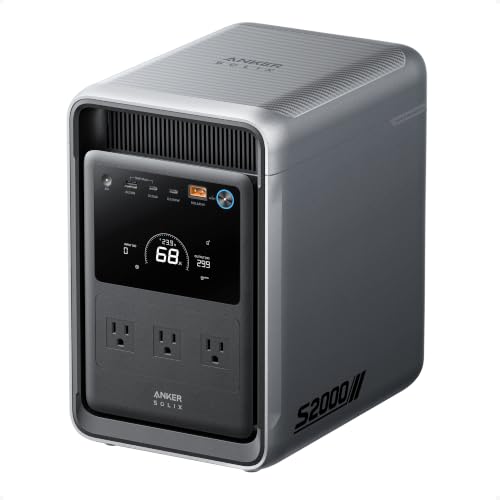
Anker SOLIX S2000
Anyone who wants one battery that finishes a whole slow-cooker recipe away from a socket and can still be carried to the car by one person.
-
Best for a buffet table of several cookers

Generac GB2000
Potlucks, church halls and tailgates where several slow cookers and warming trays have to share one battery for a few hours.
-
Best for cooking on consecutive days

VTOMAN FlashSpeed 1500
Weekend cooks and campers who run the slow cooker two or three days in a row and have a wall socket or a vehicle available between sessions.
-
Best for a small dip cooker

Jackery Explorer 500 v2
Small dip pots, warming trays and party crocks carried to a tailgate, a desk or a potluck table where the food is already cooked.
How they compare
Scroll the table sideways to see every column.
| Product | Where to buy | Award | Capacity | AC output | Weight | AC recharge time | Rated cycle life | Battery chemistry | Best for |
|---|---|---|---|---|---|---|---|---|---|
| Anker SOLIX S2000 | Best for a full eight-hour low cook | 2010Wh | 1500W (3000W peak) | 35.7 lb (16.2 kg) | -- | 10,000 cycles | LFP | Anyone who wants one battery that finishes a whole slow-cooker recipe away from a socket and can still be carried to the car by one person. | |
| Generac GB2000 | Best for a buffet table of several cookers | 2106Wh | 1600W (3200W peak) | 48.8 lb (22.1 kg) | 3.3 hours from 0% to 80% | 1,000 cycles to 80% | Lithium-ion NMC | Potlucks, church halls and tailgates where several slow cookers and warming trays have to share one battery for a few hours. | |
| VTOMAN FlashSpeed 1500 | Best for cooking on consecutive days | 1548Wh | 1500W (3000W peak) | 41.5 lb (18.8 kg) | 1 hour to full on 1500W AC input, 45 minutes with AC, solar and DC combined | 3,000+ cycles to 80% | LiFePO4 | Weekend cooks and campers who run the slow cooker two or three days in a row and have a wall socket or a vehicle available between sessions. | |
| Jackery Explorer 500 v2 | Best for a small dip cooker | 512Wh | 500W (1000W surge) | 12.6 lb (5.7 kg) | 52 minutes to 80% | 6,000 charge cycles | LiFePO4 | Small dip pots, warming trays and party crocks carried to a tailgate, a desk or a potluck table where the food is already cooked. |
The full reviews
Best for a full eight-hour low cook
Anker SOLIX S2000
Anker
The S2000 stores 2010Wh in 35.7 lb, which is the best capacity-per-pound figure on this shortlist and enough to carry a 6-quart cooker through a whole low-setting recipe with hours in hand. The catch is planning the refill: Anker publishes no AC recharge time for it, and the solar ceiling is 400W.
What we like about the Anker SOLIX S2000
- 2010Wh covers a full eight-hour low-setting recipe with roughly seven hours still unused
- 56Wh per pound at 35.7 lb, so a two-kilowatt-hour pack is still a one-person carry
- Rated 10,000 cycles, ten times the Generac GB2000, and a slow cook uses well under one cycle
- Under 10ms UPS switchover means a wall-powered cook continues uninterrupted if the grid drops
Where it falls short for the Anker SOLIX S2000
- Anker publishes no AC recharge time for the S2000, so unlike every other unit here you cannot plan a same-day turnaround around a stated figure
- The 400W solar ceiling means refilling 2010Wh needs about five hours of full-output sun, which no real day delivers, so daytime panel top-ups will not keep pace with repeated cooking
- The port list has no 12V DC output, so a 12V cooler or car-style food warmer cannot share the unit with the crockpot
- 1500W continuous matches the FlashSpeed and sits below the GB2000's 1600W, so a 250W cooker joined by a warming tray and a kettle reaches the ceiling here sooner than on the Generac
Key specifications
- Capacity
- 2010Wh
- AC output
- 1500W (3000W peak)
- Weight
- 35.7 lb (16.2 kg)
- Rated cycle life
- 10,000 cycles
- Max solar input
- 400W
- UPS switchover
- Under 10ms
A slow cooker is the easiest load in the house to size and the hardest one to finish. It never surges, it never trips anything, and it simply keeps drawing for eight hours. That turns the purchase into a capacity question, and the S2000 answers it better per pound than anything else here.
The arithmetic that decides it
Take a common 6-quart cooker rated 250W on its base. The element draws that figure whenever it is on, but once the pot reaches temperature the thermostat switches it on and off, so the average across a long cook on low lands near half the nameplate, around 120W. Add about 10% for inverter conversion loss and the pack sees roughly 130W.
At 2010Wh that gives about 15 hours. An eight-hour recipe therefore uses a little over half the battery. Run the cooker on high instead, at a nameplate 250W and an averaged 200W, and the pack sees about 220W, which is still around nine hours.
Both numbers mean the same thing: you are not watching the battery during the cook. That is the whole point of buying at this capacity.
Why it beats the larger Generac here
The GB2000 holds 2106Wh, 96Wh more. At 130W that difference is 44 minutes of cooking. Against those 44 minutes the S2000 is 13.1 lb lighter and rated 10,000 cycles rather than 1,000.
Cycle life matters more in this job than in most. A full low-setting cook takes roughly 1kWh, so on the S2000 that is about half a cycle. Cooking twice a week for a decade barely registers against a five-figure cycle rating. On a 1,000-cycle pack the same habit is a measurable fraction of the unit’s life.
Where it frustrates
The refill. Anker gives no AC recharge time in the published specification, so there is no figure to schedule around, and the 400W solar ceiling is the lowest of the large units here. Refilling 2010Wh through panels needs about five hours at full rated output, and panels rarely hold full output for even an hour.
If your pattern is one cook, then a wall socket overnight, this is irrelevant. If your pattern is a campsite where you cook every day on sun alone, it is the reason to look elsewhere.
Who should skip it
Anyone running a 12V cooler alongside the cooker, because there is no 12V DC port on the panel. And anyone setting up several warmers at once, since 1500W continuous matches the FlashSpeed and gives up 100W of headroom to the GB2000’s 1600W.
- Best for
- Anyone who wants one battery that finishes a whole slow-cooker recipe away from a socket and can still be carried to the car by one person.
- Choose something else if
- You need to cook again the same day and have only panels to recharge with, or you want a published wall-charging time you can schedule around.
Best for a buffet table of several cookers
Generac GB2000
Generac
With 2106Wh behind a 1600W inverter and ten outputs, the GB2000 is the unit to pick when the job is three or four warmers on one table rather than a single pot. Its weak point is the pack itself: lithium-ion NMC rated 1,000 cycles, where the rest of this shortlist uses LiFePO4 rated three to ten times higher.
What we like about the Generac GB2000
- 2106Wh is the largest reserve here, roughly 16 hours for one 6-quart cooker on low
- 1600W continuous absorbs four 250W cookers at once with 600W still spare
- Ten outputs including two 65W USB-C ports and a Qi pad cover the rest of a serving table
- Expandable to 4212Wh and 3200W with a second unit and the 30A parallel kit
Where it falls short for the Generac GB2000
- Rated 1,000 cycles to 80% on lithium-ion NMC against 10,000 on the S2000, and since a single low-setting cook draws about half this pack, a twice-weekly habit works through a meaningful share of that rating within a decade
- 3.3 hours from 0% to 80% is by far the slowest refill here, so a lunch cook and a dinner cook on the same charge cannot be separated by a wall-socket top-up
- At 48.8 lb it is 13.1 lb heavier than the S2000 for 96Wh more capacity, which is 44 minutes of extra cooking
- Three AC outlets means anything past three cookers needs a power strip, even though the inverter has the headroom for more
Key specifications
- Capacity
- 2106Wh
- AC output
- 1600W (3200W peak)
- Weight
- 48.8 lb (22.1 kg)
- AC recharge time
- 3.3 hours from 0% to 80%
- Rated cycle life
- 1,000 cycles to 80%
- Battery chemistry
- Lithium-ion NMC
- Expandable
- Yes, to 4212Wh and 3200W continuous with a second unit and the optional 30A parallel kit
Most slow-cooker questions involve one pot. This unit answers a different one: what happens when the table has four.
Multiple cookers is a wattage problem, not a capacity problem
Six-quart cookers usually carry a 250W nameplate. Four of them together is 1000W, which the 1600W inverter absorbs without argument. Because heating elements are resistive and thermostatically cycled, they also almost never all draw at once once the food is up to temperature, so the sustained figure sits lower than the sum of the nameplates.
Capacity is what runs out. Four cookers averaging 120W each is 480W at the outlet, or roughly 530W from the pack after conversion loss. Against 2106Wh that is about four hours. Serving windows at a potluck are usually shorter than that, which is why this unit fits the job.
One cooker on low, by the same arithmetic, gets about 16 hours.
The chemistry trade
This is the only unit here that is not LiFePO4. Lithium-ion NMC rated 1,000 cycles to 80% is not a defect, but it is a different proposition from the 3,000 to 10,000 cycles the others carry.
Work it through. A single eight-hour low cook consumes roughly 1kWh, about half this pack. Cook twice a week and you spend around 50 full cycles a year. Ten years of that habit is 500 cycles, half the rating, before you add every other use the unit gets. That is not alarming. It is simply a shorter runway than a 10,000-cycle pack offers, and it deserves to be part of the decision rather than buried in a spec sheet.
The refill is the real limitation
3.3 hours from empty to 80% is the slowest here by a wide margin. The VTOMAN refills fully in one hour at the wall. If your day looks like a morning chilli and an evening pulled pork, this unit cannot bridge the gap on a socket, and the 468W solar ceiling will not do it either.
The counter-argument is that at 2106Wh you rarely need the bridge. One charge covers both cooks with room to spare. The problem only appears when you arrive somewhere already half empty.
Who should skip it
Anyone buying for a single pot and a single cook. The S2000 does that job with 96Wh less capacity, 13.1 lb less weight and ten times the cycle rating. Buy the GB2000 for the table, not the pot.
- Best for
- Potlucks, church halls and tailgates where several slow cookers and warming trays have to share one battery for a few hours.
- Choose something else if
- You cook on battery several times a week and want the pack to outlive the habit, or you need a fast turnaround between two cooks in one day.
Best for cooking on consecutive days
VTOMAN FlashSpeed 1500
VTOMAN
The FlashSpeed 1500 is built around turnaround rather than raw size. It refills completely in an hour at the wall and takes an expansion battery to 3096Wh, which covers two full recipes without a socket. The cost of that flexibility is weight: it stores the least of the three large units here while being heavier than one of them.
What we like about the VTOMAN FlashSpeed 1500
- Refills to full in 1 hour on 1500W AC input, so a second cook the same day is straightforward
- Expandable to 3096Wh with one extra battery, which is about 23 hours of low-setting cooking
- 1548Wh already covers a full eight-hour recipe with roughly four hours unused
- Twelve ports in total, three of them AC, alongside four USB-A, two USB-C, two DC5521 and a car port, so the cooker does not monopolise the unit
Where it falls short for the VTOMAN FlashSpeed 1500
- At 41.5 lb it stores 37.3Wh per pound, the poorest ratio here, so it is 5.8 lb heavier than the S2000 while holding 462Wh less
- Max solar input is 400W, meaning a full 1548Wh refill from panels takes around four hours of unrealistic full-rated sun, so the headline one-hour figure only applies at a wall socket
- The 45-minute charge requires AC, solar and DC all feeding at once, which is a setup most buyers will never assemble
- No published UPS switchover figure, so a cook running from the wall may not survive a grid blip uninterrupted
Key specifications
- Capacity
- 1548Wh
- AC output
- 1500W (3000W peak)
- Weight
- 41.5 lb (18.8 kg)
- AC recharge time
- 1 hour to full on 1500W AC input, 45 minutes with AC, solar and DC combined
- Expandable
- Yes, to 3096Wh with one extra battery
- Rated cycle life
- 3,000+ cycles to 80%
Most buyers in this category worry about whether one charge finishes one recipe. The FlashSpeed answers a longer question: what happens on day two.
An hour at the wall changes the pattern
1548Wh against a 6-quart cooker’s low setting works out at roughly 12 hours. That covers a standard eight-hour recipe with four hours spare, so a single cook is never in doubt.
The interesting figure is the recharge. A full refill in one hour on 1500W AC input means a Saturday chilli and a Sunday roast run off the same unit with a single overnight socket visit, or even a lunchtime one. Compare that with the Generac GB2000, which needs 3.3 hours just to reach 80%. Over a weekend of cooking, that gap is the difference between planning around the battery and ignoring it.
What the expansion battery actually buys
One extra battery takes the system to 3096Wh. In cooking terms that is about 23 hours on low, or roughly 14 hours on high at an averaged 200W plus conversion loss. Two full eight-hour recipes back to back, with a margin large enough that a cloudy day or a cold start does not matter.
That is a genuinely different capability from simply buying a larger single unit, because you can leave the expansion at home for a single-pot weekend and carry 41.5 lb instead of the whole system.
The weight problem
41.5 lb for 1548Wh is 37.3Wh per pound. The S2000 manages 56.3Wh per pound. In plain terms, the Anker gives you 462Wh more energy while weighing 5.8 lb less.
If the unit lives in a car boot and moves ten feet to a table, that gap does not matter. If you are carrying it across a campsite or up stairs to an apartment, it is the single strongest reason to buy something else.
The solar caveat
The 400W solar ceiling is the same as the S2000’s, and it undercuts the fast-charge story. Refilling 1548Wh through panels needs roughly four hours at full rated output, and panels rarely sustain their rating. The one-hour figure is a wall socket figure. The 45-minute figure requires AC, solar and DC feeding simultaneously, which is a bench setup rather than a campsite one.
Buy this unit for the socket-to-socket turnaround. Do not buy it expecting the sun to deliver the same thing.
- Best for
- Weekend cooks and campers who run the slow cooker two or three days in a row and have a wall socket or a vehicle available between sessions.
- Choose something else if
- You are carrying the unit any distance, or your only recharging source is a solar panel and you cook daily.
Best for a small dip cooker
Jackery Explorer 500 v2
Jackery
At 12.6 lb the Explorer 500 v2 is the only unit here you can carry in one hand along with the cooker. That suits a 1.5 to 2-quart dip pot on warm, which it will hold for most of an afternoon. Point it at a full 6-quart recipe and the arithmetic stops it around the halfway mark.
What we like about the Jackery Explorer 500 v2
- 12.6 lb and 512Wh, so the battery is lighter than most full slow cookers
- Holds a small 80W dip pot on the warm setting for roughly five hours
- Refills to 80% in 52 minutes, quick enough to top the unit up between two serving shifts
- Rated 6,000 charge cycles, the highest of anything on this shortlist bar the S2000
Where it falls short for the Jackery Explorer 500 v2
- 512Wh runs a 6-quart cooker on low for only about four hours, roughly half a standard slow-cooker recipe, so a full-size pot will stop before the food is done
- 500W continuous leaves 250W of headroom over a 6-quart cooker's nameplate, so a second warmer or a kettle cannot share the unit
- No published solar input figure, so recharging away from a socket cannot be planned from the specification
- Two AC outlets total, which is limiting the moment anything else on the table needs mains power
Key specifications
- Capacity
- 512Wh
- AC output
- 500W (1000W surge)
- Weight
- 12.6 lb (5.7 kg)
- AC recharge time
- 52 minutes to 80%
- Rated cycle life
- 6,000 charge cycles
This is the unit that answers a smaller question than the rest of the shortlist, and answers it well. Not “can I cook dinner off-grid” but “can I keep the queso hot at the tailgate without a generator”.
The load it is built for
A 1.5 to 2-quart dip cooker on its warm setting typically draws around 80W, and because the element cycles, the average across an afternoon lands close to that rather than above it. Add roughly 10% inverter conversion loss and the pack sees about 88W.
512Wh divided by 88W is about 5.8 hours. In practice call it five, since usable capacity always sits below the rating. Five hours is a whole tailgate, a whole office party, or a full serving window at a potluck.
Where it stops
Put a 6-quart cooker on it instead. On low, averaging 120W at the outlet and about 130W from the pack, 512Wh gives just under four hours. A standard low-setting recipe wants eight. You will get the pot warm and the food half done, which is the worst possible outcome for a slow cooker.
On high it is worse. At an averaged 200W plus conversion loss the pack sees about 220W, and 512Wh lasts a little over two hours.
The point is not that the unit is weak. It is that 512Wh and an eight-hour recipe are simply incompatible numbers, and no setting on the cooker fixes that.
The headroom question
500W continuous is plenty for a 250W cooker on paper. Slow cookers are resistive, they have no compressor inrush, and they never demand a surge, so the inverter is never the failure point.
What 500W does limit is company. A cooker at 250W leaves 250W, which covers phone charging and a speaker but not a second warmer, a kettle or a griddle. With only two AC outlets, that limit shows up quickly on a busy table.
Who should buy it
People moving already-cooked food. Chilli that was made at home and needs to stay at temperature, dips, meatballs, mulled cider. For that job the 12.6 lb weight is worth more than the extra watt-hours the larger units carry, because you are carrying the pot as well.
Anyone cooking from raw for a family should read the S2000 section instead.
- Best for
- Small dip pots, warming trays and party crocks carried to a tailgate, a desk or a potluck table where the food is already cooked.
- Choose something else if
- You want to cook a full 6-quart recipe from raw on battery, or anything else on the table also needs an AC outlet.
How we researched this guide
Four units were compared on published manufacturer specifications and converted into cooking hours using slow cooker nameplate ratings, an assumed thermostat duty cycle and an assumed 10% inverter conversion loss. We did not cook on any of these units, and each review states which sources its judgement rests on.
The full process is on our how we test portable power stations page, including what counts as hands-on use.
- Units evaluated
- 4
- Used hands-on
- 0
- Assessed from documentation and owner reports
- 4
Evaluation methods used: specification comparison
Which one should you buy?
Match your situation on the left to the recommendation on the right.
-
You want one battery that finishes a whole eight-hour recipe off-grid
Recommendation: Buy the Anker SOLIX S2000 for 2010Wh at 35.7 lb and a 10,000-cycle rating
-
You are running three or four cookers on a buffet table at once
Recommendation: Buy the Generac GB2000 for its 1600W inverter and 2106Wh reserve
-
You cook two or three days running and have a wall socket between sessions
Recommendation: Buy the VTOMAN FlashSpeed 1500, which refills fully in one hour on 1500W AC
-
You only need to keep already-cooked food hot at a tailgate or party
Recommendation: Buy the Jackery Explorer 500 v2 at 12.6 lb, which holds an 80W dip pot for about five hours
-
You want to keep cooking after a second charge with no socket nearby
Recommendation: Buy the VTOMAN FlashSpeed 1500 and its expansion battery for 3096Wh, roughly 23 hours on low
Mistakes buyers make
- Sizing from the nameplate wattage on the cooker's base, which ignores the thermostat duty cycle and overstates consumption by a wide margin
- Buying a 300Wh unit because the cooker "only draws 250W", then finding the recipe stops after two hours
- Assuming the high setting finishes sooner and therefore costs less battery, when it roughly doubles the average draw
- Ignoring cycle life on a unit where one dinner is close to one full discharge of the pack
- Counting on solar to keep pace with daily cooking when the unit's input ceiling is 400W
Our final recommendation
If you want one answer rather than a shortlist, this is the unit that suits the widest range of readers in this category.
Best for a full eight-hour low cook
Anyone who wants one battery that finishes a whole slow-cooker recipe away from a socket and can still be carried to the car by one person.
Questions buyers ask
How many watts does a crockpot actually use?
The base usually carries a 250W nameplate on a 6-quart model. That figure is the element at full output. Once the pot reaches temperature the thermostat starts cycling it, so the average over a long cook lands nearer 120W on low and around 200W on high. Sizing from the nameplate alone will make you buy far more battery than you need.
Do I need a big inverter to run a slow cooker?
No. A heating element is a resistive load with no motor and no inrush current, so there is nothing to surge past. Any unit rated comfortably above the cooker's nameplate will start it. That is why the smallest unit here, rated 500W, handles a 250W cooker without complaint, and why we ranked these on capacity instead.
Can I recharge the power station while the crockpot is still cooking?
Check your unit's manual first, since pass-through behaviour differs by model. Where it is supported, the useful question is whether the input beats the draw. The 400W solar ceiling on the S2000 and the FlashSpeed is well above the 120W a cooker averages on low, so a bright daytime cook can be close to net neutral. In poor light the battery still drains, only more slowly.
Does opening the lid cost me much battery?
More than people expect. Lifting the lid dumps the steam and heat the element spent energy building, so the thermostat holds the element on for longer afterwards. Every lift pushes the average draw back up towards the nameplate figure for a while, which is why slow cooker recipes tell you to leave it alone.
Is the keep-warm setting cheap enough to leave running all afternoon?
Fairly. Warm typically sits near 80W on a small pot, which is about 88W from the pack after conversion loss, so 512Wh works out at close to six hours on paper and nearer five once you allow for usable capacity sitting below the rating. On a 2010Wh unit that becomes most of a day. Keep-warm is the one slow cooker mode where a small battery is genuinely adequate.
About the author