We Compared 4 Portable Power Stations for Power Tools

Off-grid power editor
Published
Updated
Last fact-checked
This guide is for tradespeople and serious DIY builders who need mains power where there is none yet, and who have already discovered that a power station sized by watt-hours can still refuse to start a saw. We compared four units on the four specifications that decide tool work: published surge or peak rating, continuous inverter output, capacity per pound carried and rated cycle life. We did not use any of these units on a site, and each review states exactly what its recommendation rests on. What you get here is the duty-cycle arithmetic that turns a tool's nameplate wattage into hours of real cutting, an explanation of why the first half second of a motor start decides everything, and cycle ratings converted into years of daily van use rather than abstract numbers.
What is the best portable power station for power tools?
The Goal Zero Yeti 1500 suits the widest range of tool work. Its 2000W continuous rating and published 3600W surge cover the start-up spike of a circular saw or a compressor, and 4,000 rated cycles is about sixteen years at one cycle per working day. If you carry the unit between floors all day, the 39.5 lb Jackery Explorer 2000 v2 stores more energy for far less weight.
Key takeaways
- The published surge or peak rating decides whether a tool starts at all; capacity only decides how long it keeps going afterwards
- Tools are intermittent, so the useful figure is watt-hours per hour of work, not the number printed on the tool
- Capacity per pound matters more on a site than at home, because the unit gets carried several times a day
- Rated cycle life converted to working days separates a four-year consumable from a sixteen-year asset
- A unit with no published solar input gives you nothing to size a panel array against, so solar cannot be planned for it
Our picks at a glance
Every unit below wins a specific situation rather than a place in a ranking. Pick the row that matches how you will actually use it.
-
Best for starting high-surge tools
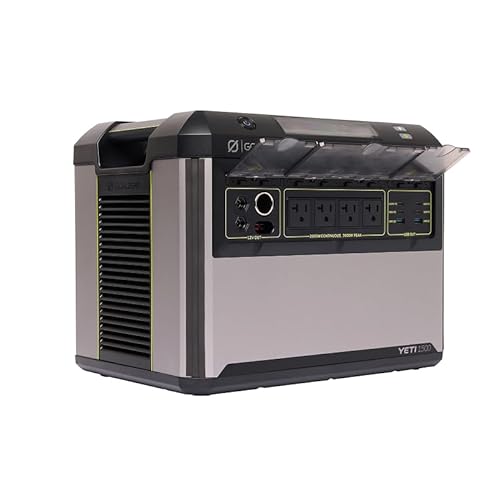
Goal Zero Yeti 1500 (6th Gen)
Crews running genuinely hungry motor tools, a compressor, a table saw or a mixer, where a failed start-up costs more than the extra weight of carrying the unit.
-
Best for a full shift carried between floors

Jackery Explorer 2000 v2
Solo remodellers and finish carpenters who move the unit between rooms and floors all day and want a full shift of stored energy without a two-person lift.
-
Best for topping up at every break indoors

EcoFlow DELTA 3 Plus
Electricians, plumbers and trim carpenters working inside occupied buildings where there is a live outlet somewhere and the unit moves floors several times a day.
-
Best for scaling up to a two-unit crew setup

Generac GB2000
Crews who expect to buy a second unit and want sustained output above 3000W without stepping up to a 240V system, on sites where solar is the only refill.
How they compare
Scroll the table sideways to see every column.
| Product | Where to buy | Award | Capacity | AC output | Weight | AC recharge time | Rated cycle life | Warranty | Best for |
|---|---|---|---|---|---|---|---|---|---|
| Goal Zero Yeti 1500 (6th Gen) | Best for starting high-surge tools | 1505Wh | 2000W (3600W surge) | 52.9 lb (24.0 kg) | Under 1 hour from 0% to 80% from the wall | 4,000 cycles | -- | Crews running genuinely hungry motor tools, a compressor, a table saw or a mixer, where a failed start-up costs more than the extra weight of carrying the unit. | |
| Jackery Explorer 2000 v2 | Best for a full shift carried between floors | 2042Wh | 2200W across 3 AC ports | 39.5 lb (17.9 kg) | 66 minutes to 80% | -- | 5 year manufacturer | Solo remodellers and finish carpenters who move the unit between rooms and floors all day and want a full shift of stored energy without a two-person lift. | |
| EcoFlow DELTA 3 Plus | Best for topping up at every break indoors | 1024Wh | 1800W | 27 lb (12.2 kg) | 40 minutes to 80% on 1500W AC input | 4,000 cycles to 80% | 5 years | Electricians, plumbers and trim carpenters working inside occupied buildings where there is a live outlet somewhere and the unit moves floors several times a day. | |
| Generac GB2000 | Best for scaling up to a two-unit crew setup | 2106Wh | 1600W (3200W peak) | 48.8 lb (22.1 kg) | 3.3 hours from 0% to 80% | 1,000 cycles to 80% | 3-year residential / 1-year commercial limited | Crews who expect to buy a second unit and want sustained output above 3000W without stepping up to a 240V system, on sites where solar is the only refill. |
The full reviews
Best for starting high-surge tools
Goal Zero Yeti 1500 (6th Gen)
Goal Zero
This is the only unit in the shortlist whose published numbers comfortably cover what a circular saw asks for in its first half second. A 2000W continuous rating with a 3600W surge, wrapped in an aluminium case with rubber bumpers and rated for 4,000 cycles, is a job site specification rather than a household one. You pay for it in weight: 52.9 lb is the heaviest here and the least capacity per pound.
What we like about the Goal Zero Yeti 1500 (6th Gen)
- 3600W published surge against 2000W continuous is 1.8 times headroom, which covers a 1400W saw spiking at two to three times nameplate
- 4,000 rated cycles is roughly sixteen years at one full cycle per working day, so daily site use is not what kills it
- Four AC outlets means a saw, a compressor, a charger and a work light without a power strip
- Under an hour from 0% to 80% returns about 1204Wh, more than the EcoFlow DELTA 3 Plus holds in total, so one charging window covers a second half-day
- Aluminium case with rubber bumpers rather than moulded plastic, which is the housing that gets dropped off a tailgate
Where it falls short for the Goal Zero Yeti 1500 (6th Gen)
- At 52.9 lb it carries 28.4Wh per pound, against 51.7 on the Jackery Explorer 2000 v2, so you haul 13.4 lb more for 537Wh less capacity
- The specification publishes no expansion path, so 1505Wh is a permanent ceiling and a heavy framing day will run past it
- No maximum solar input is published, so you cannot size a panel array to top it up on a site with no temporary power
- No warranty term appears in the specification we compared, which is a real gap when the unit is a commercial tool
Key specifications
- Capacity
- 1505Wh
- AC output
- 2000W (3600W surge)
- Weight
- 52.9 lb (24.0 kg)
- AC recharge time
- Under 1 hour from 0% to 80% from the wall
- Rated cycle life
- 4,000 cycles
- Ports
- 4 AC outlets, 6 USB outlets (including a 140W USB-C), 12V vehicle outlet, HPP output, 2 x 6mm outlets
Most power station buying advice starts with capacity. For tools that is the wrong end of the problem. A unit that cannot start the saw is useless no matter how big its battery is, and this is the unit in the shortlist least likely to fail that test.
What the surge number has to cover
A universal motor tool draws roughly two to three times its nameplate rating in the fraction of a second the armature spins up. Take a common 7-1/4 inch circular saw at about 1400W while cutting. The momentary ask is somewhere between 2800W and 4200W.
The Yeti 1500 publishes 2000W continuous and 3600W surge. That covers the middle of that band with margin, and it does so as a plain surge rating rather than a voltage-lowering assist mode. Two of the other units here publish a single flat continuous figure with no separate peak at all, which tells you nothing about the first half second.
The Generac GB2000 publishes a higher-sounding 3200W peak, but only 1600W continuous underneath it. Once the saw is actually cutting, that 400W difference is the one you live with.
Cycle life is the specification trades should read first
Rated at 4,000 cycles, and assuming a working year of roughly 250 days with one full charge and discharge each day, this pack lasts about sixteen years on paper. The Generac’s 1,000-cycle NMC rating works out to about four years on the same assumption.
That is not a small difference for something bought as a tool. It is the gap between an asset that outlives the van and a consumable.
Where the weight argument turns against it
At 1505Wh and 52.9 lb, this unit stores 28.4 watt-hours for every pound you carry. The Jackery Explorer 2000 v2 stores 51.7. In practice you are lifting 13.4 extra pounds to get 537Wh less.
If the unit lives in one place all day, that is a trade worth making for the inverter. If it goes up a ladder, into a loft and back to the van twice before lunch, it is not.
What a full day looks like
Assume a saw pulling 1400W with the trigger down 12 minutes in every hour. That is 280Wh an hour, and 1505Wh covers about 5.4 hours of that pattern. A framing day runs past it.
Switch to a finishing pattern, mostly cordless battery charging and lights, and the picture flips. Allowing 110Wh at the wall per full 5.0Ah pack including charger losses, this unit refills about 13 packs and still has room for a work light.
- Best for
- Crews running genuinely hungry motor tools, a compressor, a table saw or a mixer, where a failed start-up costs more than the extra weight of carrying the unit.
- Choose something else if
- You move the unit between floors several times a day, or you need more than about 1500Wh in a single charge, because there is no published expansion battery.
Best for a full shift carried between floors
Jackery Explorer 2000 v2
Jackery
Two thousand watt-hours in a 39.5 lb box is the most efficient energy-to-weight deal in this shortlist by a wide margin, and 2200W continuous is enough for most single-tool trades. It is the unit to buy if the thing you actually hate is carrying the thing. The catch is the port panel: three AC outlets and a single USB-C is a thin spread for a crew.
What we like about the Jackery Explorer 2000 v2
- 2042Wh at 39.5 lb works out to 51.7 watt-hours per pound, against 28.4 on the Goal Zero Yeti 1500
- 2200W continuous across three AC ports runs a 1500W miter saw with 700W left for a vacuum on the same unit
- 66 minutes from 0% to 80% is an average input of about 1485W, so a long lunch puts most of the pack back
- 20ms UPS switchover keeps a laser level, site laptop or router alive when you move it onto shore power
- Five-year manufacturer warranty, matching the EcoFlow DELTA 3 Plus and five times the Generac GB2000's one-year commercial cover
Where it falls short for the Jackery Explorer 2000 v2
- The specification lists 2200W with no separate surge or peak figure, so a 1400W circular saw spiking to three times nameplate has no documented margin to rely on
- Three AC outlets and one USB-C port means a crew charging several tool packs at once still needs a power strip
- No rated cycle life is published, so you cannot work out how many years of daily site charging the pack is designed for
- No maximum solar input appears in the specification, which rules out planning a panel top-up on a site with no temporary power
Key specifications
- Capacity
- 2042Wh
- AC output
- 2200W across 3 AC ports
- Weight
- 39.5 lb (17.9 kg)
- AC recharge time
- 66 minutes to 80%
- UPS switchover
- 20ms
- Warranty
- 5 year manufacturer
Every other unit in this guide asks you to choose between reserve and portability. This one mostly refuses the question, and that is the whole reason it is here.
The ratio that decides the day
Divide capacity by weight and the shortlist splits cleanly. This unit stores 51.7 watt-hours for every pound. The Generac GB2000 manages 43.2, the EcoFlow DELTA 3 Plus 37.9, the Goal Zero Yeti 1500 just 28.4.
Put concretely: against the Yeti you get 537Wh more energy while carrying 13.4 lb less. On a second-floor bathroom remodel where the unit follows you around, that is the specification you feel every hour.
What 2042Wh buys in tool time
Assume a 1500W miter saw with the trigger down 10 minutes in every hour. That is 250Wh an hour, and the pack covers roughly eight hours of that pattern. This is one of only two units here that genuinely finishes a working day of intermittent cutting on a single charge.
Shift to cordless battery charging and it goes further. Allowing 110Wh at the wall for a full 5.0Ah pack including charger losses, 2042Wh refills about 18 packs.
The number that is missing
The specification quotes 2200W continuous and stops there. There is no peak, no surge, no assist mode.
That is not automatically bad, because a flat rating is at least honest. But a circular saw asking two to three times its 1400W nameplate for half a second is requesting 2800W to 4200W, and 2200W of documented continuous output does not tell you how the inverter reacts. If your work is drills, drivers, a track saw and lighting, this is a non-issue. If it is a compressor, buy the surge rating instead.
The port panel is the real constraint
Three AC outlets and a single 100W USB-C is a spread built for a person, not a crew. Two battery chargers and a work light already fills it.
The Yeti 1500 publishes four AC outlets and six USB outlets for a reason. If three people share one power station, that difference costs you a power strip and an extension lead every morning.
- Best for
- Solo remodellers and finish carpenters who move the unit between rooms and floors all day and want a full shift of stored energy without a two-person lift.
- Choose something else if
- Your heaviest tool is a compressor or a table saw, because no published peak rating means you are gambling on the start-up spike rather than planning for it.
Best for topping up at every break indoors
EcoFlow DELTA 3 Plus
EcoFlow
Forty minutes from flat to 80% is the shortest charge time any unit here puts a firm number on, and that is the mechanism that stretches a 1024Wh pack across a full day: every break is a meaningful refill rather than a token one. It helps that at 27 lb a single person lifts it up a stepladder without thinking, and that 1800W still covers a track saw or a reciprocating saw. All of that collapses the moment there is no outlet to use.
What we like about the EcoFlow DELTA 3 Plus
- 27 lb with an 1800W inverter is 66.7 watts of output per pound, nearly double the Goal Zero Yeti 1500's 37.8
- 40 minutes to 80% is about 1228W average input, so a 45-minute break covers the entire 0-to-80% window and puts 819Wh back into a flat pack
- Expandable to 5kWh using DELTA 3, DELTA Pro 3 or DELTA 2 Max batteries, so the small pack is a starting point not a ceiling
- 4,000 cycles to 80% is around sixteen years at one full cycle per working day
- 10ms UPS switchover against the Jackery Explorer 2000 v2's 20ms, the only two switchover figures published in this shortlist, which protects a site laptop or laser level when you swap to temporary power
- Five-year warranty and a 16 x 8 x 11 in footprint that fits a van shelf rather than the floor
Where it falls short for the EcoFlow DELTA 3 Plus
- 1024Wh is half the Jackery Explorer 2000 v2 and covers only about 3.7 hours of saw work at a 12-minute-per-hour duty cycle, so a full day requires somewhere to plug in
- The specification lists a flat 1800W with no separate surge or peak rating, leaving just 300W of paper headroom over a 1500W miter saw before the start-up spike is even counted
- No maximum solar input is published, so it cannot be sized for panel charging on a site with no mains supply
- Getting past 1024Wh means buying an EcoFlow DELTA 3, DELTA Pro 3 or DELTA 2 Max battery, so the one-person 27 lb carry that justifies the unit is gone the moment your day needs more than a morning of saw work
Key specifications
- Capacity
- 1024Wh
- AC output
- 1800W
- Weight
- 27 lb (12.2 kg)
- AC recharge time
- 40 minutes to 80% on 1500W AC input
- Rated cycle life
- 4,000 cycles to 80%
- Expandable
- Yes, up to 5kWh with DELTA 3, DELTA Pro 3 or DELTA 2 Max battery packs
The other three units in this guide try to store enough energy to outlast the day. This one takes the opposite approach. It stays small, stays light, and gets most of the way back so quickly that the small pack stops being the constraint, as long as there is somewhere to plug it in.
Half the weight of the Yeti, most of the inverter
Twenty-seven pounds is the difference between a unit you move and a unit you leave where it is. Against the Yeti 1500’s 52.9 lb, you are carrying roughly half the weight and still getting 1800W of inverter.
Expressed as inverter watts per pound, this unit delivers 66.7. The Jackery Explorer 2000 v2 manages 55.7, the Yeti 37.8, the Generac GB2000 32.8. If your day involves stairs, lofts, scaffolding or a van door, that ratio is the specification you will notice first.
What a 40-minute charge is worth in practice
Eighty per cent of 1024Wh is 819Wh, delivered in 40 minutes. That is an average input of about 1228W.
Give it a normal 45-minute lunch break and the whole 0-to-80% window fits inside it with five minutes spare, so a flat pack comes back to 819Wh. Charging past 80% tapers on every unit here, which is why that is the figure to plan against rather than a straight-line extrapolation to full. Compare it to the Generac, whose 3.3 hours to 80% works out to about 511W average, returning under 400Wh in the same window. The Generac holds twice the energy but recovers under a fifth of itself while you eat.
That is the trade this unit is built around, and it works only if the outlet exists.
Where the arithmetic runs out
At 1024Wh, a 1400W saw cutting 12 minutes an hour averages 280W and empties it in about 3.7 hours. That is a morning, not a day.
Two things fix that. An expansion battery takes the system to 5kWh, though you are then carrying two boxes and the weight advantage is gone. Or you accept the tether and plug in at every break. Neither works on a bare site.
The headroom question
The specification quotes a flat 1800W. A 1500W miter saw sits 300W under that before you account for the start-up spike, and there is no published peak rating to tell you what happens in that first half second.
For drills, drivers, a multi-tool and lighting that is plenty. For a compressor, read the Yeti’s 3600W surge rating instead.
- Best for
- Electricians, plumbers and trim carpenters working inside occupied buildings where there is a live outlet somewhere and the unit moves floors several times a day.
- Choose something else if
- You work on a site with no mains power at all, because a 1024Wh pack with no published solar rating cannot be refilled on location and will not last a shift.
Best for scaling up to a two-unit crew setup
Generac GB2000
Generac
Bought alone this is the weakest inverter in the shortlist at 1600W continuous. Bought in pairs with the 30A parallel kit it becomes the strongest, reaching 4212Wh and 3200W continuous, which is enough to run a miter saw and a compressor off one setup. It is also the only unit here with a published solar input, so it is the one you can plan to refill on a site with no mains at all.
What we like about the Generac GB2000
- The 30A parallel kit takes two units to 4212Wh and 3200W continuous, more sustained output than any single unit in this guide
- 2106Wh is the largest single pack here, covering about 7.5 hours of saw work at a 12-minute-per-hour duty cycle
- 468W published maximum solar input, the only stated solar figure in this shortlist, so an array can actually be sized for it
- A 3200W peak against 1600W continuous is 2 times headroom, the highest surge ratio here
- 2106Wh in 48.8 lb is 43.2 watt-hours per pound, second only to the Jackery Explorer 2000 v2
Where it falls short for the Generac GB2000
- The 1,000-cycle NMC pack works out to roughly four years at one full cycle per working day, against about sixteen years for the 4,000-cycle LiFePO4 units in this guide
- The warranty drops from three years residential to one year commercial, which is precisely the use case this award describes
- 3.3 hours from 0% to 80% is about 511W average input, so a 45-minute break returns under 400Wh, less than half what the EcoFlow DELTA 3 Plus recovers in the same window
- 1600W continuous is the lowest here, 600W under the Jackery Explorer 2000 v2, so a 1500W miter saw leaves only 100W for anything else on the same unit
Key specifications
- Capacity
- 2106Wh
- AC output
- 1600W (3200W peak)
- Weight
- 48.8 lb (22.1 kg)
- AC recharge time
- 3.3 hours from 0% to 80%
- Rated cycle life
- 1,000 cycles to 80%
- Expandable
- Yes, to 4212Wh and 3200W continuous with a second unit and the optional 30A parallel kit
Judged as one box this unit loses to everything else in the guide. Judged as half of a system it wins outright, and that split is the whole decision.
Why the parallel figure changes the argument
A single GB2000 gives 1600W continuous. That runs a 1500W miter saw and almost nothing else. Add a second unit and the 30A parallel kit and the specification moves to 4212Wh and 3200W continuous.
Three thousand two hundred watts is the number that matters. It covers a 1500W saw and a 1400W compressor running at the same time with about 300W to spare, and it does so as continuous output rather than a momentary peak. No single unit in this shortlist reaches that. The Jackery Explorer 2000 v2 tops out at 2200W, the Goal Zero Yeti 1500 at 2000W continuous.
The only unit you can plan solar around
Of the four products here, this is the only one that publishes a maximum solar input at all: 468W.
That sounds like a small detail until you are on a bare lot with no temporary power. The other three units in this guide give you no figure to size an array against, which means the only honest refill plan for them is a mains outlet or a van. A published 468W ceiling lets you buy panels with intent.
The chemistry bill comes due
This is an NMC pack rated at 1,000 cycles to 80%, and that is the specification that should give a trade buyer pause.
Assume roughly 250 working days a year and one full charge and discharge each day. That rating is about four years. The Goal Zero Yeti 1500 and the EcoFlow DELTA 3 Plus are both rated at 4,000 LiFePO4 cycles, which on the same assumption is around sixteen. For a tool bought to be used daily, that is the difference between replacing it once and never replacing it.
Charging is slow enough to change how you work
Eighty per cent of 2106Wh is 1685Wh in 3.3 hours, an average of about 511W.
Over a 45-minute break that is under 400Wh, under a fifth of the pack. The DELTA 3 Plus completes its entire 819Wh 0-to-80% charge in the same window. This unit is not designed to be topped up between tasks. It is designed to be charged overnight and to hold enough that it does not need topping up.
- Best for
- Crews who expect to buy a second unit and want sustained output above 3000W without stepping up to a 240V system, on sites where solar is the only refill.
- Choose something else if
- You are buying one unit for daily solo use, because a 1,000-cycle pack and a one-year commercial warranty are the wrong economics for a tool used every day.
How we researched this guide
Four units were compared using published manufacturer specifications and electrical documentation. None were used on a job site by us. Every runtime, watt-hours-per-pound and cycles-per-year figure on this page is our own arithmetic on those published numbers, and each review names the limits of that approach.
The full process is on our how we test portable power stations page, including what counts as hands-on use.
- Units evaluated
- 4
- Used hands-on
- 0
- Assessed from documentation and owner reports
- 4
Evaluation methods used: specification comparison
Which one should you buy?
Match your situation on the left to the recommendation on the right.
-
Your heaviest tool is a compressor, a table saw or a mixer
Recommendation: Buy the Goal Zero Yeti 1500, the only unit here with a published 3600W surge over a 2000W continuous rating
-
You move the unit between floors and rooms several times a day
Recommendation: Buy the Jackery Explorer 2000 v2 at 51.7 watt-hours per pound, but check your tools start on a flat 2200W
-
You work inside occupied buildings where there is always an outlet somewhere
Recommendation: Buy the EcoFlow DELTA 3 Plus and top it up at breaks, since 40 minutes returns about 819Wh
-
You expect to buy a second unit and need more than 3000W of sustained output
Recommendation: Buy the Generac GB2000 and the 30A parallel kit for 4212Wh and 3200W continuous
-
Your site has no mains power and solar is the only way to refill
Recommendation: Buy the Generac GB2000, the only unit here publishing a maximum solar input at 468W
-
The unit will be charged and drained every working day for years
Recommendation: Buy a 4,000-cycle LiFePO4 unit, the Goal Zero Yeti 1500 or the EcoFlow DELTA 3 Plus, not the 1,000-cycle Generac
Mistakes buyers make
- Sizing by watt-hours and buying a unit whose inverter cannot survive the start-up spike of the saw it was bought for
- Reading a headline peak figure without checking the continuous rating underneath it, which is the number that applies once the tool is running
- Treating a tool's nameplate wattage as a constant draw, when the trigger is down for a fraction of every hour
- Ignoring rated cycle life on a unit that will be fully charged and drained every single working day
- Planning to charge on site from solar without checking whether the unit publishes a maximum solar input at all
- Buying one unit for a crew and discovering the AC outlet count will not cover two chargers, a light and a saw
Our final recommendation
If you want one answer rather than a shortlist, this is the unit that suits the widest range of readers in this category.
Best for starting high-surge tools
Crews running genuinely hungry motor tools, a compressor, a table saw or a mixer, where a failed start-up costs more than the extra weight of carrying the unit.
Questions buyers ask
Can a portable power station run a circular saw?
Yes, if the inverter survives the start-up spike. A universal motor draws roughly two to three times its nameplate for a fraction of a second, so a 1400W saw asks for 2800W to 4200W momentarily. The Yeti 1500 publishes a 3600W surge for exactly this. A unit quoting only a flat continuous figure gives you no way to check.
Do power tools need a pure sine wave inverter?
Brushless tools, their chargers and anything with a speed controller do. A modified sine wave can make motors run hot and confuse charger electronics. All four units here are mains-grade inverters intended for household appliances, so this is not a point of difference between them, but it matters if you are comparing against a cheap car inverter.
How many tool battery packs can one charge refill?
Allow about 110Wh at the wall for a full 5.0Ah 18V pack once charger losses are counted. On that basis the 1024Wh DELTA 3 Plus refills roughly 9 packs, the 1505Wh Yeti about 13, and the 2042Wh Jackery about 18. Running a work light at the same time takes a slice off each of those.
Will these survive being knocked about on a site?
None of these units publishes an ingress protection rating, so dust and moisture resistance is genuinely unknown rather than merely untested. The Yeti 1500 is the only one whose case is described as aluminium with rubber bumpers. Treat all of them as tool-adjacent equipment that still wants a dry spot, not as a site radio.
Is a power station cheaper to run than a petrol generator?
Running cost is not the reason to choose one. The reasons are no exhaust, so it can sit indoors on a remodel, no noise complaint on a residential street, and no fuel to carry. The trade-off is a hard energy ceiling: a generator refuels in a minute, and these units need between 40 minutes and 3.3 hours to get back to 80%.
About the author