We Compared 4 Portable Power Stations in the 2000W Class

Off-grid power editor
Published
Updated
Last fact-checked
This guide is for people who have already settled on a size bracket and are now choosing between units that look almost identical on a listing page. We compared four power stations with continuous inverter ratings from 2000W to 2400W, all of them LiFePO4, on the four things that actually separate them: surge headroom, watt-hours per pound, how much energy each one puts back per minute of charging, and how far the capacity can grow later. We did not test these units, and every review states exactly what its recommendation rests on. What you get here is the arithmetic a retailer listing leaves out, a clear explanation of why 2000W and 2000Wh are unrelated numbers, and the reason two of these four publish no surge rating at all.
What is the best 2000W portable power station?
The Jackery Explorer 2000 v2 suits the most buyers in this bracket. It holds 2042Wh at 39.5 lb, which is 51.7 watt-hours per pound and the best carry ratio of the four, and its 2200W inverter leaves 700W spare above a 1500W appliance. If you need published surge headroom for a motor, the OUPES Mega 1 states 4500W where Jackery states nothing.
Key takeaways
- 2000W is an inverter rating and has nothing to do with how much energy the unit stores; watt-hours is the capacity number
- Model numbers lie in both directions in this bracket, so read the continuous inverter rating rather than the name on the case
- Watt-hours per pound ranges from 28.4 to 51.7 across these four units, which is a bigger practical gap than any capacity difference between them
- The fastest recharge on the clock is not the fastest recharge in watt-hours, because a smaller pack finishes sooner while moving less energy
- Two of these four publish no surge rating, so nobody can tell you what they do with a compressor or pump start
Our picks at a glance
Every unit below wins a specific situation rather than a place in a ranking. Pick the row that matches how you will actually use it.
-
Best for moving 2kWh on your own

Jackery Explorer 2000 v2
People who move a full two kilowatt-hours between a garage, a truck bed and a campsite rather than leaving the unit parked in one room.
-
Best for hard-starting motors

OUPES Mega 1
Job sites, workshops and garages where the hard part is starting a compressor, pump or saw rather than running anything for hours on end.
-
Best for RV hookups and later expansion

BLUETTI AC200L
Travel trailer, van and cabin owners who want a 30A hookup now and room to add battery capacity as their power use grows.
-
Best for charging a bench full of devices
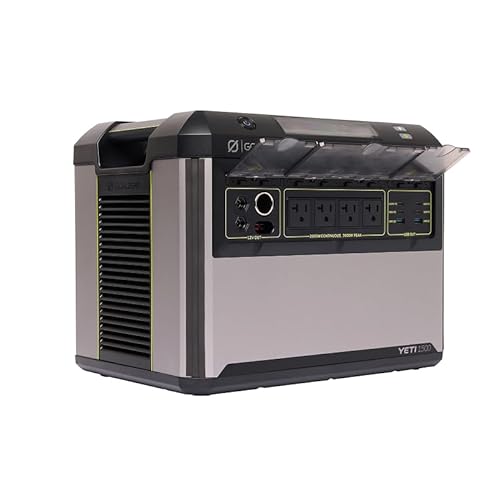
Goal Zero Yeti 1500 (6th Gen)
Workbenches, editing desks, craft rooms and market stalls where a dozen things need charging at once and the unit is not going anywhere.
How they compare
Scroll the table sideways to see every column.
| Product | Where to buy | Award | Capacity | AC output | Weight | AC recharge time | Battery chemistry | Ports | Best for |
|---|---|---|---|---|---|---|---|---|---|
| Jackery Explorer 2000 v2 | Best for moving 2kWh on your own | 2042Wh | 2200W across 3 AC ports | 39.5 lb (17.9 kg) | 66 minutes to 80% | LiFePO4 | 3 AC outlets, 1 USB-C PD 100W | People who move a full two kilowatt-hours between a garage, a truck bed and a campsite rather than leaving the unit parked in one room. | |
| OUPES Mega 1 | Best for hard-starting motors | 1024Wh | 2000W (4500W surge) | 27.8 lb (12.6 kg) | 36 minutes to 80% on AC, 26 minutes with AC and solar together | LiFePO4 | 2x USB-C 100W PD, 4x USB-A QC3.0, 12V DC outputs, AC outlets | Job sites, workshops and garages where the hard part is starting a compressor, pump or saw rather than running anything for hours on end. | |
| BLUETTI AC200L | Best for RV hookups and later expansion | 2048Wh | 2400W | 61.41 lb (27.9 kg) | 0-80% in 45 minutes (2400W AC input) | LiFePO4 | 11 ports, including a 30A RV port and a 48V/8A DC port | Travel trailer, van and cabin owners who want a 30A hookup now and room to add battery capacity as their power use grows. | |
| Goal Zero Yeti 1500 (6th Gen) | Best for charging a bench full of devices | 1505Wh | 2000W (3600W surge) | 52.9 lb (24.0 kg) | Under 1 hour from 0% to 80% from the wall | LiFePO4 | 4 AC outlets, 6 USB outlets (including a 140W USB-C), 12V vehicle outlet, HPP output, 2 x 6mm outlets | Workbenches, editing desks, craft rooms and market stalls where a dozen things need charging at once and the unit is not going anywhere. |
The full reviews
Best for moving 2kWh on your own
Jackery Explorer 2000 v2
Jackery
The Explorer 2000 v2 carries 2042Wh at 39.5 lb, which is 51.7 watt-hours for every pound you lift. Nothing else in this bracket comes close on that ratio, and the trade is a spec sheet with no published surge figure and a single USB port.
What we like about the Jackery Explorer 2000 v2
- 2042Wh at 39.5 lb works out to 51.7Wh per pound, the best carry ratio of the four units here
- 2200W across three AC ports leaves 700W spare while a 1500W appliance is running
- 20ms UPS switchover is fast enough that a desktop or router does not reboot when the grid drops
- 66 minutes to 80% restores roughly 1634Wh, so a single lunch break on the wall covers most of a night
Where it falls short for the Jackery Explorer 2000 v2
- Jackery publishes 2200W continuous but no surge rating at all, so there is no stated headroom for a compressor, pump or saw start
- One USB-C PD port is the entire USB provision on a 2kWh unit, so anything more than a laptop and a phone has to go through the AC outlets
- No expansion battery is listed, so 2042Wh is a permanent ceiling, while the BLUETTI AC200L in this guide reaches 8192Wh and the OUPES Mega 1 reaches 5120Wh
Key specifications
- Capacity
- 2042Wh
- AC output
- 2200W across 3 AC ports
- Weight
- 39.5 lb (17.9 kg)
- AC recharge time
- 66 minutes to 80%
- UPS switchover
- 20ms
- Warranty
- 5 year manufacturer
The argument for this unit is a division sum. Divide 2042Wh by 39.5 lb and you get 51.7 watt-hours per pound. Do the same for the other three units in this guide and you get 36.8, 33.4 and 28.4. In a bracket where every unit does roughly the same job, that gap is the decision.
What the weight actually buys back
Weight in this category is not vanity. A 2000W-class unit that lives permanently in a basement corner is a different purchase from one that goes in a vehicle every other weekend. The second one gets used; the first one gets forgotten.
At 39.5 lb the Explorer 2000 v2 is the only unit here carrying a full 2kWh that one adult can realistically lift into a truck bed without planning the movement. The BLUETTI AC200L holds six more watt-hours and weighs 21.9 lb more to do it.
Runtime, with the assumption stated
Rated capacity is not usable capacity. Inverter conversion costs you something, and a reasonable working assumption is that around 85% of the rating reaches the outlet. On that basis 2042Wh becomes roughly 1736Wh at the socket.
Against a full-size refrigerator averaging 150W across its compressor duty cycle, that is about 11.6 hours. Against an 1800W load with no cycling, it is about 58 minutes. Both numbers come from the same pack, which is why “how long does it last” has no single answer until you name the load.
A day of fridge duty is roughly 3.6kWh, so a full charge here covers a little under half of one.
The missing surge number
The published figure is 2200W across three AC ports. There is no surge or peak rating alongside it.
That matters because motor loads do not draw their running wattage at start-up. A compressor pulls several times its running draw for a fraction of a second, and the specification that tells you whether the inverter rides that out is the surge rating. The OUPES Mega 1 publishes 4500W. The Goal Zero Yeti 1500 publishes 3600W. Jackery publishes nothing, and we are not going to guess on its behalf.
For electronics, lighting, a fridge you have already confirmed starts on similar hardware, or resistive loads like a kettle, this is not a problem. For a pump, a compressor or a table saw, the absence of a number is itself the answer: choose a unit that states one.
One USB port
Three AC outlets and one 100W USB-C is a thin port list for a pack this size. It is a genuine limitation on a camping trip where four people arrive with phones. The workaround is a multi-port charger in an AC outlet, which works fine and costs you a little conversion efficiency, but it is an extra thing to remember to pack.
2042Wh is the ceiling, not the starting point
No expansion battery is listed for this unit, so the capacity you buy is the capacity you keep. Two of the other three units here are not built that way: the BLUETTI AC200L reaches 8192Wh and the OUPES Mega 1 reaches 5120Wh with two B2 batteries.
That is fine if 2042Wh is genuinely enough, and it is the one constraint in this bracket you cannot fix after the fact. If your power use is trending upwards, weigh that against the carry ratio before the carry ratio decides it for you.
- Best for
- People who move a full two kilowatt-hours between a garage, a truck bed and a campsite rather than leaving the unit parked in one room.
- Choose something else if
- You want a published surge number before trusting a unit with a refrigerator compressor, a well pump or a large corded tool, or you expect to add battery capacity later, because no expansion battery is listed for this unit.
Best for hard-starting motors
OUPES Mega 1
OUPES
A 4500W surge on a 2000W inverter is a 2.25x margin, the widest published start-up headroom in this bracket, and it arrives in a 27.8 lb box. The catch is the pack behind it: 1024Wh is half what the other units here hold.
What we like about the OUPES Mega 1
- 4500W surge against a 2000W continuous rating is a 2.25x margin, the widest of the four units compared here
- 27.8 lb is 11.7 lb lighter than the next unit and the only one here a single person carries one-handed
- 36 minutes to 80% on AC, or 26 minutes with AC and solar together, is the fastest wall-clock refill in this guide
- Expands to 5120Wh with two B2 batteries, five times the base pack, so the small capacity is not permanent
- 3,500+ rated cycles to 80% against 1024Wh is roughly 3,584kWh of lifetime throughput
Where it falls short for the OUPES Mega 1
- 1024Wh is half the capacity of every other 2000W-class unit here, so a 150W refrigerator gets about 5.8 hours rather than 11.6
- The 36-minute headline restores only about 819Wh, which is 22.8Wh per minute against the BLUETTI AC200L's 36.4, so it is the fastest clock and the slowest energy transfer
- Getting to a useful overnight capacity means buying two B2 expansion batteries, which turns the lightest unit here into a stack you no longer carry one-handed
Key specifications
- AC output
- 2000W (4500W surge)
- Capacity
- 1024Wh
- Weight
- 27.8 lb (12.6 kg)
- AC recharge time
- 36 minutes to 80% on AC, 26 minutes with AC and solar together
- UPS switchover
- Under 20ms
- Expandable
- Yes, to 5120Wh with two B2 extra batteries
- Rated cycle life
- 3,500+ cycles to 80%
Most units in this bracket are bought for capacity. This one is bought for the moment the load switches on.
Why the surge margin is the whole pitch
Divide 4500 by 2000 and you get 2.25. That is the multiple by which this inverter can exceed its continuous rating for a start-up transient. For comparison, the Goal Zero Yeti 1500 publishes 3600W over 2000W, a 1.8x margin, and two units in this guide publish no surge figure whatsoever.
That matters because motors do not draw their running wattage when they start. A compressor, a well pump, a shop vac or a mitre saw pulls a brief multiple of its running draw, and an inverter without margin trips rather than starts. A unit that cannot start a load cannot run it, no matter how many watt-hours sit behind it.
What is not published is how long that 4500W is held. A surge figure without a duration is half a specification, and we are treating it as such.
The capacity is the price you pay
1024Wh is not a 2kWh pack. Applying the same 85% conversion assumption we use throughout this guide gives roughly 870Wh at the outlet.
Against a refrigerator averaging 150W across its duty cycle, that is about 5.8 hours. Against a 1500W circular saw drawing continuously, it is around 35 minutes, although a saw cuts in bursts so real working time is far longer than that figure suggests. Against a full day of fridge duty, which is roughly 3.6kWh, one charge covers about a quarter.
For a workshop this is usually fine, because tool use is intermittent and the wall is nearby. For an overnight outage it is not, and that is the line to check yourself against before buying.
The recharge figure is smaller than it looks
Thirty-six minutes to 80% is the fastest number in this guide, and it is genuinely useful when you are working near a socket. But 80% of 1024Wh is about 819Wh, which means 22.8Wh restored for every minute plugged in.
The BLUETTI AC200L takes 45 minutes, nine minutes longer, and restores about 1638Wh in that time, or 36.4Wh per minute. If your constraint is a short window at a socket, the OUPES wins. If your constraint is total energy back in the pack, it does not. Both statements come from the same two specifications.
Expansion changes the unit
Two B2 batteries take it to 5120Wh, five times the base pack and the largest multiple on this shortlist. That is a real answer to the capacity problem.
It is also the end of the 27.8 lb argument. Once you are hauling a stack, the reason you chose this unit over the Jackery has gone, and you should compare the expanded system against the BLUETTI AC200L’s 8192Wh ceiling instead.
- Best for
- Job sites, workshops and garages where the hard part is starting a compressor, pump or saw rather than running anything for hours on end.
- Choose something else if
- You need the base unit alone to cover an overnight outage, because 1024Wh does not stretch across a night once a refrigerator and lighting are on it.
Best for RV hookups and later expansion
BLUETTI AC200L
BLUETTI
The AC200L is the one unit here that plugs a trailer in directly through a 30A RV port and grows to 8192Wh afterwards. It also weighs 61.41 lb, so the sensible purchase is the one where it gets installed somewhere and stays put.
What we like about the BLUETTI AC200L
- A built-in 30A RV port feeds a trailer directly rather than through an adapter chain
- 45 minutes to 80% restores roughly 1638Wh, about 36.4Wh for every minute plugged in, the highest energy transfer rate here
- A 1200W solar input ceiling is high enough to move a meaningful share of a 2048Wh pack in a day even at the fraction of rated output real panels deliver
- Expands to 8192Wh, four times the base capacity and the largest ceiling on this shortlist
- 2400W continuous leaves 900W spare while a 1500W appliance is already running
Where it falls short for the BLUETTI AC200L
- 61.41 lb for 2048Wh works out to 33.4Wh per pound, against 51.7 for the Jackery Explorer 2000 v2, which holds effectively the same capacity and weighs 21.9 lb less
- The 2400W rating is published with no surge figure, so there is no stated margin for a compressor or pump start
- At 16.5 x 11 x 14.4 in it occupies floor space rather than shelf space, which is a real constraint in a van conversion
Key specifications
- Capacity
- 2048Wh
- AC output
- 2400W
- AC recharge time
- 0-80% in 45 minutes (2400W AC input)
- Max solar input
- 1200W
- Expandable
- Yes, to 8192Wh with expansion batteries
- Ports
- 11 ports, including a 30A RV port and a 48V/8A DC port
- Weight
- 61.41 lb (27.9 kg)
Two of the four units in this guide hold roughly 2048Wh. One of them weighs 39.5 lb and one weighs 61.41 lb. If capacity were the only thing that mattered, the AC200L would have nothing to say. It has two things.
The 30A RV port
This is the feature that puts the AC200L in a category of one on this shortlist. A travel trailer’s shore power cord goes straight in. No adapter chain, no splitting the load across household outlets, no guessing whether the pigtail you bought is rated for the draw.
For anyone powering a trailer, that single port is worth more than the 22 lb weight penalty, because the unit lives in a bay or a cabinet and never gets carried anywhere. The weight only becomes a problem for buyers who intended to move it.
Energy back per minute, not minutes on the clock
The published recharge is 0 to 80% in 45 minutes at 2400W AC input. Eighty percent of 2048Wh is about 1638Wh, so that is roughly 36.4Wh restored for every minute plugged in.
Run the same arithmetic on the others and the ranking changes. The OUPES Mega 1 finishes in 36 minutes but moves about 819Wh, or 22.8Wh per minute. The Jackery takes 66 minutes for about 1634Wh, or 24.8Wh per minute. The AC200L is not the fastest to reach a full bar; it is by a clear margin the fastest at putting energy back, which is what matters when the grid is intermittent or the generator only runs for an hour.
Solar, honestly
1200W is the rated input ceiling. Panels almost never hit their rating, so treat that number as a limit rather than a forecast: angle, cloud, temperature and cable losses all take a share. Even at a conservative fraction of the ceiling, though, this is enough input to move a meaningful part of a 2048Wh pack inside one day, which is not true of units with a 400W or 500W ceiling.
The expansion ceiling, and the honest caveat
8192Wh is four times the base pack, the largest ceiling of the four units here. That makes the AC200L a reasonable first purchase for someone who expects their power use to grow, because the ceiling is high enough that the base unit is unlikely to become the bottleneck.
The caveat is that expansion batteries are additional purchases, and we cannot tell you how recharge time behaves with them attached because that figure is not published. Buy the base unit for what it does today, and treat the ceiling as insurance rather than a plan.
- Best for
- Travel trailer, van and cabin owners who want a 30A hookup now and room to add battery capacity as their power use grows.
- Choose something else if
- You will be lifting the unit in and out of a vehicle regularly, because 61.41 lb is a two-person job on any staircase or tailgate.
Best for charging a bench full of devices
Goal Zero Yeti 1500 (6th Gen)
Goal Zero
Despite the 1500 on the case this is a 2000W inverter with a 3600W surge, and its real advantage is the port panel: four AC outlets and six USB including a 140W USB-C. Buy it for how many things it feeds at once, not for what it stores, because 1505Wh at 52.9 lb is the worst watt-hours per pound figure of the four.
What we like about the Goal Zero Yeti 1500 (6th Gen)
- Four AC outlets plus six USB ports, one of them 140W USB-C, run a laptop, tools and a family's phones without a power strip
- 2000W continuous with a 3600W surge is a 1.8x start-up margin, published rather than left blank
- 4,000 rated cycles against 1505Wh is roughly 6,020kWh of lifetime throughput, the highest figure in this guide
- Under 1 hour from 0% to 80% from the wall, so it refills inside a short grid window
Where it falls short for the Goal Zero Yeti 1500 (6th Gen)
- 1505Wh at 52.9 lb is 28.4Wh per pound, the worst ratio here, and it holds 537Wh less than the Jackery Explorer 2000 v2 while weighing 13.4 lb more
- No UPS switchover time is published, so this should not be the unit holding up a desktop, a NAS or a router through a cut
- No expansion battery is listed, which makes 1505Wh a permanent ceiling rather than a starting point
Key specifications
- AC output
- 2000W (3600W surge)
- Capacity
- 1505Wh
- Ports
- 4 AC outlets, 6 USB outlets (including a 140W USB-C), 12V vehicle outlet, HPP output, 2 x 6mm outlets
- Rated cycle life
- 4,000 cycles
- Weight
- 52.9 lb (24.0 kg)
- AC recharge time
- Under 1 hour from 0% to 80% from the wall
The name is misleading in the buyer’s favour for once. A Yeti 1500 in this generation carries a 2000W inverter with a 3600W surge, which puts it squarely in this bracket even though the number on the case suggests otherwise.
The port panel is the reason to buy it
Four AC outlets, six USB ports including a 140W USB-C, a 12V vehicle outlet, an HPP output and two 6mm outlets. That is fourteen sockets. The closest of the other three is the BLUETTI AC200L at a published eleven, and it reaches that count partly through a 30A RV port and a 48V DC port rather than through outlets a phone or a laptop can use.
That sounds like a minor convenience until you are the person running a market stall, a photo booth, a repair bench or a classroom cart. The alternative is a power strip in one AC outlet, which works, but it means every device is passing through an extra conversion and an extra thing to trip over. The 140W USB-C in particular runs a large laptop directly off DC without an inverter in the path at all, which is quietly more efficient than plugging its brick into an AC socket.
What it costs you in capacity
1505Wh at 52.9 lb is 28.4 watt-hours per pound. The Jackery Explorer 2000 v2 is 51.7. In plain terms: this unit weighs 13.4 lb more than the Jackery and holds 537Wh less.
At the 85% conversion assumption we apply across this guide, 1505Wh is about 1279Wh at the outlet. That is roughly 8.5 hours of a 150W refrigerator, or about 43 minutes of an 1800W continuous draw, or a bit over a third of a 3.6kWh fridge day.
Those are respectable numbers. They are just not 2kWh numbers, and buyers comparing this against the AC200L or the Jackery on capacity alone will not see that until they check the spec.
Cycle life is the long game
4,000 rated cycles multiplied by 1505Wh is roughly 6,020kWh of energy through the pack over its rated life. The OUPES Mega 1’s 3,500 cycles against 1024Wh gives about 3,584kWh. The other two units here do not publish a cycle figure, so they cannot be placed on that scale.
If this unit is going to be cycled daily on a bench rather than sitting charged waiting for an outage, that throughput number is the specification that matters most, and it is the one this unit leads on.
The gap in the sheet
There is no published UPS switchover time. For a bench full of phones and tools that is irrelevant, because none of those loads care about a brief interruption. For a desktop, a NAS or a network rack it is decisive, and the absence of a figure means you should assume it is not the job this unit was built for.
- Best for
- Workbenches, editing desks, craft rooms and market stalls where a dozen things need charging at once and the unit is not going anywhere.
- Choose something else if
- You are choosing on watt-hours per pound, or you expect to add battery capacity later, because neither is a strength of this unit.
How we researched this guide
Four units with continuous inverter ratings between 2000W and 2400W were compared using published manufacturer specifications, with aggregated owner reports drawn on only where an individual review names them as a source. None were tested by us. Every runtime figure in this guide is calculated from rated capacity assuming roughly 85% reaches the outlet after conversion loss, and every review states which sources its recommendation rests on.
The full process is on our how we test portable power stations page, including what counts as hands-on use.
- Units evaluated
- 4
- Used hands-on
- 0
- Assessed from documentation and owner reports
- 4
Evaluation methods used: specification comparison, documentation and owner-report research
Which one should you buy?
Match your situation on the left to the recommendation on the right.
-
You will carry the unit between a house, a vehicle and a campsite
Recommendation: Buy the Jackery Explorer 2000 v2, at 51.7Wh per pound the best carry ratio here
-
You need to start a compressor, pump or large corded tool
Recommendation: Buy the OUPES Mega 1, the only unit here publishing a 4500W surge on a 2000W inverter
-
You are powering a travel trailer through its shore power cord
Recommendation: Buy the BLUETTI AC200L for its built-in 30A RV port
-
You expect your power needs to grow well past 2kWh
Recommendation: Buy the BLUETTI AC200L, which expands to 8192Wh, four times its base pack
-
You need many devices charging at once from a unit that stays put
Recommendation: Buy the Goal Zero Yeti 1500 for its four AC outlets and six USB ports
-
You need the unit to hold up a desktop or a NAS through a grid cut
Recommendation: Buy the Jackery Explorer 2000 v2 or OUPES Mega 1, the only two here publishing a 20ms or faster switchover
Mistakes buyers make
- Reading the 2000W inverter rating as 2000 watt-hours of storage and buying a unit with half the capacity expected
- Trusting a model number, because a unit branded 2000 can carry a 1500W inverter and one branded 1500 can carry a 2000W one
- Comparing two units whose capacities sit within six watt-hours of each other and missing that one of them weighs 21.9 lb more
- Buying a unit with no published surge rating for a refrigerator, pump or power tool that has to start against a compressor
- Choosing on the headline recharge time rather than on how many watt-hours actually go back into the pack in that time
- Assuming a rated solar input is what panels will deliver, when angle, cloud and cable losses all take a share
Our final recommendation
If you want one answer rather than a shortlist, this is the unit that suits the widest range of readers in this category.
Best for moving 2kWh on your own
People who move a full two kilowatt-hours between a garage, a truck bed and a campsite rather than leaving the unit parked in one room.
Questions buyers ask
Does a 2000W power station store 2000 watt-hours?
No, and this is the single most common mistake in this bracket. Watts describe how much the inverter can deliver at any instant. Watt-hours describe how much energy is stored. The OUPES Mega 1 here is rated 2000W and holds 1024Wh, so it can deliver a large load but not for very long.
Can a 2000W power station run a refrigerator?
A 2000W continuous rating is comfortably above what a household fridge draws while running. The question is whether the inverter survives the compressor start, which draws a brief multiple of the running figure. Check the surge rating rather than the continuous one, and be cautious with any unit that does not publish a surge number.
Can it run a window air conditioner?
A small window unit is usually within a 2000W continuous rating, but air conditioners start against a compressor in the same way a fridge does, and they run for hours rather than cycling briefly. Capacity becomes the limit long before the inverter does, so size on watt-hours and expect a fraction of a night rather than a full one.
How much do these weigh and can one person move them?
The four here range from 27.8 lb to 61.41 lb. Anything under about 40 lb is a realistic single-person carry over a short distance. The BLUETTI AC200L at 61.41 lb is a two-person lift on stairs or into a tailgate, which is why it suits an installation rather than a unit you move around.
Is LiFePO4 worth insisting on at this size?
Yes. Every unit in this guide uses it, and the reason is cycle life. Goal Zero rates the Yeti 1500 at 4,000 cycles and OUPES rates the Mega 1 at over 3,500 to 80% capacity. At a size where the unit is a long-term purchase, a chemistry that survives daily cycling for years is the difference between one purchase and two.
About the author