The 4 Best 2000Wh Portable Power Stations

Off-grid power editor
Published
Updated
Last fact-checked

This guide is for people who have already decided they want about two kilowatt-hours of storage, usually after a 1000Wh unit ran out halfway through the job. The awkward part of this bracket is that capacity stops being useful as a comparison: the four units here sit within 64 watt-hours of each other, which is around twenty minutes of fridge runtime between the largest and the smallest. So we compared them on the things that do differ, and by a lot. Inverter ratings run from 1500W to 2600W. Weight runs from 35.7 lb to 53.35 lb for the same stored energy. Rated lifetime energy through the pack differs by more than three to one. We did not test these units, and every review states what its recommendation rests on.
What is the best 2000Wh power station?
The BLUETTI Elite 200 V2 suits the most buyers in this class. It holds 2073.6Wh, the largest pack here, and its 2600W continuous inverter is 1100W above the smallest unit on this page, so it can run a heater and a second appliance at once. If you have to carry the unit yourself, the Anker SOLIX S2000 stores nearly as much in 17.65 lb less.
Key takeaways
- Capacity is the least useful spec in this class, because all four packs sit within 64Wh of each other
- Watt-hours describe stored energy and watts describe the inverter; a 2000Wh unit can carry a 1500W or a 2600W inverter
- Rated capacity is not what reaches the outlet, so plan on roughly 85% of the number on the box
- Rated cycle life multiplied by capacity separates these units by more than three to one in lifetime energy
- Watt-hours per pound runs from 38.9 to 56.3 here, which is a far bigger practical gap than any capacity difference
- A 2000Wh pack covers under half a day of refrigerator duty, whatever the runtime chart on the listing implies
Our picks at a glance
Every unit below wins a specific situation rather than a place in a ranking. Pick the row that matches how you will actually use it.
-
Best for high-draw appliances

BLUETTI Elite 200 V2
People who want a single 2kWh unit to carry the largest appliance in the house rather than only electronics, and who will leave it in one place between uses.
-
Best for growing past 2kWh

EcoFlow DELTA 2 Max
Households that want 2kWh now with a documented route to three times that, and that need many devices plugged in at once from a unit which mostly stays put.
-
Best for years of daily cycling
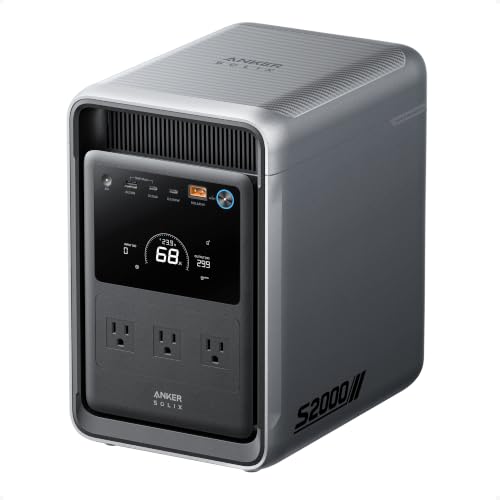
Anker SOLIX S2000
Anyone cycling a 2kWh pack daily on solar or as a desk-side backup, and anyone who has to carry the unit up stairs or into a vehicle without help.
-
Best for one-person carry without losing inverter power

Jackery Explorer 2000 v2
People who load the unit into a car, carry it to a campsite or move it between floors of a house and still need to run a full-size appliance when they arrive.
How they compare
Scroll the table sideways to see every column.
| Product | Where to buy | Award | Capacity | AC output | Weight | AC recharge time | Rated cycle life | Warranty | Best for |
|---|---|---|---|---|---|---|---|---|---|
| BLUETTI Elite 200 V2 | Best for high-draw appliances | 2073.6Wh | 2600W continuous (3900W Power Lifting) | 53.35 lb (24.2 kg) | 0-80% in 1 hour on Turbo mode (1800W AC), full in 1.6 hours on Standard mode | Over 6,000 cycles | -- | People who want a single 2kWh unit to carry the largest appliance in the house rather than only electronics, and who will leave it in one place between uses. | |
| EcoFlow DELTA 2 Max | Best for growing past 2kWh | 2048Wh | 2400W (3400W X-Boost) | 50.7 lb (23.0 kg) | 1.1 hours to 80% on AC, 43 minutes with AC plus solar | 3,000 cycles to 80% | 5 years | Households that want 2kWh now with a documented route to three times that, and that need many devices plugged in at once from a unit which mostly stays put. | |
| Anker SOLIX S2000 | Best for years of daily cycling | 2010Wh | 1500W (3000W peak) | 35.7 lb (16.2 kg) | -- | 10,000 cycles | 5 years | Anyone cycling a 2kWh pack daily on solar or as a desk-side backup, and anyone who has to carry the unit up stairs or into a vehicle without help. | |
| Jackery Explorer 2000 v2 | Best for one-person carry without losing inverter power | 2042Wh | 2200W across 3 AC ports | 39.5 lb (17.9 kg) | 66 minutes to 80% | -- | 5 year manufacturer | People who load the unit into a car, carry it to a campsite or move it between floors of a house and still need to run a full-size appliance when they arrive. |
The full reviews
Best for high-draw appliances
BLUETTI Elite 200 V2
BLUETTI
The Elite 200 V2 holds the most energy in this class and pairs it with a 2600W continuous inverter, which is 1100W more than the lightest unit here. That combination is what lets one 2kWh box carry a load a fridge-and-lights unit would trip on, and you pay for it in the 53.35 lb you have to lift.
What we like about the BLUETTI Elite 200 V2
- 2600W continuous inverter is the highest here, so a 1500W heater leaves 1100W spare for everything else
- 2073.6Wh is the largest pack in this comparison, about 1763Wh once you allow 15% conversion loss
- Turbo mode returns roughly 1659Wh in an hour, about 27.6 watt-hours per minute plugged in
- Rated over 6,000 cycles, which is roughly 12,442kWh of lifetime throughput at full capacity
Where it falls short for the BLUETTI Elite 200 V2
- At 53.35 lb it is the heaviest unit here, 17.65 lb more than the Anker SOLIX S2000 for only 63.6Wh more capacity
- The 3900W Power Lifting figure is reached by reducing output voltage, so it applies to resistive loads and never to a compressor or pump start
- No expansion battery appears in its published specifications, so 2073.6Wh is the ceiling rather than a starting point
- The 2.4-hour solar full charge assumes a 1000W array delivering about 864W average, which needs clear midday sun to come close
Key specifications
- Capacity
- 2073.6Wh
- AC output
- 2600W continuous (3900W Power Lifting)
- Weight
- 53.35 lb (24.2 kg)
- AC recharge time
- 0-80% in 1 hour on Turbo mode (1800W AC), full in 1.6 hours on Standard mode
- Rated cycle life
- Over 6,000 cycles
- Solar input
- Full charge in 2.4 hours with 1000W panels
Every unit in this comparison stores about the same amount of energy. The Elite 200 V2 is the one that can spend it fastest.
Why the inverter is the real difference here
The four packs on this page sit within 63.6Wh of each other, which is under half an hour of fridge runtime between the largest and the smallest. Capacity is effectively a tie. The continuous inverter rating is not: it runs from 1500W on the Anker SOLIX S2000 to 2600W here.
That 1100W gap decides what you can plug in at all. A 1500W space heater sits exactly on the S2000’s ceiling with nothing left over. On the Elite 200 V2 the same heater uses 58% of the inverter and leaves 1100W for a kettle, a pump or a circular saw at the same time.
What the capacity actually buys
Rated capacity is not what reaches the outlet. Assuming roughly 85% survives conversion, the 2073.6Wh pack delivers about 1763Wh. Against a full-size fridge averaging 150W across its compressor duty cycle, that is about 11.8 hours. A fridge uses roughly 3.6kWh a day, so this unit covers a little under half of one.
Against a 1500W heater the same 1763Wh lasts about 70 minutes. High-draw appliances are where 2kWh disappears quickly, and knowing that before you buy is more useful than the headline number.
Read the Power Lifting figure carefully
BLUETTI publishes 3900W alongside the 2600W continuous rating. It reaches that number by lowering output voltage so current stays within limits. A resistive load simply runs cooler and slower under lower voltage. A motor needs the voltage to develop torque, so the figure never applies to a compressor, a well pump or a tool that starts under load.
For those loads the number that counts is 2600W continuous, and it is still the best on this page.
Lifetime, and the trade-off
At over 6,000 rated cycles, a full charge and discharge every day works out to more than sixteen years. Multiplied by capacity, that is around 12,442kWh of energy through the pack across its rated life, roughly double what the EcoFlow DELTA 2 Max is rated for.
The cost is weight and a fixed ceiling. At 53.35 lb this is 38.9 watt-hours per pound, the worst carry ratio in this comparison, and no expansion battery is listed for it. If you need to grow past 2kWh, buy the DELTA 2 Max instead. If you need to lift it alone and often, buy the S2000.
- Best for
- People who want a single 2kWh unit to carry the largest appliance in the house rather than only electronics, and who will leave it in one place between uses.
- Choose something else if
- You will move the unit regularly on your own, or you expect to add a second battery later, because neither the weight nor the fixed ceiling supports that.
Best for growing past 2kWh
EcoFlow DELTA 2 Max
EcoFlow
The DELTA 2 Max is the only unit in this class that treats 2048Wh as a starting point rather than a limit, taking two extra batteries to 6kWh. Its 15 outlets also make it the one that can actually be shared by a household, but its 3,000-cycle rating is the shortest rated life on this page.
What we like about the EcoFlow DELTA 2 Max
- Expands from 2kWh to 6kWh with up to two extra batteries, about 35 hours of fridge duty at the top end
- 15 outlets total, against three AC sockets and one USB-C on the Jackery Explorer 2000 v2
- AC and solar together reach 80% in 43 minutes, about 38 watt-hours restored per minute
- 2400W continuous inverter, enough to carry a fridge, a router and several laptops at once
Where it falls short for the EcoFlow DELTA 2 Max
- Rated 3,000 cycles to 80%, less than a third of the Anker SOLIX S2000's 10,000, which is about eight years of daily cycling against twenty-seven
- Its 20 in length is 6.2 in more than the Elite 200 V2's longest side and 7.3 in more than the S2000's, so it will not drop into a bay or shelf sized around either of them
- The 3400W X-Boost figure comes from lowering output voltage, so it does nothing for a compressor or pump start
- The 43-minute recharge needs a solar array feeding the unit at the same time as wall power; on AC alone it takes 1.1 hours to 80%
Key specifications
- Capacity
- 2048Wh
- AC output
- 2400W (3400W X-Boost)
- Expandable
- Yes, from 2kWh to 6kWh with up to 2 extra batteries
- Ports
- 15 outlets total
- Rated cycle life
- 3,000 cycles to 80%
- Warranty
- 5 years
Nothing else in this comparison answers the question “what if 2kWh turns out not to be enough?” The DELTA 2 Max does, and that is the whole reason to buy it.
The expansion path is the product
At 2048Wh it is unremarkable in this class, sitting 25.6Wh below the BLUETTI Elite 200 V2 and 38Wh above the Anker SOLIX S2000. Nobody would notice the difference.
What separates it is the documented route from 2kWh to 6kWh with two extra batteries. Run the same arithmetic used everywhere on this page, allowing about 15% conversion loss: 6144Wh becomes roughly 5222Wh at the outlet, and a fridge averaging 150W across its duty cycle runs for about 35 hours. That is a day and a half, where the base unit gives about 11.6 hours.
This matters because most people who buy 2kWh discover their real requirement afterwards. Every other unit here would need replacing. This one takes a battery.
Fifteen outlets is not a spec-sheet detail
During an outage the limit is rarely the inverter. It is how many things can be plugged in before you are running a daisy chain of power strips off one socket.
Fifteen outlets against the Jackery’s three AC sockets and single USB-C is the difference between one appliance plus a phone and a fridge, a router, two laptops, a lamp and the family’s phones at once. The 2400W continuous rating comfortably covers that mix, since the fridge and the electronics together rarely pass 400W.
Where the arithmetic turns against it
The 3,000-cycle rating is the weak point and it is not a small one. Multiply cycles by capacity and the DELTA 2 Max is rated for roughly 6,144kWh through the pack across its life. The S2000, rated at 10,000 cycles, comes to about 20,100kWh. That is more than three times the lifetime energy from a pack holding 38Wh less.
If the unit lives in a closet and comes out during storms, 3,000 cycles is decades of use and this is irrelevant. If you intend to cycle it daily on solar, it is the single most important number on the page, and you should buy the S2000 or the Elite 200 V2 instead.
Size, honestly
At 12.2 by 9.7 by 20 in this is a long box. It suits a garage shelf or a basement corner. It does not suit a cabinet, a closet floor or a van bay sized around the S2000’s 12.7 in tallest dimension. Measure before you commit.
- Best for
- Households that want 2kWh now with a documented route to three times that, and that need many devices plugged in at once from a unit which mostly stays put.
- Choose something else if
- The unit will be cycled hard every day for years, or you need it to fit a shallow cabinet or a vehicle bay, because 20 inches of length rules out both.
Best for years of daily cycling
Anker SOLIX S2000
Anker
The S2000 stores 2010Wh in 35.7 lb and is rated for 10,000 cycles, so it is both the easiest unit here to carry and the one rated to survive the longest. The compromise is the 1500W inverter, which is the smallest on this page by a wide margin and sets a hard limit on what you can plug in.
What we like about the Anker SOLIX S2000
- Rated 10,000 cycles, about 20,100kWh of lifetime energy through the pack, more than three times the DELTA 2 Max figure
- 2010Wh in 35.7 lb works out to 56.3 watt-hours per pound, the best carry ratio in this comparison
- Switches over in under 10ms, fast enough that a desktop or a network switch does not notice a grid cut
- At 8.19 by 11.1 by 12.7 in it has the smallest published footprint here, needing 8.19 in of shelf width against 12.2 in for the DELTA 2 Max and 13.78 in for the Elite 200 V2
Where it falls short for the Anker SOLIX S2000
- The 1500W inverter is 1100W below the BLUETTI Elite 200 V2 and sits exactly at the draw of a 1500W heater or kettle, leaving no headroom for anything else
- Solar input caps at 400W, so a full pack needs at least five hours of perfect sun against roughly two on the 1000W units here
- Anker publishes no AC recharge time for this unit, so you cannot plan refills around short grid windows the way you can with the others
- The port layout has no 12V DC output, which rules out 12V fridges, tyre pumps and vehicle accessories that expect one
Key specifications
- Capacity
- 2010Wh
- AC output
- 1500W (3000W peak)
- Weight
- 35.7 lb (16.2 kg)
- Rated cycle life
- 10,000 cycles
- UPS switchover
- Under 10ms
- Warranty
- 5 years
The S2000 is the one unit here that is not really competing on capacity. It is competing on how long the pack lasts and how easily you can pick it up.
The cycle life number is the reason to buy it
Rated cycle life is the specification most buyers skim past, and in this class it separates the units by more than three to one.
Multiply the rating by the capacity and you get lifetime energy through the pack:
- Anker SOLIX S2000: 10,000 cycles at 2010Wh, about 20,100kWh
- BLUETTI Elite 200 V2: over 6,000 cycles at 2073.6Wh, about 12,442kWh
- EcoFlow DELTA 2 Max: 3,000 cycles at 2048Wh, about 6,144kWh
At one full charge and discharge a day, 10,000 cycles is roughly twenty-seven years against about eight for the DELTA 2 Max. For a unit sitting in a cupboard waiting for storms, none of that matters. For a unit cycled every day on a solar array or as a permanent desk backup, it is the whole argument.
The lightest way to carry 2kWh
At 2010Wh and 35.7 lb this is 56.3 watt-hours per pound. The Elite 200 V2, which holds only 63.6Wh more, is 38.9. In practical terms the S2000 gives you the same stored energy for 17.65 lb less to lift, and at 8.19 by 11.1 by 12.7 in it takes up less shelf than either the DELTA 2 Max at 12.2 by 9.7 by 20 in or the Elite 200 V2 at 13.78 by 9.84 by 12.74 in. Jackery publishes no dimensions for the Explorer 2000 v2, so that unit cannot be placed in this comparison.
The inverter is the catch, and it is a real one
1500W continuous is the smallest rating on this page. It comfortably carries a fridge, lighting, a router, a CPAP and laptops; a 40W CPAP runs about 42 hours on the roughly 1709Wh that reaches the outlet after conversion loss, which is five nights of eight-hour use.
What it does not carry is a heater, a kettle, a microwave or a hair dryer with anything else attached. Those appliances draw 1200W to 1500W on their own, which uses the entire inverter. The published 3000W peak covers brief start-up, not a sustained second load.
Plan the recharge before you buy
The 400W solar ceiling is the other limit. Refilling 2010Wh from panels needs at least five hours at full nameplate input, and nameplate is optimistic once you account for angle and cloud. Anker publishes no AC recharge time at all, so if refilling quickly between outages matters to you, the Elite 200 V2 or the DELTA 2 Max give you a number to plan around and this one does not.
- Best for
- Anyone cycling a 2kWh pack daily on solar or as a desk-side backup, and anyone who has to carry the unit up stairs or into a vehicle without help.
- Choose something else if
- You need to run a heater, kettle, microwave or any appliance drawing near 1500W, because the inverter has no headroom left at that point.
Best for one-person carry without losing inverter power
Jackery Explorer 2000 v2
Jackery
The Explorer 2000 v2 is the only unit here that pairs a 2200W inverter with a weight under 40 lb, so you do not have to choose between carrying the thing and being able to plug something substantial into it. The trade-off is a thin port list and specifications Jackery simply does not publish.
What we like about the Jackery Explorer 2000 v2
- 2042Wh at 39.5 lb is 51.7 watt-hours per pound, second only to the S2000 and with 700W more inverter
- 2200W continuous across three AC ports, enough to run a fridge and a 1500W appliance at the same time
- Reaches 80% in 66 minutes, about 24.8 watt-hours restored per minute of wall time
- 20ms switchover holds up a desktop or a router through a grid cut, backed by a 5-year manufacturer warranty
Where it falls short for the Jackery Explorer 2000 v2
- Jackery publishes no cycle life for this unit, so its lifetime throughput cannot be compared against the 10,000-cycle S2000 or the 6,000-cycle Elite 200 V2
- Three AC outlets and a single USB-C is the thinnest port list here, four outlets against fifteen on the DELTA 2 Max and eight on the S2000
- No solar input figure is published, so there is no way to plan an off-grid recharge before you own it
- No expansion battery is listed, so 2042Wh is a permanent ceiling rather than a first step
Key specifications
- Capacity
- 2042Wh
- AC output
- 2200W across 3 AC ports
- Weight
- 39.5 lb (17.9 kg)
- AC recharge time
- 66 minutes to 80%
- UPS switchover
- 20ms
- Warranty
- 5 year manufacturer
Every 2kWh unit involves a choice between what it can deliver and what it costs you to move. The Explorer 2000 v2 is the one that mostly refuses to make it.
Two thousand watt-hours you can actually carry
The Anker SOLIX S2000 is lighter, at 35.7 lb against 39.5 lb, and carries more watt-hours per pound. But it does it with a 1500W inverter. The Jackery gives up 4.6 watt-hours per pound to gain 700W of inverter, and that is the trade most people should take.
The numbers side by side:
- Jackery Explorer 2000 v2: 2042Wh, 39.5 lb, 51.7Wh per pound, 2200W
- Anker SOLIX S2000: 2010Wh, 35.7 lb, 56.3Wh per pound, 1500W
- EcoFlow DELTA 2 Max: 2048Wh, 50.7 lb, 40.4Wh per pound, 2400W
- BLUETTI Elite 200 V2: 2073.6Wh, 53.35 lb, 38.9Wh per pound, 2600W
The two units with a bigger inverter both weigh over 50 lb. That is the point in this class where a single-person carry up a flight of stairs stops being sensible.
What 2200W and 2042Wh do together
Allowing about 15% conversion loss, roughly 1736Wh reaches the outlet. Against a fridge averaging 150W across its duty cycle that is about 11.6 hours, near identical to every other unit here because the packs are near identical.
The inverter is where it separates. 2200W means a fridge at 150W and a 1500W kettle can run at the same time with 550W still spare. On the S2000 the kettle alone uses the whole inverter. If your reason for buying 2kWh is a camp kitchen or a work van rather than a phone charging station, that gap is the decision.
The specifications Jackery does not publish
Two absences matter. There is no cycle life figure, so you cannot calculate lifetime throughput the way you can for the other three units on this page. And there is no solar input rating, so an off-grid recharge cannot be planned before purchase.
Neither absence means the unit performs badly. It means you are buying without those numbers, which is a fair trade for a campsite unit used a few dozen times a year and a poor one for a pack you intend to cycle daily.
The port list is thinner than it looks
Three AC outlets and one USB-C is enough for an appliance, a laptop and a phone. It is not enough for a household during an outage, where the DELTA 2 Max’s fifteen outlets do a job this unit cannot. Budget for a power strip, and remember a strip does not raise the 2200W ceiling.
- Best for
- People who load the unit into a car, carry it to a campsite or move it between floors of a house and still need to run a full-size appliance when they arrive.
- Choose something else if
- You need many devices plugged in at once, or you intend to cycle the pack daily and want a published cycle rating to plan its working life around.
How we researched this guide
Four units holding between 2010Wh and 2073.6Wh were compared using published manufacturer specifications and aggregated owner reports. None were tested by us. Every runtime figure here is calculated from rated capacity assuming roughly 85% reaches the outlet after conversion loss, and every review states which sources its recommendation rests on. Each pick also carries at least one drawback substantial enough to rule that unit out for some buyers.
The full process is on our how we test portable power stations page, including what counts as hands-on use.
- Units evaluated
- 4
- Used hands-on
- 0
- Assessed from documentation and owner reports
- 4
Evaluation methods used: specification comparison, documentation and owner-report research
Which one should you buy?
Match your situation on the left to the recommendation on the right.
-
You need to run a heater, kettle or microwave alongside anything else
Recommendation: Buy the BLUETTI Elite 200 V2, whose 2600W inverter is the highest here
-
You will cycle the pack every day on solar or as a permanent desk backup
Recommendation: Buy the Anker SOLIX S2000, rated 10,000 cycles against 3,000 on the DELTA 2 Max
-
You suspect 2kWh will not be enough within a year or two
Recommendation: Buy the EcoFlow DELTA 2 Max, which takes two extra batteries to 6kWh
-
You have to carry the unit up stairs or into a vehicle on your own
Recommendation: Buy the Anker SOLIX S2000 at 35.7 lb, or the Jackery Explorer 2000 v2 if you need more than 1500W
-
You want a campsite or work-van unit that can still run a full-size appliance
Recommendation: Buy the Jackery Explorer 2000 v2, 2200W of inverter under 40 lb
-
You need several people charging devices at once during an outage
Recommendation: Buy the EcoFlow DELTA 2 Max for its 15 outlets
Mistakes buyers make
- Comparing 2010Wh against 2073.6Wh as though the difference matters, when it is about twenty minutes of fridge runtime
- Reading 2000Wh as an inverter rating and buying a unit that cannot start the appliance it was bought for
- Planning around the capacity printed on the box rather than the roughly 85% of it that reaches the outlet
- Ignoring rated cycle life on a unit you intend to charge and discharge every day, which is where the real lifetime difference sits
- Buying the heaviest unit in the class for a job that involves carrying it, when a lighter pack holds within 3% of the same energy
- Assuming a 2000Wh unit covers a multi-day outage, when a fridge alone uses roughly 3.6kWh a day
Our final recommendation
If you want one answer rather than a shortlist, this is the unit that suits the widest range of readers in this category.
Best for high-draw appliances
People who want a single 2kWh unit to carry the largest appliance in the house rather than only electronics, and who will leave it in one place between uses.
Questions buyers ask
How long will a 2000Wh power station actually run?
Divide usable capacity by the load. Allowing about 85% of the rated figure reaching the outlet, 2000Wh gives roughly 1700Wh. That is around 11 hours for a fridge averaging 150W, about 42 hours for a 40W CPAP, and a little over an hour for a 1500W heater. The load matters far more than which of these units you buy.
Is 2000Wh the same as 2000W?
No. Watt-hours are stored energy and watts are the rate the inverter can supply it. The units here all hold about 2000Wh but their inverters range from 1500W to 2600W. Capacity decides how long something runs; the inverter decides whether it runs at all.
Can a 2000Wh power station run a refrigerator overnight?
Yes, with room to spare. A full-size fridge averages roughly 150W once the compressor duty cycle is accounted for, so about 1700Wh of usable capacity covers eleven hours or so. A full day of fridge duty is around 3.6kWh, which is more than double the usable energy in any unit here.
How many times can I recharge one of these before it wears out?
It depends entirely on the cell rating, and the spread here is large. Anker rates the S2000 at 10,000 cycles, BLUETTI rates the Elite 200 V2 at over 6,000, and EcoFlow rates the DELTA 2 Max at 3,000 to 80% capacity. At one full cycle a day that is roughly 27 years, 16 years and 8 years. Jackery publishes no figure.
Should I buy one 2000Wh unit or two 1000Wh units?
One unit if you need the inverter, two if you need the portability. Two smaller packs cannot combine their output, so a 1500W appliance still needs a single unit rated for it. Two packs do let you leave one charging while the other works, and each is light enough to carry one-handed.
About the author