Portable Power Stations for CPAP: 4 That Last a Full Night

Off-grid power editor
Published
Updated
Last fact-checked
This guide is for CPAP users who want a battery that reaches morning, whether that means four nights in a tent or one night with the grid down. We compared four units in the 512Wh to 1152Wh band on the four things that decide the outcome: usable capacity, the solar input ceiling, weight, and switchover behaviour. We did not test these units and no CPAP was connected to any of them by us; every review says exactly what its judgement rests on. What you get instead of a runtime chart is arithmetic. We divide usable watt-hours by a stated CPAP load to give nights per charge, we price the heated humidifier in watt-hours rather than warning you about it, and we check each solar ceiling against one night of draw to show which units can genuinely run on indefinitely and which quietly lose ground every day.
What is the best portable power station for a CPAP machine?
The Pecron F1000LFP suits most CPAP buyers. Its 960Wh covers two nights without the humidifier, and its 600W solar ceiling is the highest here, taking in roughly two and a half humidifier nights of energy in a day of sun, so a long trip is not capped by the battery. If your unit will live beside the bed for outages, the Jackery Explorer 500 v2 and its 10ms switchover is the better buy.
Key takeaways
- A heated humidifier and heated tube roughly double the load, turning a 280Wh night into a 640Wh night on our assumptions
- Usable capacity sits below the rating once the inverter takes its cut, which is why we plan on 85% rather than the number on the box
- The solar input ceiling, not the battery size, decides whether a trip longer than three nights is possible at all
- Running the machine from a DC socket instead of the AC inverter avoids the conversion loss entirely, where your machine's maker sells a DC cord
- Cycle life divided by 365 tells you the years of nightly use you are buying, and the three units here that publish a rating span 8 years to 16
Our picks at a glance
Every unit below wins a specific situation rather than a place in a ranking. Pick the row that matches how you will actually use it.
-
Best for solar-recharged multi-night trips
Pecron F1000LFP
Multi-night camping where you run the heated humidifier and can set out panels during the day, so the battery never has to hold the whole trip at once.
-
Best for humidifier and heated tube every night

BLUETTI AC180
CPAP users who run the heated humidifier at full setting every night and want the largest single-charge reserve before solar or a mains socket is involved.
-
Best for backpacking and canoe trips you carry

EcoFlow RIVER 2 Pro
Two-night trips where the unit has to be carried rather than wheeled, especially if you sleep without the humidifier and want the lightest honest reserve.
-
Best for bedside outage backup

Jackery Explorer 500 v2
Keeping a CPAP running through a power cut at home, on a nightstand, where the unit is plugged in permanently and only ever discharges during an outage.
How they compare
Scroll the table sideways to see every column.
| Product | Where to buy | Award | Capacity | AC output | Max solar input | AC recharge time | UPS switchover | Weight | Rated cycle life | Best for |
|---|---|---|---|---|---|---|---|---|---|---|
| Pecron F1000LFP | Best for solar-recharged multi-night trips | 960Wh | 1500W pure sine wave | 600W | 50 minutes to 80%, 70 minutes to full at 1000W AC | Within 20ms | 23.9 lb (10.8 kg) | -- | Multi-night camping where you run the heated humidifier and can set out panels during the day, so the battery never has to hold the whole trip at once. | |
| BLUETTI AC180 | Best for humidifier and heated tube every night | 1152Wh | 1800W (2700W Power Lifting) | 500W | 45 minutes to 80% | Under 20ms | 35.3 lb (16.0 kg) | 3,500 cycles to 80% | CPAP users who run the heated humidifier at full setting every night and want the largest single-charge reserve before solar or a mains socket is involved. | |
| EcoFlow RIVER 2 Pro | Best for backpacking and canoe trips you carry | 768Wh | 800W | 220W | 70 minutes to full | -- | 18.2 lb (8.3 kg) | 3,000 cycles to 80% | Two-night trips where the unit has to be carried rather than wheeled, especially if you sleep without the humidifier and want the lightest honest reserve. | |
| Jackery Explorer 500 v2 | Best for bedside outage backup | 512Wh | 500W (1000W surge) | -- | 52 minutes to 80% | 10ms | 12.6 lb (5.7 kg) | 6,000 charge cycles | Keeping a CPAP running through a power cut at home, on a nightstand, where the unit is plugged in permanently and only ever discharges during an outage. |
The full reviews
Best for solar-recharged multi-night trips
Pecron F1000LFP
Pecron
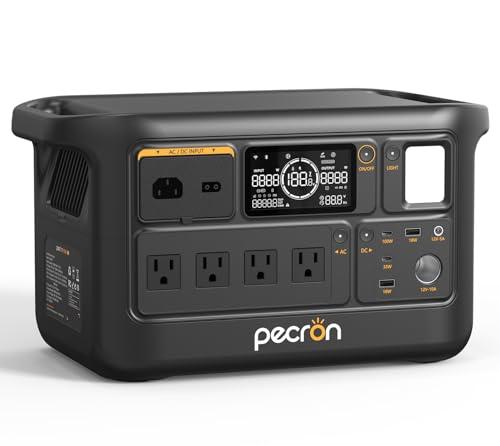
At 600W the F1000LFP has the highest solar ceiling on this shortlist, taking in roughly two and a half humidifier nights of energy in a day of sun, which is what turns a four-night trip into an open-ended one. It gets there at 23.9 lb, lighter than the larger-capacity AC180, and its outlet panel includes DC options so the CPAP need not go through the inverter at all.
What we like about the Pecron F1000LFP
- 600W maximum solar input is the highest ceiling here, taking in roughly two and a half humidifier nights of energy on a clear day, against the AC180's 500W and the RIVER 2 Pro's 220W
- 960Wh covers two humidifier-off nights and most of a third at our 35W assumption
- Pure sine wave output, which is what a CPAP blower motor and its control board expect
- Carries a DC 5525 barrel and a car port, so the machine can run on DC and skip the inverter conversion loss
- 40.2Wh per pound is within 5% of the best ratio here, the RIVER 2 Pro's 42.2, despite holding almost a kilowatt-hour
Where it falls short for the Pecron F1000LFP
- Our specification record carries no rated cycle life for this unit, so we cannot tell you how many nightly charges it is built for, while the Jackery Explorer 500 v2 is rated for 6,000
- The 1500W inverter is far larger than a 35W to 80W CPAP needs, and a big inverter left on all night carries no-load overhead that a DC connection would avoid
- At 23.9 lb it is a car-camping and lift-it-once unit, not something to carry any distance on a trail
- The 600W ceiling only pays off if you actually buy 600W of panels, which is a large array to pack
Key specifications
- Capacity
- 960Wh
- AC output
- 1500W pure sine wave
- Max solar input
- 600W
- AC recharge time
- 50 minutes to 80%, 70 minutes to full at 1000W AC
- UPS switchover
- Within 20ms
- Weight
- 23.9 lb (10.8 kg)
Everything about this unit is arranged around one number that most CPAP buyers ignore: the 600W solar input ceiling.
Why the solar ceiling decides a long trip
A CPAP with the heated humidifier and heated tube running draws roughly 80W averaged across the night on our assumption, which is 640Wh across eight hours. A CPAP with the humidifier off draws roughly 35W, or 280Wh a night.
At 960Wh rated, and taking usable capacity at 85%, the F1000LFP holds about 816Wh. That is two humidifier-off nights with about 7.3 hours left over on the third, or one full humidifier night plus a little over two hours.
Stored capacity alone therefore buys you a weekend, not a week. The solar ceiling is what extends it. Assume a matched array returns about 70% of its rated wattage across four usable peak-sun hours, and a 600W input accepts around 1,680Wh in a day. That covers just over two and a half humidifier nights, or six nights with the humidifier off. The battery stops being the trip’s limit and becomes a buffer between sundown and sunrise. The AC180’s 500W ceiling clears a humidifier night too, at about 1,400Wh, but from a bigger pack that takes longer to refill; nothing else here comes close.
By the same arithmetic the RIVER 2 Pro’s 220W ceiling returns about 616Wh a day, which is 24Wh short of a single humidifier night. That is the whole difference between the two units for anyone camping past a weekend.
The DC point, which matters more than the inverter rating
The 1500W pure sine wave inverter is a specification you will never use. Your machine draws under 100W. What matters is that the outlet panel carries a DC 5525 barrel and a car port alongside the four AC outlets. Running the CPAP from DC where your machine’s manufacturer sells a DC cord avoids the inverter conversion entirely, and an inverter left running all night to serve a 35W load is the least efficient way to use a battery.
We apply an 85% usable-capacity assumption for AC use in this guide for exactly that reason, and a DC connection is the one change that makes the assumption conservative rather than optimistic.
Where it gives ground
Our specification record for the F1000LFP does not carry a rated cycle life. The AC180 publishes 3,500 cycles to 80%, the RIVER 2 Pro 3,000, and the Jackery Explorer 500 v2 6,000. For a unit you intend to cycle every night of a two-week trip that is a real gap in what we can tell you, and it is the main reason someone might choose differently.
It also weighs 23.9 lb. That is fine beside a car and unpleasant on a trail.
Who should buy it
Buy this if you camp for more than two nights at a time, run the humidifier, and will actually carry panels. If you will not carry panels, the ceiling that justifies this unit does nothing for you and the arithmetic points at raw capacity instead.
- Best for
- Multi-night camping where you run the heated humidifier and can set out panels during the day, so the battery never has to hold the whole trip at once.
- Choose something else if
- You are carrying the unit on foot, or you will not be buying solar panels, in which case the 600W ceiling that justifies it is wasted.
Best for humidifier and heated tube every night
BLUETTI AC180
BLUETTI
If you refuse to turn the humidifier off, this is the shortlist's largest reserve: 1152Wh, or roughly one and a half full humidifier nights before a single watt of sun or grid arrives. It pays for that in mass, at 35.3 lb, and the pack cannot be expanded, so what you buy is what you will ever have.
What we like about the BLUETTI AC180
- 1152Wh is the largest reserve here, about 979Wh usable, covering three humidifier-off nights with four hours to spare
- 45 minutes to 80% is the fastest refill on this shortlist, so a short stop at a powered site is worth making
- 500W solar input accepts roughly 1,400Wh on a clear day, more than two humidifier nights of draw
- Rated for 3,500 cycles to 80%, which is nine and a half years of nightly charging
- Under 20ms switchover is short enough that a machine plugged in at home should ride through a grid cut without stopping, though that depends on your machine's own power supply
Where it falls short for the BLUETTI AC180
- At 35.3 lb it is 11.4 lb heavier than the Pecron F1000LFP for only 192Wh more, the worst capacity-per-pound ratio here at 32.6Wh per pound
- The pack is not expandable, so when a trip outgrows 1152Wh your only option is a second unit
- Its 500W solar ceiling is below the F1000LFP's 600W despite the larger battery, so it takes longer in sun to refill from empty
- The 1800W inverter and Power Lifting mode are irrelevant to a 35W to 80W CPAP and add no-load overhead if you run the machine on AC all night
Key specifications
- Capacity
- 1152Wh
- AC output
- 1800W (2700W Power Lifting)
- Max solar input
- 500W
- AC recharge time
- 45 minutes to 80%
- UPS switchover
- Under 20ms
- Weight
- 35.3 lb (16.0 kg)
- Rated cycle life
- 3,500 cycles to 80%
- Expandable
- No
The AC180 wins one argument outright, and it is the argument a lot of CPAP users actually care about: how long can I go before I have to think about power again.
The humidifier is the whole question
A heated humidifier and heated tube are the difference between a CPAP being a small load and a meaningful one. On our assumption of 80W averaged across an eight-hour night, they cost 640Wh. With the humidifier off, the same night costs about 280Wh at 35W.
At 1152Wh rated and 85% usable, the AC180 holds roughly 979Wh. That is one full humidifier night with about four hours of a second, or three humidifier-off nights with four hours left over. Nothing else here comes close on a single charge. The Pecron F1000LFP manages 816Wh usable, the RIVER 2 Pro 653Wh, and the Jackery Explorer 500 v2 435Wh, which does not reach a single humidifier night at all.
If you have decided the humidifier stays on, that ranking is the ranking.
What the weight actually costs you
The bill arrives at 35.3 lb. Divide capacity by mass and the AC180 returns 32.6Wh per pound, against 40.2 for the F1000LFP, 40.6 for the Jackery and 42.2 for the RIVER 2 Pro. It is the least efficient unit here per pound carried, and it is 11.4 lb heavier than the F1000LFP for 192Wh more.
Put another way: the AC180 costs about 10.1 lb for every humidifier-off night it carries. The RIVER 2 Pro costs 7.8 lb per night. If your unit lives in a car boot and gets lifted to a table once, that gap is noise. If you move it, it is the reason to buy something else.
The two specifications that surprise people
First, recharge. Forty-five minutes to 80% is the fastest here, ahead of the Jackery’s 52 minutes, the F1000LFP’s 50 and the RIVER 2 Pro’s 70 minutes to full. Forty-five minutes gets 80% of 1152Wh into the pack, roughly 920Wh rated or about 780Wh usable, so a coffee stop at a powered site is worth one full humidifier night with nearly two hours over, or close to three nights with the humidifier off.
Second, switchover. Under 20ms is short enough that a machine left plugged in at home should stay running through a grid cut rather than stopping and restarting, though whether yours does depends on its own power supply rather than on this unit. Many CPAP users buy their first power station for exactly this and never take it camping.
Where it stops
The pack is not expandable. Every other capacity decision on this shortlist has some route upward; this one does not. When 1152Wh is no longer enough you buy a second unit, not a battery. Pair that with the 500W solar ceiling, which is lower than the smaller F1000LFP’s 600W, and this is a unit designed to be filled from the wall and carried out full, rather than topped up in the field.
- Best for
- CPAP users who run the heated humidifier at full setting every night and want the largest single-charge reserve before solar or a mains socket is involved.
- Choose something else if
- You have to carry the unit any distance, or you expect your needs to grow, since the pack cannot be expanded and already weighs 35.3 lb.
Best for backpacking and canoe trips you carry
EcoFlow RIVER 2 Pro
EcoFlow
Nothing else here moves as many nights of therapy per pound: 768Wh in an 18.2 lb body works out at 42.2Wh per pound, and about 7.8 lb for each humidifier-off night it carries. The catch is the 220W solar ceiling, which falls just short of replacing one humidifier night in a day of sun.
What we like about the EcoFlow RIVER 2 Pro
- 42.2Wh per pound is the best ratio on this shortlist, and 18.2 lb is genuinely liftable with a pack already on
- 653Wh usable covers two humidifier-off nights with about 2.7 hours into the third
- 70 minutes takes it to full rather than to 80%, so a single stop leaves nothing behind
- Rated for 3,000 cycles to 80%, which is over eight years of charging it every single night
- Eleven outlets give you somewhere to put a phone, a lamp and a watch charger without unplugging the machine
Where it falls short for the EcoFlow RIVER 2 Pro
- The 220W solar ceiling accepts roughly 616Wh on a clear day, about 24Wh short of a single humidifier night, so a humidifier user on solar loses ground every day
- 768Wh usable is 653Wh, which is one humidifier night with roughly 13Wh spare and no margin for a cold night or a higher pressure setting
- Our specification record lists no UPS switchover figure, so we cannot recommend it as a bedside unit that keeps therapy running through a grid cut
- It holds 192Wh less than the Pecron F1000LFP for only 5.7 lb saved, so the moment the unit travels in a car rather than on your back you have given up more than half a humidifier-off night of reserve to save weight you never carry
Key specifications
- Capacity
- 768Wh
- AC output
- 800W
- Max solar input
- 220W
- AC recharge time
- 70 minutes to full
- Weight
- 18.2 lb (8.3 kg)
- Rated cycle life
- 3,000 cycles to 80%
Weight is the only specification that matters once you have to move a power station yourself, and the RIVER 2 Pro is the unit that treats it seriously.
The number that wins this category
768Wh in an 18.2 lb body is 42.2Wh per pound. The Jackery Explorer 500 v2 returns 40.6, the Pecron F1000LFP 40.2, and the BLUETTI AC180 32.6.
Translate that into the thing you actually plan around. With the humidifier off, we assume 35W averaged across an eight-hour night, so 280Wh a night. Taking usable capacity at 85%, the RIVER 2 Pro holds about 653Wh, which is two full nights and 2.7 hours of a third. That is 7.8 lb of kit for every night carried. The AC180 costs 10.1 lb a night, the F1000LFP 8.2, the Jackery 8.1.
For a two-night trip where the unit rides in a pack or on a portage, this is the correct answer and it is not close.
Where the arithmetic turns against it
Turn the humidifier on and the same night costs 640Wh at our 80W assumption. 653Wh usable clears that by about 13Wh, which is roughly ten minutes. There is no margin in that figure for a cold night, a higher pressure setting, or a pack that has aged.
Then the solar problem. A 220W input ceiling, assuming a matched array returns around 70% of rating across four usable peak-sun hours, accepts roughly 616Wh in a day. That is 24Wh less than one humidifier night. A humidifier user recharging only by solar therefore goes backwards, slowly, every single day. Not dramatically, but the direction is fixed and the trip ends when the battery does.
The F1000LFP’s 600W ceiling accepts about 1,680Wh by the same method, which is just over two and a half humidifier nights. That is the entire reason it leads this guide and this unit does not.
What it is like to live with
Eleven outlets on a unit this small means the CPAP never has to be unplugged so something else can charge, which sounds trivial until you are doing it in the dark. Seventy minutes to full rather than to 80% is a quietly better specification than it looks, because 80% figures always hide a slower final stretch.
Three thousand cycles to 80% works out at more than eight years if you charge it every night of every year, so the pack is not the thing that will limit this purchase.
Who should choose something else
Anyone buying a bedside unit. Our specification record for the RIVER 2 Pro carries no switchover figure, and a CPAP that stops and restarts in the middle of the night is exactly the failure a home buyer is trying to prevent. The Jackery Explorer 500 v2 publishes 10ms and is the lighter answer for that job.
- Best for
- Two-night trips where the unit has to be carried rather than wheeled, especially if you sleep without the humidifier and want the lightest honest reserve.
- Choose something else if
- You run the heated humidifier and intend to recharge by solar, because the 220W ceiling cannot replace what a humidifier night takes out.
Best for bedside outage backup
Jackery Explorer 500 v2
Jackery
Most people searching for a CPAP power station are not camping at all; they want therapy to survive a blackout. The Explorer 500 v2 answers that job with a 10ms switchover and a 6,000-cycle rating, which is sixteen years of charging it every night. It is not a camping battery, because 512Wh will not carry a humidifier night.
What we like about the Jackery Explorer 500 v2
- 10ms switchover is the fastest here, fast enough that the machine should not stop and restart when the grid drops
- 6,000 rated charge cycles is 16.4 years of nightly cycling, nearly double the AC180's 3,500 and exactly double the RIVER 2 Pro's 3,000
- At 12.6 lb it is by far the lightest unit on this shortlist and can sit on a nightstand
- 40.6Wh per pound, ahead of the F1000LFP's 40.2 and well ahead of the AC180's 32.6, so the small pack is not wasted mass
- 52 minutes to 80% means it is back to useful charge inside an hour after an outage ends
Where it falls short for the Jackery Explorer 500 v2
- 512Wh gives about 435Wh usable, which is only 5.4 hours with the heated humidifier running and does not reach a full eight-hour night
- Our specification record lists only two AC outlets and no DC or car socket, so the CPAP has to run through the inverter and pay the conversion loss
- No maximum solar input is published in our record, so we cannot treat this as a unit you recharge in the field
- The 500W inverter is the smallest here and leaves nothing spare if you also want to run a kettle or a compressor fridge from it
Key specifications
- Capacity
- 512Wh
- AC output
- 500W (1000W surge)
- UPS switchover
- 10ms
- AC recharge time
- 52 minutes to 80%
- Weight
- 12.6 lb (5.7 kg)
- Rated cycle life
- 6,000 charge cycles
This is the pick for the reader whose problem is not a campsite. It is a grid that goes down, and a machine that stops when it does.
The specification that matters for an outage
Ten milliseconds. That is the switchover figure, and it is the fastest on this shortlist, ahead of the Pecron F1000LFP at within 20ms and the AC180 at under 20ms. A gap that short should pass beneath the threshold at which a CPAP drops out and needs to restart, which is the failure a home buyer is trying to prevent.
That said, whether your particular machine rides through it depends on your machine’s own power supply, not on the battery. This is worth confirming with your device before you rely on it.
Sixteen years of nights
The other outage-relevant number is cycle life. Jackery publishes 6,000 charge cycles here. The AC180 publishes 3,500 to 80%, the RIVER 2 Pro 3,000 to 80%, and our record for the F1000LFP carries no figure at all.
Six thousand cycles divided by 365 is 16.4 years of charging it every single night. For a unit that will sit permanently plugged in and cycle shallowly during cuts, that rating is the difference between equipment and a consumable.
Why it is fourth, not first
Capacity. 512Wh rated is roughly 435Wh usable at our 85% assumption. Run a CPAP with the heated humidifier and heated tube at our 80W assumption and that is 5.4 hours, which stops about two and a half hours short of an eight-hour night. With the humidifier off at 35W, it stretches to one night plus about 4.4 hours into a second.
So as a camping battery it is a one-night unit at best, and a partial night if you want humidity. Anyone planning a trip should be reading the F1000LFP or AC180 sections instead. As a bedside unit, where the grid refills it the moment power returns, 435Wh is a perfectly sensible amount of insurance.
The connection detail
Our specification record for this unit lists two AC sine wave outlets and nothing else. No DC barrel, no car socket. That matters more than it sounds, because running a CPAP from DC where your machine’s maker supplies a DC cord skips the inverter conversion entirely and is the cheapest way to add runtime to a small pack. On this unit that route is not available to us, so every watt-hour goes through the inverter.
At 12.6 lb, though, it is the only unit here you can move with one hand and leave on a nightstand without it dominating the room. For the job it is picked for, that is the right trade.
- Best for
- Keeping a CPAP running through a power cut at home, on a nightstand, where the unit is plugged in permanently and only ever discharges during an outage.
- Choose something else if
- You camp with the heated humidifier on, because 435Wh usable runs out about two and a half hours short of a full night.
How we researched this guide
Four units between 512Wh and 1152Wh were compared on published manufacturer specifications and aggregated owner reports. None were tested by us and no CPAP was connected to any of them. Every runtime figure on this page is calculated from rated capacity using the load assumptions stated in the buying guide, and each review names the sources and limits behind its placement plus at least one meaningful drawback for every recommendation we make.
The full process is on our how we test portable power stations page, including what counts as hands-on use.
- Units evaluated
- 4
- Used hands-on
- 0
- Assessed from documentation and owner reports
- 4
Evaluation methods used: specification comparison, documentation and owner-report research
Which one should you buy?
Match your situation on the left to the recommendation on the right.
-
You camp for more than two nights and will carry solar panels
Recommendation: Buy the Pecron F1000LFP for its 600W solar ceiling, which accepts roughly two and a half humidifier nights of energy in a day
-
You run the heated humidifier every night and want one charge to cover the trip
Recommendation: Buy the BLUETTI AC180, which holds 1152Wh, the largest single-charge reserve on this shortlist
-
You have to carry the unit on your back or in a canoe
Recommendation: Buy the EcoFlow RIVER 2 Pro at 18.2 lb, the only unit here under 20 lb that still covers two humidifier-off nights
-
You want the machine to keep running when the power goes out at home
Recommendation: Buy the Jackery Explorer 500 v2 for its 10ms switchover and 6,000-cycle rating
-
You sleep without the humidifier and want the lightest possible unit
Recommendation: Buy the Jackery Explorer 500 v2 at 12.6 lb, which covers a night and 4.4 hours of a second
Mistakes buyers make
- Sizing the battery from the CPAP's nameplate wattage, which reflects peak draw at maximum pressure rather than the average across a night
- Planning a trip on rated watt-hours and finding the inverter has already taken its cut, leaving roughly 85% of the number on the box
- Buying capacity for a multi-night trip when the solar input ceiling is what actually caps the trip length
- Assuming the heated humidifier is a minor extra when it roughly doubles the overnight load
- Running the machine through the AC inverter all night when the manufacturer sells a DC cord that skips the conversion entirely
- Treating a fast switchover figure as a guarantee that your specific machine restarts cleanly, when that depends on the machine's own power supply
Our final recommendation
If you want one answer rather than a shortlist, this is the unit that suits the widest range of readers in this category.
Best for solar-recharged multi-night trips
Multi-night camping where you run the heated humidifier and can set out panels during the day, so the battery never has to hold the whole trip at once.
Questions buyers ask
How many watts does a CPAP actually use?
It depends on your pressure setting and whether the humidifier is on, so we plan with two figures rather than one: roughly 35W averaged across the night without humidification, and roughly 80W with a heated humidifier and heated tube. Check your machine's own documentation, because a high pressure setting pushes both numbers up.
Will my CPAP restart on its own after the power comes back?
Most machines resume when power returns, but they stop first, and some ask for a button press or lose the ramp setting. That interruption is what a fast switchover prevents. Confirm the behaviour with your own device before relying on a battery to cover a cut, because it is a property of the machine and not of the power station.
Should I run the CPAP on DC or through the AC outlet?
Use DC if your machine's manufacturer sells a DC cord for it. Going through the inverter means converting the pack's DC to AC and then back to DC inside the machine's own power supply, and you pay for both conversions in watt-hours. A DC connection also lets you turn the inverter off entirely overnight.
Do these lose capacity on a cold night?
Yes. Every lithium pack delivers less in the cold, and LiFePO4 cells also refuse to charge below freezing to protect themselves. A unit left outside the tent on a near-freezing night will give you less than these figures suggest and may not accept a solar charge until it warms up in the morning.
Can I fly with one of these?
No. Every unit here is far above the 100Wh lithium limit airlines apply to cabin batteries, and the 160Wh ceiling that some carriers allow with prior approval. These are for driving, camping and bedside use. Air travel needs a dedicated CPAP battery sized under the airline limit.
About the author