Solar Panel Pairing: 4 Power Stations Compared on Input Ceiling

Off-grid power editor
Published
Updated
Last fact-checked
This guide is for people who already own solar panels, or are about to, and need to know which power station will absorb what those panels make. The number that decides it is the solar input ceiling, because it caps the size of the array no matter how many panels you connect. We compared four units on that ceiling, on capacity, on inverter output and on weight, then converted each pairing into the figure manufacturers rarely publish: hours from empty to full on panels alone, using a stated derating assumption rather than laboratory conditions. We did not test these units and every review says what its judgement rests on. What you get here is the refill ratio that separates a unit which fills by mid-morning from one that spends the week catching up, the break-even panel wattage for a common household load, and a plain explanation of why the input ceiling and the voltage window are two different limits that both have to be respected.
What is the best portable power station for solar panels?
The BLUETTI AC200L suits the widest range of solar setups. Its 1200W input ceiling absorbs a four to six panel array, and against a 2048Wh pack that fills the battery in roughly two and a half hours of strong sun. If your panels fold into a bag rather than mount on a roof, the Pecron F1000LFP pairs better because it takes 600W into only 960Wh and weighs 23.9 lb.
Key takeaways
- The solar input ceiling caps total array watts, so extra panels beyond it are simply clipped and wasted
- Plan on about 70% of rated panel wattage in real sun; the remaining 30% goes to heat, tilt and wiring loss
- Divide solar ceiling by capacity to get the refill ratio; near 0.5 or above fills the pack in a morning
- Adding expansion batteries never raises the input ceiling, so a bigger bank always means a slower solar fill
- Covering a full-size fridge from panels alone needs roughly 1,030W of rated array in summer and closer to 1,714W in winter
Our picks at a glance
Every unit below wins a specific situation rather than a place in a ranking. Pick the row that matches how you will actually use it.
-
Best for a six-panel array without a permanent install

BLUETTI AC200L
Off-grid setups with four to six rigid panels already mounted, where the goal is to refill a large pack every clear day rather than trickle it.
-
Best for charging from panels and the wall together

EcoFlow DELTA 2 Max
People who alternate between panel charging in the field and a wall socket at home, and want the battery full again before the next trip starts.
-
Best for a solar refill you can carry
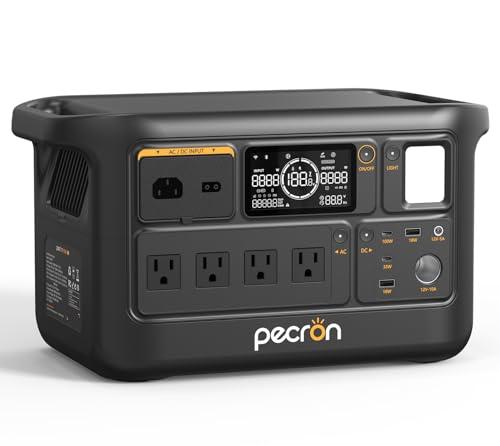
Pecron F1000LFP
Weekend camping and van setups where one or two folding panels totalling 400W to 600W are the entire charging system and the unit has to be carried.
-
Best for a permanent roof or ground array

Anker SOLIX F3800
Cabins, workshops and homes with a fixed array already on the roof or the ground, where the unit is bolted in place and the panels are permanent.
How they compare
Scroll the table sideways to see every column.
| Product | Where to buy | Award | Max solar input | Capacity | AC output | AC recharge time | Weight | Expandable | Best for |
|---|---|---|---|---|---|---|---|---|---|
| BLUETTI AC200L | Best for a six-panel array without a permanent install | 1200W | 2048Wh | 2400W | 0-80% in 45 minutes (2400W AC input) | 61.41 lb (27.9 kg) | Yes, to 8192Wh with expansion batteries | Off-grid setups with four to six rigid panels already mounted, where the goal is to refill a large pack every clear day rather than trickle it. | |
| EcoFlow DELTA 2 Max | Best for charging from panels and the wall together | 1000W | 2048Wh | 2400W (3400W X-Boost) | 1.1 hours to 80% on AC, 43 minutes with AC plus solar | 50.7 lb (23.0 kg) | Yes, from 2kWh to 6kWh with up to 2 extra batteries | People who alternate between panel charging in the field and a wall socket at home, and want the battery full again before the next trip starts. | |
| Pecron F1000LFP | Best for a solar refill you can carry | 600W | 960Wh | 1500W pure sine wave | 50 minutes to 80%, 70 minutes to full at 1000W AC | 23.9 lb (10.8 kg) | -- | Weekend camping and van setups where one or two folding panels totalling 400W to 600W are the entire charging system and the unit has to be carried. | |
| Anker SOLIX F3800 | Best for a permanent roof or ground array | 2400W | 3840Wh | 6000W | About 1.5 hours to full | 132 lb (60 kg) | Yes, to 26.9kWh with expansion batteries | Cabins, workshops and homes with a fixed array already on the roof or the ground, where the unit is bolted in place and the panels are permanent. |
The full reviews
Best for a six-panel array without a permanent install
BLUETTI AC200L
BLUETTI
The AC200L accepts 1200W of solar, the highest ceiling here on a unit one person can still shift alone. Against its 2048Wh pack that is enough input to refill the battery inside a single strong morning, which is the whole point of buying panels rather than a longer extension cord.
What we like about the BLUETTI AC200L
- Accepts 1200W of panel, so a six-panel array is absorbed rather than clipped
- 1200W into 2048Wh works out at 0.59 solar watts per watt-hour, behind only the Pecron and the F3800 which both sit at 0.63
- 2400W inverter runs a fridge, a kettle and tools while the array is still charging the pack
- Expandable to 8192Wh, so the same array can feed a much larger bank over several days
Where it falls short for the BLUETTI AC200L
- At 61.41 lb this is a two-hand, planted-feet lift, and moving it around a site to chase sun is not realistic
- The solar ceiling stays at 1200W when you expand to 8192Wh, so a fully expanded bank needs roughly ten hours of strong sun to fill from empty and will not do it in one winter day
- The 1200W ceiling only pays off if you own the array to fill it: on the 400W of folding panel most buyers actually have, an empty 2048Wh pack takes about 7.3 hours of strong sun, longer than a winter day gives you
- The 45-minute AC figure is 0-80%, not a full charge, and it needs a 2400W wall feed that a 15A household circuit shared with other loads will not always give you
Key specifications
- Max solar input
- 1200W
- Capacity
- 2048Wh
- AC output
- 2400W
- AC recharge time
- 0-80% in 45 minutes (2400W AC input)
- Weight
- 61.41 lb (27.9 kg)
- Expandable
- Yes, to 8192Wh with expansion batteries
The AC200L is the unit on this list built around the array rather than around the battery. Its 1200W solar ceiling is what separates it from everything else you can lift without a trolley.
What 1200W of input actually buys
Rated panel wattage is a laboratory number. In real midday sun, after heat, wiring loss and imperfect tilt, planning on about 70% of the rating is the honest figure. A 1200W array therefore delivers roughly 840W into the unit.
Divide the 2048Wh pack by that and you get about 2.4 hours from empty to full. In practice you plug in at breakfast and the battery is done before lunch, with the rest of the day’s sun going straight through to whatever you are running.
Stretch it across a day instead. Five peak sun hours at 840W is around 4,200Wh harvested. A full-size fridge averaging 150W across its duty cycle needs about 3,600Wh a day. The AC200L is the only unit here short of the F3800 class that can cover that load from panels alone and still bank a surplus.
Why the ratio matters more than the ceiling
A big input number is worthless if the pack behind it is bigger still. The useful figure is solar watts accepted per watt-hour stored: 1200 divided by 2048 gives 0.59. Anything near or above 0.5 refills in a morning. Anything well below it spends the day catching up.
That ratio is also why expansion is the trap here. The pack grows to 8192Wh; the input ceiling does not move. Filling a maxed bank from empty at 840W takes close to ten hours of strong sun, which is more than one usable solar day for most of the year. Expand for storage across cloudy days, not for faster refills.
Living with the weight
At 61.41 lb this is 2048Wh divided by 61.41, or roughly 33 watt-hours per pound. The DELTA 2 Max stores the same 2048Wh for 50.7 lb. If the unit lives in one place and the panels come to it, that gap does not matter. If you are lifting it into a truck bed every weekend, it does.
The 2400W inverter is the compensation. You can run the fridge, boil a kettle and charge tools while the array is still topping the battery, and nothing about that combination gets close to the rating.
Who should choose something else
Anyone with a single 200W folding panel. You would be feeding a 1200W controller with a sixth of what it can take, carrying 61 lb to do it, and a smaller unit would refill just as fast from the same panel.
- Best for
- Off-grid setups with four to six rigid panels already mounted, where the goal is to refill a large pack every clear day rather than trickle it.
- Choose something else if
- You own one or two foldable panels totalling under 400W, because most of the 1200W input hardware you are paying for will never be used.
Best for charging from panels and the wall together
EcoFlow DELTA 2 Max
EcoFlow
EcoFlow publishes a combined figure most brands leave out: 43 minutes to 80% when AC and solar feed the DELTA 2 Max at the same time, against 1.1 hours on AC alone. For anyone who camps near a hookup or rides out outages with intermittent grid, that dual path is worth more than a bigger panel ceiling.
What we like about the EcoFlow DELTA 2 Max
- Reaches 80% in 43 minutes on AC and solar together, against 1.1 hours on AC alone
- Stores 2048Wh for 50.7 lb, about 40 watt-hours per pound, level with the far smaller Pecron and well clear of the AC200L and F3800
- 1000W solar ceiling still fills the pack in roughly three hours of strong sun
- 15 ports, the most on this shortlist, backed by a 5-year warranty
Where it falls short for the EcoFlow DELTA 2 Max
- The 1000W ceiling against 2048Wh is only 0.49 solar watts per watt-hour, the weakest refill ratio here, so on a cloudy week it falls behind the AC200L
- Expanding to 6kWh does not raise the solar ceiling, so a full bank needs about nine hours of strong sun and realistically two days of panel-only charging
- The 3400W X-Boost figure is reached by dropping output voltage and applies to resistive loads only, never to a compressor or a pump
- Even a full 1000W array misses break-even on a full-size fridge: about 3,500Wh harvested across five peak sun hours against the roughly 3,600Wh the fridge draws in a day, so the pack ends each day lower than it started while the AC200L on the same shortlist banks a surplus
Key specifications
- Max solar input
- 1000W
- Capacity
- 2048Wh
- AC output
- 2400W (3400W X-Boost)
- AC recharge time
- 1.1 hours to 80% on AC, 43 minutes with AC plus solar
- Weight
- 50.7 lb (23.0 kg)
- Expandable
- Yes, from 2kWh to 6kWh with up to 2 extra batteries
Every unit here charges from solar. The DELTA 2 Max is the one that publishes what happens when solar and the wall run at once, and that number changes how you plan a trip.
The dual-input case
On AC alone the pack reaches 80% in 1.1 hours. Add panels and the same 80% arrives in 43 minutes. That is roughly a third off the wait, and it lands in the exact scenario most owners are actually in: a campsite with a hookup, a driveway before departure, a house with power flickering back on between cuts.
It matters most when the sun is not doing the whole job. On an overcast morning the panels might contribute a few hundred watts rather than the full ceiling, and the AC feed simply covers the gap instead of the charge stalling.
Solar-only arithmetic
Plan on about 70% of rated panel wattage in real conditions. A 1000W array therefore gives roughly 700W. Divide 2048Wh by 700W and a solar-only refill takes close to three hours of strong sun.
Across a whole day, five peak sun hours at 700W is around 3,500Wh harvested. That is just under the 3,600Wh a full-size fridge averaging 150W uses in twenty-four hours. Panel-only, this unit very nearly breaks even on a fridge and does not quite get there, which is a useful thing to know before you assume it will.
Where the ratio bites
Divide the ceiling by the capacity: 1000 into 2048 is 0.49 solar watts per watt-hour. The AC200L manages 0.59, and the Pecron and the F3800 both reach 0.63. On a run of bright days the difference is invisible because everything fills by mid-morning. On a grey week it is the whole story, because the unit with the higher ratio recovers more of its pack from the same weak light.
Expansion makes that worse rather than better. The bank grows to 6kWh; the input stays at 1000W. Filling 6kWh at 700W is roughly nine hours, so a fully expanded system is a two-day panel charge in anything but perfect summer conditions. Treat the extra batteries as reserve for bad weather, not as capacity your panels will turn over daily.
Weight is where it wins back ground
2048Wh in 50.7 lb is about 40 watt-hours per pound. The AC200L stores the same energy in 61.41 lb, roughly 33 per pound. Eleven pounds is the difference between a one-person lift and a careful one, and if the unit moves between a car, a tent and a garage it is the specification you will notice most.
Who should choose something else
If your panels are your only charging source for weeks at a time, buy the higher ratio instead. The combined charge path is this unit’s headline feature, and off grid it is dead weight.
- Best for
- People who alternate between panel charging in the field and a wall socket at home, and want the battery full again before the next trip starts.
- Choose something else if
- You are genuinely off grid with no AC socket for weeks, because the feature you are paying for here is the combined charge path you will never use.
Best for a solar refill you can carry
Pecron F1000LFP
Pecron
A 600W solar ceiling on a 960Wh pack ties this unit with the 132 lb F3800 for the highest input-to-storage ratio of the four, and it does it at 23.9 lb. It is the one you can walk to the panels rather than dragging the panels to it, and it refills before lunch on a clear day.
What we like about the Pecron F1000LFP
- 600W input against 960Wh of storage is 0.63 solar watts per watt-hour, tied with the F3800 for the best refill ratio here and reached at under a fifth of its 132 lb
- 23.9 lb makes it a genuine one-hand carry, so the unit can follow the sun around a site
- 960Wh in 23.9 lb is about 40 watt-hours per pound, matching units more than twice its weight
- Sub-20ms UPS switchover lets it sit between a wall socket and a router while panels top it up
Where it falls short for the Pecron F1000LFP
- The 1500W inverter is 900W below the AC200L and DELTA 2 Max on this list and may not start a full-size fridge compressor, which rules out the most common backup job
- The 600W ceiling is the lowest here, so an existing array above 600W is clipped and the surplus panels contribute nothing at all
- Unlike the other three units here, no expansion battery is listed in its specifications, so growing past 960Wh means buying a second unit
- The 50-minute AC figure is to 80% and needs a 1000W wall feed; a full charge is 70 minutes, and not every campsite pedestal or shared circuit will supply that draw
Key specifications
- Max solar input
- 600W
- Capacity
- 960Wh
- AC output
- 1500W pure sine wave
- AC recharge time
- 50 minutes to 80%, 70 minutes to full at 1000W AC
- Weight
- 23.9 lb (10.8 kg)
- UPS switchover
- Within 20ms
Most solar pairing advice pushes you towards a bigger battery. This unit is the argument for the opposite: a small pack with an oversized input, so the panels finish the job in one morning instead of chasing it all week.
The ratio that decides a one-day refill
Divide solar ceiling by capacity. The Pecron takes 600W into 960Wh, which is 0.63 solar watts per watt-hour. Only the 132 lb F3800 matches that figure, and it tells you the pack is small relative to what can be pushed into it.
Put real numbers on it. Rated panel wattage is optimistic; plan on about 70% in midday sun. A 600W array delivers roughly 420W. Divide 960Wh by 420W and you get about 2.3 hours from empty to full.
Now stretch it over a day. Five peak sun hours at 420W is around 2,100Wh harvested, against a 960Wh pack. The array can fill the battery twice over. That surplus is not wasted if you are running loads during daylight, which is exactly how a campsite works: fridge, laptop and lights draw straight from the panels while the battery holds the evening in reserve.
The weight case
23.9 lb is a suitcase, not equipment. Divide 960Wh by that and you get about 40 watt-hours per pound, which matches the DELTA 2 Max and beats the AC200L and the F3800. You get that density without giving up the ability to pick the thing up with one hand and move it to where the panel is pointing.
That mobility is worth more in solar than it is anywhere else. Panels lose real output to shade and bad angles, and the cheapest fix is moving the setup an hour into the afternoon. A 61 lb unit does not get moved. This one does.
Where the 1500W inverter stops you
This is the specification that decides whether the Pecron belongs in your setup. 1500W is fine for induction-free cooking, laptops, a CPAP machine, lights and a 12V compressor fridge. It is not a confident start for a full-size household refrigerator, whose compressor pulls a large surge for a fraction of a second at switch-on. The AC200L and DELTA 2 Max both carry 2400W and clear that comfortably.
If your reason for buying panels is keeping a kitchen fridge alive through outages, this is the wrong unit and the arithmetic does not save it.
The other ceiling
960Wh is roughly a quarter of what a full-size fridge uses in a day. Once the pack is full by mid-morning, further sun only helps if something is drawing. There is no expansion battery in its published specifications, so the growth path is a second unit rather than a bigger bank. Buy it knowing 960Wh is the answer, not the starting point.
- Best for
- Weekend camping and van setups where one or two folding panels totalling 400W to 600W are the entire charging system and the unit has to be carried.
- Choose something else if
- You need to start a full-size refrigerator compressor, or you draw more than about a kilowatt-hour a day and cannot add a second unit.
Best for a permanent roof or ground array
Anker SOLIX F3800
Anker
Nothing else here takes 2400W of panel. That ceiling, a 3840Wh pack and a path to 26.9kWh make the F3800 the only unit on this list you can build a fixed array around and expect to live off. It is also 132 lb, so it is installed once and never moved again.
What we like about the Anker SOLIX F3800
- 2400W solar ceiling is double the next highest here and absorbs a genuine rooftop or ground array
- 2400W into 3840Wh is 0.63 solar watts per watt-hour, level with the far smaller Pecron for the best refill ratio here, so the pack still fills in a morning despite its size
- 6000W inverter with 120V and 240V split phase covers well pumps and ranges no other unit here can start
- Expandable to 26.9kWh, so the same array can charge a bank sized for several cloudy days
Where it falls short for the Anker SOLIX F3800
- At 132 lb it stores only about 29 watt-hours per pound, the worst density here, and it moves on wheels rather than being carried
- Filling the expanded 26.9kWh bank at a realistic 1680W of harvest takes roughly sixteen hours of strong sun, which at five peak sun hours is over three solar days rather than one
- A 2400W array is rigid panels on a mounted structure, not folding panels, so the real project is mounting and wiring rather than the power station itself
- The 240V split-phase output is only useful through a transfer switch installed by an electrician, which is a separate job and cost
Key specifications
- Max solar input
- 2400W
- Capacity
- 3840Wh
- AC output
- 6000W
- AC recharge time
- About 1.5 hours to full
- Weight
- 132 lb (60 kg)
- Expandable
- Yes, to 26.9kWh with expansion batteries
The other three units on this list are batteries you can charge with panels. The F3800 is the point where the array becomes the system and the power station is just the thing it feeds.
What a 2400W ceiling changes
Derate rated panel wattage by about 30% for heat, tilt and wiring and a 2400W array puts roughly 1680W into the unit. Divide the 3840Wh pack by that and a full refill takes about 2.3 hours of strong sun, which is the same morning fill the far smaller Pecron manages. Size scales, speed does not have to suffer.
Across a day the difference is stark. Five peak sun hours at 1680W is around 8,400Wh harvested. A full-size fridge averaging 150W needs about 3,600Wh in twenty-four hours, so this array covers the fridge, a freezer, a well pump’s daily cycling and lighting, and still banks a surplus for the night.
The expansion trap, and how it differs here
Adding batteries never raises a solar ceiling, and that is as true here as on the DELTA 2 Max. The difference is where the ceiling sits. At 1680W of real harvest, filling the maximum 26.9kWh bank from empty takes about sixteen hours, which at five peak sun hours a day is a little over three full solar days.
That sounds like a failure until you consider why anyone expands. A 26.9kWh bank is not there to be emptied and refilled daily. It is there so that three grey days in a row do not end with a warm freezer. Sized that way, three days of sun to recover from a deep discharge is a reasonable trade.
Where the weight lands
3840Wh in 132 lb is roughly 29 watt-hours per pound, the worst figure of the four. The DELTA 2 Max stores its energy at about 40 per pound. That comparison is only meaningful if you intend to move the unit, and you do not. It rolls on wheels to a position and then stays there while the panels come to it on a mounted frame.
The 6000W inverter is what the mass is really buying. It is the only unit here that puts out 120V and 240V split phase, which means a well pump or an electric range is in scope instead of being the reason you also keep a fuel generator.
Who should choose something else
Anyone whose panels fold. A 2400W input fed by a 400W portable panel would take close to fourteen hours to fill this pack, and you would be paying for a charge controller doing a sixth of its work. Portable panels belong on the smaller units in this guide.
- Best for
- Cabins, workshops and homes with a fixed array already on the roof or the ground, where the unit is bolted in place and the panels are permanent.
- Choose something else if
- Your panels fold into a bag and live in a car boot, because a 2400W controller fed by 400W of portable panel is hardware you will never use.
How we researched this guide
Four units were compared using published manufacturer specifications and aggregated owner reports, then ranked on solar input ceiling relative to capacity. None were tested by us. Every harvest and recharge figure in this guide is calculated from rated specifications using a stated 70% derate and five peak sun hours, and each review names the sources behind its judgement.
The full process is on our how we test portable power stations page, including what counts as hands-on use.
- Units evaluated
- 4
- Used hands-on
- 0
- Assessed from documentation and owner reports
- 4
Evaluation methods used: specification comparison, documentation and owner-report research
Which one should you buy?
Match your situation on the left to the recommendation on the right.
-
You have four to six rigid panels already mounted on a frame or a shed roof
Recommendation: Buy the BLUETTI AC200L, the only carryable unit here that accepts 1200W
-
Your panels fold into a bag and the unit has to be carried to them
Recommendation: Buy the Pecron F1000LFP at 23.9 lb, which fills from 600W of panel in about 2.3 hours of strong sun
-
You alternate between panel charging away and a wall socket at home
Recommendation: Buy the EcoFlow DELTA 2 Max, which reaches 80% in 43 minutes on AC and solar together
-
You have a fixed rooftop or ground array and 240V loads such as a well pump
Recommendation: Buy the Anker SOLIX F3800, the only unit here that takes 2400W of solar and outputs split phase
-
You want the array to cover a full-size refrigerator indefinitely
Recommendation: Size about 1,030W of rated panel, which rules out every unit here except the AC200L and the F3800
Mistakes buyers make
- Buying more panel wattage than the input ceiling accepts, which clips the surplus rather than charging faster
- Using the manufacturer's best-case solar charge time for planning instead of derating rated panel wattage by about 30%
- Adding expansion batteries and assuming solar refill speed scales with them, when the input ceiling never moves
- Wiring panels in series without checking the unit's documented voltage window, which can push open-circuit voltage past the limit on a cold morning
- Sizing the battery for a load the array can never break even on, so the pack empties a little further every day
- Assuming any panel connects to any power station, when connectors and adapters differ between brands
Our final recommendation
If you want one answer rather than a shortlist, this is the unit that suits the widest range of readers in this category.
Best for a six-panel array without a permanent install
Off-grid setups with four to six rigid panels already mounted, where the goal is to refill a large pack every clear day rather than trickle it.
Questions buyers ask
How many solar panels can I connect to a portable power station?
As many as fit under two limits at once. Total rated wattage must stay at or below the input ceiling, and the wired array's voltage and current must sit inside the window in the manual. A 1200W ceiling is six 200W panels or three 400W panels, but only if the way you wire them keeps voltage in range.
What happens if my panels exceed the input ceiling?
A well-behaved charge controller clips the surplus and charges at its maximum, so nothing breaks and nothing charges faster. Over-voltage is the real hazard, not over-wattage. Too many panels in series can push open-circuit voltage past the limit, and on a cold clear morning that voltage runs higher than the panel label suggests.
Should I wire panels in series or parallel?
Series adds voltage and keeps current low, which suits long cable runs and helps a controller start working in weak light. Parallel keeps voltage low and adds current, which handles partial shade better because one shaded panel does not drag the string down. Most units want a mix once you pass three or four panels.
Will my existing panels physically connect?
Not always. Most rigid panels terminate in MC4 connectors while power stations use their own input plug, so an adapter cable is usually needed and is often not supplied. Check the connector and the cable gauge before buying, because a thin adapter is a real loss on a long run.
Do I need an MPPT charge controller, or is PWM fine?
The charge controller sits inside the power station, so it is not a part you choose separately. It is still worth knowing which one you are buying, because an MPPT controller converts the panel's higher voltage down instead of throwing it away, and the gap over PWM widens in cold and weak light. Check the controller type and the input voltage window in the manual before you buy, and treat the 70% derate used throughout this guide as assuming a reasonably efficient controller.
How much does cloud cover cut the harvest?
Heavy overcast can drop output to a small fraction of the rating, and short winter days cut peak sun hours from about five to about three. That is why the break-even figures in this guide roughly double in winter, and why a higher refill ratio matters far more in bad weather than in good.
About the author