We Compared 4 Solar Generators for Off-Grid Living

Off-grid power editor
Published
Updated
Last fact-checked
This guide is for people who will cycle a battery every day rather than a few times a year: cabin owners, homesteaders and anyone living somewhere the utility will never reach. We compared four units on the three specifications that decide an off-grid system, which are the solar input ceiling, the rated cycle life and whether the bank can be expanded later. We did not test these units, and every review states what its recommendation rests on. What you get here is arithmetic a product listing will not do for you: rated cycle counts converted into lifetime kilowatt-hours and then into years, rated solar input derated to what an array actually delivers, and capacity turned into days of autonomy against a stated daily load. Peak wattage barely features, because off grid it is rarely what stops you.
What is the best solar generator for off-grid living?
The Anker SOLIX F3800 suits the widest range of off-grid sites. Its 2400W solar ceiling is double anything else here, it expands to 26.9kWh, and it is the only unit that outputs 240V for a deep well pump. If you are building your system in stages, the BLUETTI AC200L grows from 2048Wh to 8192Wh without replacing the head unit.
Key takeaways
- Off grid, the solar input ceiling matters more than AC recharge time, because a wall outlet is not part of the plan
- Rated panel wattage is optimistic; plan on about 75% of nameplate once angle, heat and wiring losses are counted
- A cycle count means nothing until you divide by capacity, since a big pack uses a fraction of a cycle per day
- A 2kWh unit is about one day of autonomy on a modest cabin load, not the three or four days people assume
- Expansion is worth paying for only if your daily load is genuinely going to grow, otherwise buy the capacity once
Our picks at a glance
Every unit below wins a specific situation rather than a place in a ranking. Pick the row that matches how you will actually use it.
-
Best for running a whole cabin on solar

Anker SOLIX F3800
Cabins and homesteads with 240V loads such as a deep well pump, where the battery lives permanently in one corner of a utility room and is fed by an array of 2kW or more.
-
Best for growing a bank one battery at a time

BLUETTI AC200L
People moving onto a property in stages who want a working system this season and a four-day bank in two or three years, without replacing the head unit they start with.
-
Best for heavy 120V tools and pumps

BLUETTI Elite 200 V2
Off-grid workshops, cabin builds and homesteads that run real tools during the day and want the pack back to full before evening, with a fixed capacity requirement that will not grow.
-
Best for a pack that gets cycled every single day
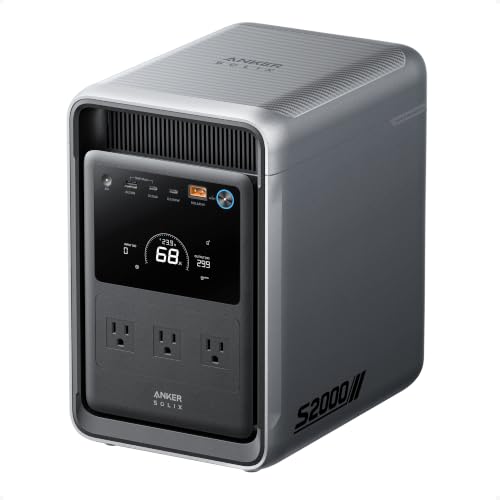
Anker SOLIX S2000
Small, low-draw off-grid sites in sunny regions where the same pack is emptied and refilled every day for years, and where being able to carry it alone matters.
How they compare
Scroll the table sideways to see every column.
| Product | Where to buy | Award | Capacity | AC output | Max solar input | Rated cycle life | Weight | Best for |
|---|---|---|---|---|---|---|---|---|
| Anker SOLIX F3800 | Best for running a whole cabin on solar | 3840Wh | 6000W | 2400W | 3,000 cycles to 80% | 132 lb (60 kg) | Cabins and homesteads with 240V loads such as a deep well pump, where the battery lives permanently in one corner of a utility room and is fed by an array of 2kW or more. | |
| BLUETTI AC200L | Best for growing a bank one battery at a time | 2048Wh | 2400W | 1200W | -- | 61.41 lb (27.9 kg) | People moving onto a property in stages who want a working system this season and a four-day bank in two or three years, without replacing the head unit they start with. | |
| BLUETTI Elite 200 V2 | Best for heavy 120V tools and pumps | 2073.6Wh | 2600W continuous (3900W Power Lifting) | Full charge in 2.4 hours with 1000W panels | Over 6,000 cycles | 53.35 lb (24.2 kg) | Off-grid workshops, cabin builds and homesteads that run real tools during the day and want the pack back to full before evening, with a fixed capacity requirement that will not grow. | |
| Anker SOLIX S2000 | Best for a pack that gets cycled every single day | 2010Wh | 1500W (3000W peak) | 400W | 10,000 cycles | 35.7 lb (16.2 kg) | Small, low-draw off-grid sites in sunny regions where the same pack is emptied and refilled every day for years, and where being able to carry it alone matters. |
The full reviews
Best for running a whole cabin on solar
Anker SOLIX F3800
Anker
This is the only unit on the shortlist that behaves like a house battery rather than a large appliance. A 2400W solar ceiling, 240V split-phase output and a 26.9kWh expansion path cover a cabin's whole electrical load, and the trade you accept for that is 132 lb that stops being portable the day you set it down.
What we like about the Anker SOLIX F3800
- 2400W solar input is double the next-highest ceiling here, so a big array is not wasted on it
- Derated to a realistic 75% array yield, 1800W of real input refills the full 3840Wh in about 2.1 hours of strong sun
- 120V/240V split phase drives a deep well pump and an electric range, which none of the 120V units can
- Expandable to 26.9kWh, which is roughly twelve days of autonomy against a 2.2kWh cabin day
- 3000 cycles across a 3840Wh pack works out to about 0.57 cycles a day at that load, or around fourteen years
Where it falls short for the Anker SOLIX F3800
- At 132 lb this is a two-person lift and becomes a fixed installation in practice, so it cannot double as the unit you take to a job site or a truck
- The 6000W inverter and the split-phase transformer are sized for loads a 2.2kWh-a-day cabin never calls on, so on a 120V-only site a large share of the 132 lb and the purchase is capacity that will sit idle for the life of the unit
- The 3000-cycle rating is the lowest published count here, and only the size of the pack keeps the calendar life competitive with the 6000-cycle Elite 200 V2
- Using the 240V output for cabin circuits means an inlet or transfer switch wired by an electrician, which is a separate job with its own cost
Key specifications
- Capacity
- 3840Wh
- AC output
- 6000W
- Max solar input
- 2400W
- Rated cycle life
- 3,000 cycles to 80%
- Expandable
- Yes, to 26.9kWh with expansion batteries
- Weight
- 132 lb (60 kg)
Everything else in this guide is a battery you put next to your appliances. The F3800 is a battery you wire into the building. That difference is what decides whether it is the right answer or an expensive mistake.
The solar ceiling is the reason it is here
Off grid, the number that limits you is not how fast a unit charges from a wall outlet. It is how much array it will accept. At 2400W the F3800 takes double what the BLUETTI AC200L accepts and more than twice what the Elite 200 V2 is rated for.
Rated panel wattage is optimistic. Angle, heat, cloud edge and wiring losses mean a planning figure of about 75% of nameplate is honest. On that basis a 2400W array delivers roughly 1800W, and 3840Wh divided by 1800W is about 2.1 hours of strong sun to go from empty to full. Against a 2.2kWh daily cabin load, the same array covers a full day’s consumption in about 1.2 hours of good light. That headroom is what carries you through a week of thin winter sun, because you only need a short clear window rather than a whole clear day.
What 240V actually buys
A deep well pump, an electric range and a central air handler are 240V split-phase loads. No amount of watt-hours in a 120V unit will start them. The F3800 is the only unit on this shortlist that outputs 240V, and if you are on a well that single fact ends the comparison.
If you are not on a well, be honest about it. A cabin running lights, a fridge, a satellite modem and a laptop is a 120V site, and the 240V half of this unit will never be energised.
Where the arithmetic turns against it
Two places. Weight is the obvious one: 3840Wh at 132 lb is 29.1Wh per pound, the worst ratio here. You are paying in mass for the inverter and the split-phase transformer, not for stored energy.
The subtler one is cycle life. Three thousand cycles sounds modest next to the 6000 of the Elite 200 V2. Read alone, that is misleading. A 2.2kWh day is only 0.57 of a full cycle on a 3840Wh pack, so 3000 cycles is about 5,250 days, near fourteen years. Lifetime throughput comes out around 11,520kWh. That is respectable, and it is still the lowest of the three figures on this page that can be calculated at all, which is worth knowing before you assume the biggest unit is also the longest-lived. The AC200L publishes no cycle rating, so it sits outside the comparison rather than below it.
Who should buy it
Anyone building a permanent off-grid electrical system with a real array and at least one 240V load. Anyone who wants a bank that can grow to 26.9kWh without ever replacing the head unit. If your plan is a single portable box you carry between a cabin and a vehicle, choose one of the 2kWh units instead and accept the shorter autonomy.
- Best for
- Cabins and homesteads with 240V loads such as a deep well pump, where the battery lives permanently in one corner of a utility room and is fed by an array of 2kW or more.
- Choose something else if
- You have to move the unit yourself, your site has no 240V load, or your array is capped near 1000W, because most of what you are paying for then sits unused.
Best for growing a bank one battery at a time
BLUETTI AC200L
BLUETTI
Buy this if you would rather start at one day of autonomy and add capacity as money allows than commit to a full system now. Its 8192Wh ceiling is four times its own pack, and a 30A RV port lets it feed a cabin inlet directly. The gap in its spec sheet is a published cycle rating, which makes lifespan a guess.
What we like about the BLUETTI AC200L
- Expands from 2048Wh to 8192Wh, which takes a 2.2kWh cabin day from under one day of autonomy to about 3.7 days
- 1200W solar input is second only to the F3800 and refills the whole pack in roughly 2.3 hours of strong sun at a 75% array yield
- 0-80% in 45 minutes on 2400W AC input, so a winter generator top-up can be a short run rather than an afternoon
- A 30A RV port feeds a cabin or trailer inlet directly instead of forcing everything through extension cords
- A 4-year warranty covers the years when an off-grid pack does its heaviest cycling
Where it falls short for the BLUETTI AC200L
- BLUETTI publishes no cycle-life rating for this pack, so you cannot work out lifetime kilowatt-hours the way you can for the Elite 200 V2 or the S2000, and that is the single most important number for a battery cycled daily
- 61.41 lb for 2048Wh is 33.3Wh per pound, the worst density of the three 2kWh units here and eight pounds heavier than the Elite 200 V2 for the same capacity
- 2400W continuous sits 200W under the Elite 200 V2, which puts a large induction hob or a 2500W shop heater out of reach
- Reaching the 8192Wh ceiling means buying three expansion packs, and each one adds its own weight and floor space to a cabin that probably has neither spare
Key specifications
- Capacity
- 2048Wh
- AC output
- 2400W
- Max solar input
- 1200W
- Expandable
- Yes, to 8192Wh with expansion batteries
- AC recharge time
- 0-80% in 45 minutes (2400W AC input)
- Weight
- 61.41 lb (27.9 kg)
The AC200L answers a question the rest of this shortlist does not: what do you buy when you cannot afford the whole system yet, and you do not want to throw away the first piece when you can?
The expansion path is the product
On its own, 2048Wh is under one day. A cabin drawing 2.2kWh a day, which is a compressor fridge, lights, a satellite modem and a laptop, empties this pack before the next morning. That sounds like a failure until you look at what it grows into.
Three expansion packs take it to 8192Wh, or about 3.7 days at that same load. Three days of autonomy is the point where a run of overcast weather stops being an emergency, and reaching it without replacing the inverter, the screen or the ports is the whole argument for this unit.
Compare that with the BLUETTI Elite 200 V2, which beats it on inverter output, energy density and published cycle life, and lists no expansion battery at all. The AC200L takes the solar ceiling, the faster AC top-up and the 30A RV port in return. If your capacity requirement is going to change, the expansion path outweighs the rest of the spec sheet.
Solar input and generator days
At 1200W the AC200L accepts more array than anything here except the F3800. Derate that to a realistic 75% and you have roughly 900W of real charging, which refills 2048Wh in about 2.3 hours of strong sun and covers a 2.2kWh day in about 2.4 hours.
Winter is where the 45-minute AC charge to 80% earns its place. A small generator running under an hour puts most of a pack back. On a unit that took three hours to accept the same energy, you would burn three times the fuel and sit through three times the noise for the same result.
The number that is missing
Every other unit on this page publishes a cycle rating, and for a battery you plan to cycle once a day that rating is the closest thing to a lifespan. BLUETTI does not publish one for the AC200L.
You can still infer that a LiFePO4 pack will outlast a nickel-based one by a wide margin. What you cannot do is the calculation we run on the other three: capacity multiplied by cycles, divided by the daily load, to get years. Anyone whose main worry is how long the pack survives should read the Elite 200 V2 or the Anker SOLIX S2000 entry instead, because both let you do that sum.
Who should buy it
Someone building out a property over several seasons, or anyone who wants a wired 30A cabin inlet rather than a bundle of cords running through a doorway. Skip it if you know your final capacity today, because buying that capacity once will always weigh less and cost less than assembling it from four boxes.
- Best for
- People moving onto a property in stages who want a working system this season and a four-day bank in two or three years, without replacing the head unit they start with.
- Choose something else if
- You want a published cycle rating before trusting a pack with daily deep cycling, or you have already decided on the final size of your system and can buy it once.
Best for heavy 120V tools and pumps
BLUETTI Elite 200 V2
BLUETTI
The Elite 200 V2 carries the strongest 120V-only inverter on this shortlist and refills its whole pack from 1000W of panels in 2.4 hours, which suits a workshop or a build site that consumes hard and recharges in a single afternoon. What it does not give you is a way up: BLUETTI lists no expansion battery for it, so 2073.6Wh is the ceiling for as long as you own it.
What we like about the BLUETTI Elite 200 V2
- 2600W continuous is the highest 120V-only rating here and covers most of what a 20A circuit would run
- 6000 rated cycles across 2073.6Wh is roughly 12,440kWh of lifetime throughput, about fifteen years at a 2.2kWh day
- A full charge in 2.4 hours from 1000W of panels means one clear afternoon replaces a whole cabin day
- 38.9Wh per pound beats the AC200L, giving the same usable class of capacity for eight fewer pounds
- Turbo mode reaches 80% in an hour on 1800W AC, which keeps a winter generator run short
Where it falls short for the BLUETTI Elite 200 V2
- There is no expansion battery for this unit, so the only route past 2073.6Wh is a second complete station with a second inverter you have already paid for once
- The 3900W Power Lifting figure is reached by lowering output voltage, so it applies to a heater element or a kettle and never to a pump or compressor motor
- The 2.4-hour solar figure assumes 1000W of panels delivering their full nameplate; at the 75% array yield used throughout this guide that array supplies about 750W and the same refill takes about 2.8 hours, so the single-afternoon recharge depends on a genuinely clear day rather than an average one
- 1000W is a modest array ceiling for a permanent site, and adding panels beyond that buys you nothing
Key specifications
- Capacity
- 2073.6Wh
- AC output
- 2600W continuous (3900W Power Lifting)
- Solar input
- Full charge in 2.4 hours with 1000W panels
- Rated cycle life
- Over 6,000 cycles
- AC recharge time
- 0-80% in 1 hour on Turbo mode (1800W AC), full in 1.6 hours on Standard mode
- Weight
- 53.35 lb (24.2 kg)
Most 2kWh units are sized to keep a fridge and some lights alive. This one is sized to run a saw. That is a different job, and it changes who should be looking at it.
The inverter is what separates it
At 2600W continuous the Elite 200 V2 has 200W more headroom than the AC200L and 1100W more than the Anker SOLIX S2000. Off grid that gap is the difference between finishing a cut and resetting a tripped inverter. A circular saw, a small compressor or a 1500W well pump on 120V all sit comfortably inside 2600W; only the last of those sits inside 1500W, and only barely.
Ignore the 3900W Power Lifting number when you are sizing for motors. That mode reaches its figure by dropping output voltage so current stays in range. Lower voltage means a slower kettle, which is fine. It also means less torque, which is not, so a pump or a compressor sees the 2600W rating and nothing more.
Recharge in one afternoon
BLUETTI rates a full charge at 2.4 hours from 1000W of panels. Read that figure the way the rest of this guide reads panel ratings: it assumes the array delivers its nameplate. Derate to 75% and 1000W becomes about 750W, which turns 2073.6Wh into roughly 2.8 hours. Either way, a single clear afternoon puts back more than a full 2.2kWh cabin day.
It is not the quickest refill here, though, and the review is worth reading against the others on that point. On the guide’s derated figures the F3800 fills its pack in about 2.1 hours and the AC200L in about 2.3, so this unit sits third of the four on whole-pack refill time and only ahead of the S2000.
The ceiling is the catch. A permanent site with roof space can easily justify 2kW of array, and this unit will not use it. If you are already planning a large array, that argument points at the F3800 instead.
Fifteen years, if the maths holds
Six thousand cycles at 2073.6Wh is about 12,440kWh of throughput across the rated cycle life. At 2.2kWh a day, roughly 803kWh a year, that is close to fifteen years. Only the S2000 beats it on this page, and the S2000 gives up 1100W of inverter and most of its solar ceiling to do so.
The wall you will hit
There is no expansion battery. BLUETTI publishes an expansion ceiling for the AC200L at 8192Wh and Anker publishes one for the F3800 at 26.9kWh; nothing of the sort is listed for this unit, and nothing is listed for the S2000 either. The day your load rises you are buying a second complete station and paying a second time for an inverter, a screen and a set of ports.
That is not a reason to avoid it. It is a reason to be certain about your daily load before you commit. If the answer is “about two kilowatt-hours and it will stay that way”, this is the strongest unit in that class. If the answer is “I am not sure yet”, buy the AC200L and grow into it.
- Best for
- Off-grid workshops, cabin builds and homesteads that run real tools during the day and want the pack back to full before evening, with a fixed capacity requirement that will not grow.
- Choose something else if
- You expect your daily load to increase, because no expansion battery is published for this unit and adding capacity means buying a second complete station. If a growing bank is the requirement, the AC200L and the F3800 are the two units here that publish an expansion ceiling.
Best for a pack that gets cycled every single day
Anker SOLIX S2000
Anker
Nothing else here is rated for 10,000 cycles, and nothing else puts 2010Wh into a 35.7 lb box one person can carry. That combination suits a small off-grid site that drains and refills the same pack daily for decades. The price of it is a 400W solar ceiling that will not keep up on a short winter day.
What we like about the Anker SOLIX S2000
- 10,000 rated cycles across 2010Wh is about 20,100kWh of lifetime throughput, roughly 25 years at a 2.2kWh day
- 56.3Wh per pound is by far the best density here, so 2010Wh travels as a genuine one-person carry
- Under 10ms UPS switchover, against under 20ms for the F3800 and no published figure for either BLUETTI, keeps a satellite modem or laptop alive when a generator hands over
- A 5-year warranty and an LFP pack rated well past the others make it the low-risk choice for daily deep cycling
Where it falls short for the Anker SOLIX S2000
- 400W is the lowest solar ceiling here by a wide margin; derated to a realistic 75% array yield that is about 300W, so refilling 2010Wh takes around 6.7 hours of strong sun and a 2.2kWh cabin day needs about 7.3 hours, which a short winter day will not give you
- 1500W continuous is 1100W below the Elite 200 V2, so a 1800W kettle, a large circular saw or most electric heaters are out of reach
- There is no 12V DC port, which rules out feeding 12V cabin lighting or a DC compressor fridge directly and forces those loads through the inverter
- No expansion battery is listed for it, so a growing load means a second unit rather than a bigger bank
Key specifications
- Capacity
- 2010Wh
- AC output
- 1500W (3000W peak)
- Max solar input
- 400W
- Rated cycle life
- 10,000 cycles
- UPS switchover
- Under 10ms
- Weight
- 35.7 lb (16.2 kg)
Two numbers make this unit worth a section on an off-grid page, and one number almost disqualifies it. It is worth understanding all three before deciding.
Twenty-five years, on paper
Rated cycle counts are usually quoted and then ignored. Do the arithmetic and this one stops being decoration. Ten thousand cycles at 2010Wh is roughly 20,100kWh of throughput across the rated cycle life.
An off-grid cabin drawing 2.2kWh a day consumes about 803kWh a year. Divide, and you get around 25 years. The Elite 200 V2, with 6000 cycles, comes out near fifteen. The F3800, with 3000 cycles across a much larger pack, lands near fourteen. On lifetime energy delivered per pack, this is the strongest unit on the page by some distance.
The carry
At 35.7 lb for 2010Wh, this is 56.3Wh per pound. The Elite 200 V2 manages 38.9 and the AC200L 33.3. In practical terms, that means a cabin battery you can lift into a truck bed alone, take to a remote build for a week and bring home, which none of the others realistically allow.
The ceiling that decides it
Four hundred watts of solar input is the problem. Derate a rated array to about 75% and you are charging at roughly 300W. Refilling 2010Wh takes about 6.7 hours at that rate, and covering a 2.2kWh daily draw takes about 7.3 hours.
In July, in a sunny state, that works. In December, in most of the country, you do not get 7.3 hours of strong sun in a day, and a run of overcast weather leaves you with no way to catch up quickly. The AC200L accepts three times the array, and the F3800 six times, which means both can bank a day’s energy in a short clear window. This one needs the whole day.
Who should buy it
Sites with a modest daily load, plenty of sun and a long time horizon. Anyone whose loads are all electronics, lighting and a small fridge, and who would rather own one pack for twenty years than replace two. Anyone running a well pump, power tools or electric heat should choose the Elite 200 V2 for the inverter, or the F3800 if the pump is 240V.
- Best for
- Small, low-draw off-grid sites in sunny regions where the same pack is emptied and refilled every day for years, and where being able to carry it alone matters.
- Choose something else if
- You live somewhere with short or overcast winters, or you run tools and appliances above 1500W, because the solar ceiling and the inverter both become the limit.
How we researched this guide
Four units were compared using published manufacturer specifications only. None were tested by us. Every runtime, refill and lifespan figure on this page is calculated from rated specifications against a stated 2.2kWh daily load and a 75% array yield, and each review names the sources it relies on.
The full process is on our how we test portable power stations page, including what counts as hands-on use.
- Units evaluated
- 4
- Used hands-on
- 0
- Assessed from documentation and owner reports
- 4
Evaluation methods used: specification comparison
Which one should you buy?
Match your situation on the left to the recommendation on the right.
-
You have a deep well pump, an electric range or any other 240V load
Recommendation: Buy the Anker SOLIX F3800, the only unit here with 120V/240V split-phase output
-
You are building the site over several seasons and cannot buy the whole system now
Recommendation: Buy the BLUETTI AC200L and add expansion packs toward its 8192Wh ceiling as budget allows
-
You run power tools, a compressor or a 120V well pump during the day
Recommendation: Buy the BLUETTI Elite 200 V2 for its 2600W continuous inverter and 2.4-hour solar refill
-
Your loads are lighting, electronics and a small fridge, and you get long sunny days
Recommendation: Buy the Anker SOLIX S2000 for 10,000 rated cycles and a 35.7 lb one-person carry
-
You need to carry the battery alone between a cabin and a vehicle
Recommendation: Buy the Anker SOLIX S2000 at 35.7 lb, but accept its 400W solar ceiling and 1500W inverter
-
Your array is already planned at 2kW or more
Recommendation: Buy the Anker SOLIX F3800, because every other unit here caps solar input at 1200W or below
Mistakes buyers make
- Sizing by watt-hours alone and ending up with a pack the array cannot refill in a short winter day
- Treating rated panel wattage as delivered wattage, which overstates a day of charging by roughly a quarter
- Comparing raw cycle counts between packs of different sizes instead of working out lifetime kilowatt-hours
- Buying a 240V-capable unit for a site with no 240V load, which is weight and money that will never be used
- Assuming an expandable unit can be expanded indefinitely, when every model has a fixed ceiling
- Planning the whole system around summer sun and having no generator or reserve for a week of overcast weather
Our final recommendation
If you want one answer rather than a shortlist, this is the unit that suits the widest range of readers in this category.
Best for running a whole cabin on solar
Cabins and homesteads with 240V loads such as a deep well pump, where the battery lives permanently in one corner of a utility room and is fed by an array of 2kW or more.
Questions buyers ask
How many solar panels do I need to keep one of these charged?
Work backwards from your daily consumption rather than from the unit. A site using 2.2kWh a day needs an array that delivers 2.2kWh in the sun hours your location gives you in December, not June. At four usable winter sun hours and a 75% yield, that is roughly 730W of nameplate panel. Then check the unit accepts it: the S2000 caps at 400W, so it could not use that array.
Can a solar generator run a well pump?
A 120V jet pump under 1500W running draw will usually start on the Elite 200 V2 or the AC200L. A deep well submersible pump is normally 240V split phase, and only the F3800 outputs that. Ignore surge or boost modes when checking this, because they lower voltage and a motor needs voltage to make torque.
Will these still work in freezing weather?
They discharge in the cold with reduced capacity, but LiFePO4 packs refuse to charge below freezing to protect the cells. An unheated shed in January is the worst place for one. Keep the unit inside the insulated envelope and run the panel cable out to it instead.
Is it better to buy one large unit or expand a smaller one?
Buying the capacity once is lighter, takes less floor space and costs less per watt-hour. Expanding is right only when you genuinely cannot buy the whole system now or your load is going to change. Two units here publish an expansion ceiling, the AC200L at 8192Wh and the F3800 at 26.9kWh. Neither the Elite 200 V2 nor the S2000 lists an expansion battery at all, so with either of those what you buy is what you keep.
Do I still need a generator if I have solar?
Most off-grid sites outside the sunbelt keep a small one. A week of overcast weather is a normal event, and unexpanded none of these holds even two days at a 2.2kWh load: the largest, the F3800, covers 1.75 days and the three 2kWh units cover under one. The relevant spec is how fast the unit accepts AC input: the AC200L takes 2400W and reaches 80% in 45 minutes, so a generator run stays short.
About the author