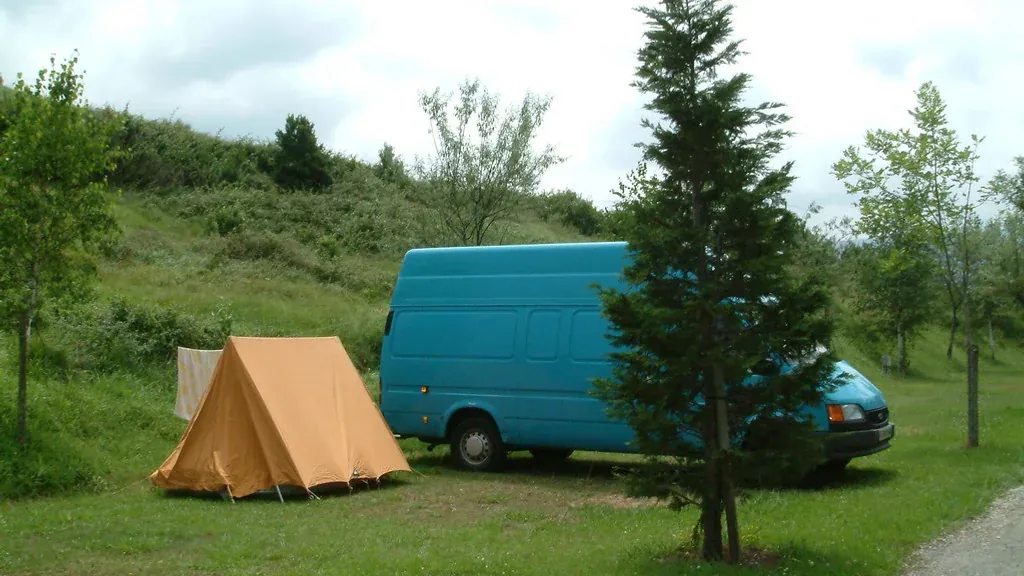
We Compared 4 Solar Generators for RVs and Camper Vans

Off-grid power editor
Published
Updated
Last fact-checked

This guide is for RV, travel trailer and van owners who want to run a fridge, lights and device charging without dragging a fuel generator around. We compared four units on the four things that decide the outcome in a vehicle: capacity against a stated daily load, watt-hours per pound, watt-hours per cubic inch, and how long each one needs plugged in to replace a day of use. We did not test these units, and every review says exactly what its recommendation rests on. What you get here is arithmetic a product listing will not show you: a published 560Wh daily budget, every capacity divided by it, and an honest account of what expansion really costs you in payload and cabinet space.
What is the best solar generator for an RV?
The BLUETTI AC200L suits most RVs and trailers. It is the only unit here with a 30A RV port, so the coach shore cord plugs straight in, its 2048Wh covers around three and a half days of a normal fridge and lighting load, and its 1200W solar ceiling accepts a full roof array. In a weight-limited van conversion, the EcoFlow DELTA 3 Plus is the better buy.
Key takeaways
- Size against a daily watt-hour budget, not a manufacturer runtime chart; a 12V compressor fridge is a duty cycle, not a constant draw
- Vans run out of payload and cabinet volume before they run out of watt-hours, so compare watt-hours per pound and per cubic inch
- Recharge speed is better expressed as minutes of shore power needed to replace one day of use, which ranges from 15 to 27 minutes across these four
- A 30A RV port is the difference between replacing the pedestal and running extension cords through a window
- Where a unit publishes both, rated cycle life outlasts its warranty by more than a decade at RV duty, so compare warranty length instead
Our picks at a glance
Every unit below wins a specific situation rather than a place in a ranking. Pick the row that matches how you will actually use it.
-
Best for feeding a 30A RV shore cord

BLUETTI AC200L
Motorhomes and travel trailers with a 30A shore cord and roof space for a large array, where storage volume matters less than capacity and recharge speed.
-
Best for 12V fridges and cabin fans

VTOMAN FlashSpeed 1500
Van and camper builds that run the fridge, fans and water pump on 12V DC and only wake the inverter for a laptop, a kettle or a power tool.
-
Best for weight-limited van builds

EcoFlow DELTA 3 Plus
Van conversions sitting close to their payload limit, and anyone who needs the fridge and the internet connection to ride through a shore power cut unnoticed.
-
Best for high-draw appliances in a compact pack

OUPES Mega 1
Campers that occasionally run a microwave, an induction hob or a power tool alongside the fridge, with shore power or a generator available most nights.
How they compare
Scroll the table sideways to see every column.
| Product | Where to buy | Award | Capacity | AC output | Weight | AC recharge time | Rated cycle life | Expandable | Dimensions | Best for |
|---|---|---|---|---|---|---|---|---|---|---|
| BLUETTI AC200L | Best for feeding a 30A RV shore cord | 2048Wh | 2400W | 61.41 lb (27.9 kg) | 0-80% in 45 minutes (2400W AC input) | -- | Yes, to 8192Wh with expansion batteries | 16.5 x 11 x 14.4 in | Motorhomes and travel trailers with a 30A shore cord and roof space for a large array, where storage volume matters less than capacity and recharge speed. | |
| VTOMAN FlashSpeed 1500 | Best for 12V fridges and cabin fans | 1548Wh | 1500W (3000W peak) | 41.5 lb (18.8 kg) | 1 hour to full on 1500W AC input, 45 minutes with AC, solar and DC combined | 3,000+ cycles to 80% | Yes, to 3096Wh with one extra battery | 15.4 x 10.6 x 11.0 in | Van and camper builds that run the fridge, fans and water pump on 12V DC and only wake the inverter for a laptop, a kettle or a power tool. | |
| EcoFlow DELTA 3 Plus | Best for weight-limited van builds | 1024Wh | 1800W | 27 lb (12.2 kg) | 40 minutes to 80% on 1500W AC input | 4,000 cycles to 80% | Yes, up to 5kWh with DELTA 3, DELTA Pro 3 or DELTA 2 Max battery packs | 16 x 8 x 11 in | Van conversions sitting close to their payload limit, and anyone who needs the fridge and the internet connection to ride through a shore power cut unnoticed. | |
| OUPES Mega 1 | Best for high-draw appliances in a compact pack | 1024Wh | 2000W (4500W surge) | 27.8 lb (12.6 kg) | 36 minutes to 80% on AC, 26 minutes with AC and solar together | 3,500+ cycles to 80% | Yes, to 5120Wh with two B2 extra batteries | 15.1 x 9.1 x 11.6 in | Campers that occasionally run a microwave, an induction hob or a power tool alongside the fridge, with shore power or a generator available most nights. |
The full reviews
Best for feeding a 30A RV shore cord
BLUETTI AC200L
BLUETTI
The AC200L is the only unit on this shortlist with a 30A RV port, so a coach shore cord plugs straight into it rather than through a chain of dogbone adapters. You pay for that convenience in payload and cabinet volume, because it is also the heaviest and bulkiest thing here.
What we like about the BLUETTI AC200L
- A 30A RV port among its 11 ports means the coach cord goes straight in, with no adapter stack
- 2048Wh covers roughly three and a half days of the 560Wh fridge, lights and charging budget used in this guide
- 1200W maximum solar input accepts a full roof array, three times what the VTOMAN here will take
- 45 minutes to 80% works out at about 15 minutes of shore power to replace one day of that budget
- Expansion to 8192Wh is the highest ceiling on this shortlist by a wide margin
Where it falls short for the BLUETTI AC200L
- At 61.41 lb it returns 33 watt-hours per pound, the worst weight ratio of the four here despite holding the most energy
- The 16.5 x 11 x 14.4 in case is the largest footprint in this guide, which is a genuine problem in a van where the only spare volume is under a bench seat
- BLUETTI publishes no cycle life figure for this unit while the other three here publish 3,000 to 4,000 cycles, so long-term degradation is harder to plan for
- No published UPS switchover time, so it should not be assumed to hold a router or a satellite terminal up through a shore power dropout
Key specifications
- Capacity
- 2048Wh
- AC output
- 2400W
- Ports
- 11 ports, including a 30A RV port and a 48V/8A DC port
- AC recharge time
- 0-80% in 45 minutes (2400W AC input)
- Max solar input
- 1200W
- Expandable
- Yes, to 8192Wh with expansion batteries
- Weight
- 61.41 lb (27.9 kg)
Most power stations sold to RV owners are house-shaped products with a camping photo on the box. The AC200L is one of the few that carries a port an RV owner actually has a cable for.
The 30A port is the whole argument
A 30A RV shore cord is a TT-30 plug. Feeding one from a normal power station means a dogbone adapter down to a 15A household outlet, which caps you at whatever that outlet allows and puts a connector in the chain that will be sat in the weather. The AC200L includes a 30A RV port in its 11-port panel, so the cord goes straight in and the coach distribution panel does its normal job: fridge, lights, water pump, sockets, all on their existing breakers.
That is a different way of living with a power station. You are not running extension cords through a window. You are replacing the pedestal.
What 2048Wh buys in days
This guide assumes 560Wh a day: a 12V compressor fridge at 45W running on a one-third duty cycle (360Wh), four 5W lights for five hours (100Wh) and about 100Wh of phone, laptop and camera charging.
Against that budget, 2048Wh is roughly three and a half days. If you feed the fridge through the AC inverter rather than a DC port, expect to lose ten to fifteen percent to conversion, which pulls it back closer to three days. That is a long weekend without sun, which is the realistic planning case for most people.
Recharging is where it separates
The 2400W AC input reaching 80% in 45 minutes means 1638Wh restored in three quarters of an hour, about 2184Wh per hour. One day of the budget above therefore takes roughly 15 minutes plugged in. Nothing else here is close.
The 1200W solar ceiling matters just as much. A 600W roof array on a motorhome is common, and the AC200L will take all of it plus more. The VTOMAN here tops out at 400W, so half that array would be wasted.
Where it hurts
Weight and volume. At 61.41 lb it is 33 watt-hours per pound, worse than every other unit here, and its 2613 cubic inches make it the largest case in the guide. On a Class C with a basement locker that is irrelevant. In a Transit conversion with 700 lb of payload left, it is a real decision.
BLUETTI also publishes no cycle life figure for this model, which is unhelpful when three competitors do. Plan around the four-year warranty instead.
- Best for
- Motorhomes and travel trailers with a 30A shore cord and roof space for a large array, where storage volume matters less than capacity and recharge speed.
- Choose something else if
- You are converting a small van where every pound of payload and every cubic inch under the bench is already accounted for.
Best for 12V fridges and cabin fans
VTOMAN FlashSpeed 1500
VTOMAN
A camper spends most of its energy on DC loads, and the FlashSpeed 1500 is built around that: two DC5521 outputs and a car port alongside the AC side, in the tightest case-to-capacity ratio in this guide. Its ceiling is low, though, both on solar input and on how far it can be expanded.
What we like about the VTOMAN FlashSpeed 1500
- Two DC5521 barrel outputs plus a car port drive a 12V fridge, cabin fans and a water pump without routing them through the AC inverter
- 1548Wh in a 15.4 x 10.6 x 11.0 in case is 0.86 watt-hours per cubic inch, the densest use of cabinet volume here
- 1548Wh covers close to three days of the 560Wh daily budget used in this guide, landing between the 1kWh units and the 2kWh class
- Full recharge in about an hour on 1500W AC input, which is roughly 22 minutes of shore power per day of use
- 3,000+ cycles to 80% at this capacity is over twenty years at the duty assumed here
Where it falls short for the VTOMAN FlashSpeed 1500
- The 1500W inverter is 500W below the OUPES Mega 1 and 900W below the AC200L, so a microwave running while the compressor kicks in is outside its rating
- 400W maximum solar input is a third of the AC200L's 1200W, so anything larger than two 200W roof panels is throttled and largely wasted
- One extra battery caps expansion at 3096Wh, well below the DELTA 3 Plus at 5kWh and under half the AC200L's 8192Wh
- VTOMAN publishes no warranty term for this unit, while the EcoFlow and OUPES units here both publish five years
Key specifications
- Capacity
- 1548Wh
- AC output
- 1500W (3000W peak)
- Ports
- 12 total, 3 AC outlets, 4x USB-A, 2x USB-C, 2x DC5521, car port
- Expandable
- Yes, to 3096Wh with one extra battery
- Dimensions
- 15.4 x 10.6 x 11.0 in
- Weight
- 41.5 lb (18.8 kg)
Almost everything that runs continuously in a camper is a DC load. The fridge, the ceiling fan, the water pump and the LED strips all want 12V. Sending them through an AC inverter and back down through a wall adapter wastes energy at both conversions and keeps the inverter awake all night for nothing.
Why the port list decides this one
The FlashSpeed 1500 carries twelve ports, including two DC5521 barrel outputs and a car port next to its three AC outlets. That is enough to run the fridge and a fan directly on DC and leave the inverter off until you need a laptop charger or a kettle. Over a night, an inverter left idling to serve one small load is a measurable share of a small battery.
The OUPES Mega 1 in this guide also has 12V outputs, but at 1024Wh it does not have the endurance to sit on those loads for three days. The AC200L does, at double the weight.
Watt-hours per cubic inch
Vans run out of two things: payload and volume. The FlashSpeed 1500 measures 15.4 x 10.6 x 11.0 in, or about 1796 cubic inches, holding 1548Wh. That is 0.86 watt-hours per cubic inch. The AC200L manages 0.78, the DELTA 3 Plus 0.73 and the OUPES Mega 1 only 0.64.
Put another way: the OUPES takes 89% of this unit’s cabinet volume to store a third less energy. If your build has one dedicated locker and no more, that ratio is the specification that matters.
Runtime and recharge
Against the 560Wh daily budget used throughout this guide, 1548Wh is close to three days, or a little under two and a half once you allow for inverter losses on the AC side. A full recharge takes about an hour at 1500W AC, which means one day of that budget is replaced in roughly 22 minutes plugged in.
Rated at 3,000+ cycles to 80%, and drawing 560Wh a day, it sees about a third of a full cycle daily. That is more than twenty years of cycling. Cycle life is not what will retire this unit.
The two ceilings
Both are low. 400W maximum solar input means a 600W roof array is money spent on panels the unit cannot use. And a single expansion battery takes it to 3096Wh and stops there, which is the smallest growth path in this guide.
Buy it because 1548Wh and a good DC port set is what you need now, not because you expect it to become a 5kWh system later.
- Best for
- Van and camper builds that run the fridge, fans and water pump on 12V DC and only wake the inverter for a laptop, a kettle or a power tool.
- Choose something else if
- You are planning a 600W or larger roof array, or you expect to grow the system past roughly 3kWh later on.
Best for weight-limited van builds
EcoFlow DELTA 3 Plus
EcoFlow
Every conversion eventually hits its payload plate, and this is the unit that costs the least to carry: 1024Wh for 27 lb. The 10ms switchover is a bonus for anyone running a router or a satellite terminal. What it does not give you is endurance, so treat it as the first module of a system rather than the whole thing.
What we like about the EcoFlow DELTA 3 Plus
- 27 lb for 1024Wh is 37.9 watt-hours per pound, the best weight ratio of the four units here
- 10ms UPS switchover is fast enough that a router or satellite terminal will not reboot when shore power drops
- 4,000 cycles to 80% at roughly half a cycle a day works out at around twenty years of full-time use
- Expands to 5kWh using DELTA 3, DELTA Pro 3 or DELTA 2 Max packs, so a later upgrade is not tied to one battery family
- 40 minutes to 80% on 1500W AC input replaces a day of the budget used here in under half an hour
Where it falls short for the EcoFlow DELTA 3 Plus
- 1024Wh covers under two days of the 560Wh daily budget in this guide, so anyone parking up for a long weekend without sun is buying an expansion battery rather than a finished system
- EcoFlow publishes no maximum solar input figure for this unit, which makes it impossible to size a roof array from the specification sheet alone
- At 0.73 watt-hours per cubic inch it is less space-efficient than the VTOMAN FlashSpeed 1500, so it saves payload rather than cabinet volume
- The 1800W inverter is 600W below the AC200L, which rules out a microwave and a compressor start landing at the same moment
Key specifications
- Capacity
- 1024Wh
- AC output
- 1800W
- Weight
- 27 lb (12.2 kg)
- UPS switchover
- 10ms
- Rated cycle life
- 4,000 cycles to 80%
- Expandable
- Yes, up to 5kWh with DELTA 3, DELTA Pro 3 or DELTA 2 Max battery packs
Payload is the constraint van builders discover last and regret first. A Transit or Sprinter conversion with water, tools, bikes and two people on board rarely has much margin left, and a house battery is one of the heaviest single items going in.
The number that wins this category
1024Wh divided by 27 lb is 37.9 watt-hours per pound. The VTOMAN FlashSpeed 1500 manages 37.3, the OUPES Mega 1 36.8, and the BLUETTI AC200L only 33.3. Those gaps look small as ratios, but they compound when you scale the system: adding capacity here costs less weight per watt-hour than adding it anywhere else in this guide.
The expansion path helps for the same reason. EcoFlow lets this unit pair with DELTA 3, DELTA Pro 3 or DELTA 2 Max packs up to 5kWh, so you can add capacity without committing today to one battery model staying in production.
Switchover time is not a gimmick here
10ms matters more in a camper than it does in a house. When you unplug from a pedestal, or a campground pedestal browns out, anything sensitive on the circuit notices. A router, a satellite terminal or a CPAP will ride through a 10ms gap without resetting. The OUPES Mega 1 here quotes under 20ms, the AC200L publishes nothing at all.
Where the arithmetic stops being friendly
This guide assumes 560Wh a day: a 12V compressor fridge at 45W on a one-third duty cycle, four 5W lights for five hours, and about 100Wh of device charging. 1024Wh against that is 1.8 days, and closer to 1.6 once you allow for inverter conversion losses on the AC side.
So this is a two-night unit, not a four-night unit. That is fine if you move often, or you have a roof array, or you plan to add a pack. It is the wrong choice if you want to sit in one spot for a week.
The 4,000 cycle rating is worth putting in perspective. At 560Wh a day this unit sees roughly half a cycle daily, so 4,000 cycles is about twenty years. The five-year warranty will expire long before the cells do, which is true of every LiFePO4 unit in this guide and is why warranty length, not cycle count, is the number worth comparing.
- Best for
- Van conversions sitting close to their payload limit, and anyone who needs the fridge and the internet connection to ride through a shore power cut unnoticed.
- Choose something else if
- You want one unit to cover several days away from a hookup without immediately adding an expansion battery to it.
Best for high-draw appliances in a compact pack
OUPES Mega 1
OUPES
A 4500W surge rating on a 27.8 lb unit is unusual, and it is the reason to look at the Mega 1: it absorbs a compressor kicking in underneath something already drawing hard. The trade is endurance and cabinet space, because 1024Wh in this size of case is the loosest packaging on the shortlist.
What we like about the OUPES Mega 1
- 2000W continuous with a 4500W surge rating is the largest surge headroom in this guide, so a fridge compressor starting under an existing load is absorbed rather than tripping the unit
- 36 minutes to 80% on AC replaces a full day of the 560Wh budget used here in around 25 minutes, and AC and solar together reach 80% in 26 minutes
- Expands to 5120Wh with two B2 batteries, five times its own capacity
- 3,500+ cycles to 80% and a five-year warranty on a 27.8 lb unit
- Sub-20ms UPS switchover holds a router or a fridge through a pedestal dropout
Where it falls short for the OUPES Mega 1
- At 0.64 watt-hours per cubic inch it is the least space-efficient unit here, taking 89% of the VTOMAN FlashSpeed 1500's cabinet volume to store a third less energy
- 1024Wh covers under two days of the 560Wh daily budget used in this guide, so the surge headroom is bought at the cost of endurance
- OUPES publishes no maximum solar input for this unit, so a roof array has to be sized by asking the manufacturer rather than reading the spec sheet
- The 2000W rating outruns the 1024Wh pack, because a sustained full-rated draw empties it in about 31 minutes, so the surge headroom buys short bursts from a microwave or a hob rather than a session of cooking off battery
Key specifications
- Capacity
- 1024Wh
- AC output
- 2000W (4500W surge)
- Weight
- 27.8 lb (12.6 kg)
- AC recharge time
- 36 minutes to 80% on AC, 26 minutes with AC and solar together
- Rated cycle life
- 3,500+ cycles to 80%
- Expandable
- Yes, to 5120Wh with two B2 extra batteries
Surge headroom is the specification that decides whether a camper feels like a home or like a fuse box. The Mega 1 has more of it than anything else here, and it carries it in a case one person can lift.
What 4500W actually protects you from
Continuous ratings tell you what a unit can hold. Surge ratings tell you what it survives. In a camper the awkward moment is not a single big load, it is two things overlapping: a compressor restarting while the microwave is already running, or a water pump cycling while a kettle boils.
At 2000W continuous the Mega 1 handles the steady state, and the 4500W surge rating gives it 2500W of momentary margin on top. The DELTA 3 Plus in this guide runs out 200W earlier on continuous draw, and the VTOMAN FlashSpeed 1500 a further 300W earlier than that. If your build has an induction hob or a microwave in it, that difference is the one to weigh.
Weigh it against the tank behind it, though. A 1024Wh pack held at its own 2000W rating is empty in about 31 minutes, and about 41 minutes at a more typical 1500W microwave draw. The Mega 1 lets high-draw appliances run without tripping; it does not let them run for long.
Refilling faster than you empty it
36 minutes from empty to 80% means 819Wh restored in a little over half an hour, about 1365Wh per hour. Against the 560Wh daily budget used throughout this guide (a 12V compressor fridge at 45W on a one-third duty cycle, four 5W lights for five hours, and roughly 100Wh of charging), a full day of use comes back in around 25 minutes plugged in. With AC and solar together the 80% mark drops to 26 minutes.
For a camper that overnights at hookups and boondocks between them, that is a useful pattern: you are never waiting on the battery.
The cost of that packaging
1024Wh in a 15.1 x 9.1 x 11.6 in case is about 1594 cubic inches, or 0.64 watt-hours per cubic inch. That is the weakest figure in this guide. The VTOMAN FlashSpeed 1500 occupies only 13% more volume and holds half again as much energy. If your locker is already measured and cut, that is a hard argument to answer.
Endurance is the other cost. 1024Wh against 560Wh a day is 1.8 days, so this is a unit you plan around expansion for. Two B2 batteries take it to 5120Wh, which covers about nine days of the same budget, but that is three boxes to house rather than one.
Who should skip it
Anyone whose loads are all small and constant. If nothing in the camper draws more than a few hundred watts, you are paying in cabinet space for surge headroom you will never call on, and the VTOMAN or the AC200L will serve better.
- Best for
- Campers that occasionally run a microwave, an induction hob or a power tool alongside the fridge, with shore power or a generator available most nights.
- Choose something else if
- Cabinet volume is your tightest constraint, or you need several days of autonomy from a single pack without expanding it.
How we researched this guide
Four units were compared using published manufacturer specifications and electrical documentation, then scored against a single stated load budget of 560Wh a day. None of the units in this guide were tested by us, and every review names the sources its recommendation rests on and what that evaluation does not cover.
The full process is on our how we test portable power stations page, including what counts as hands-on use.
- Units evaluated
- 4
- Used hands-on
- 0
- Assessed from documentation and owner reports
- 4
Evaluation methods used: specification comparison
Which one should you buy?
Match your situation on the left to the recommendation on the right.
-
You have a motorhome or trailer with a 30A shore cord
Recommendation: Buy the BLUETTI AC200L, the only unit here with a 30A RV port to take the cord directly
-
Your van conversion is close to its payload plate
Recommendation: Buy the EcoFlow DELTA 3 Plus at 27 lb, the best watt-hours per pound here
-
Your fridge, fans and water pump all run on 12V DC
Recommendation: Buy the VTOMAN FlashSpeed 1500 for its two DC5521 outputs and car port
-
You run a microwave or an induction hob in the camper
Recommendation: Buy the OUPES Mega 1 for its 2000W continuous rating and 4500W surge headroom
-
You have one dedicated locker and cannot make it bigger
Recommendation: Buy the VTOMAN FlashSpeed 1500, which stores 0.86Wh per cubic inch against 0.64 for the OUPES
-
You plan to add capacity every season for the next few years
Recommendation: Buy the BLUETTI AC200L, which expands to 8192Wh rather than stopping at 3kWh or 5kWh
Mistakes buyers make
- Sizing from a manufacturer runtime chart instead of adding up your own daily watt-hours, then finding the unit lasts half as long as expected
- Treating a 12V compressor fridge as a constant load when it cycles, which either doubles or halves your estimate depending on which way you guessed
- Buying a large solar array before checking the unit's maximum solar input, so half the roof feeds nothing
- Choosing on capacity alone in a van conversion that has no payload margin and no locker big enough for the case
- Assuming any of these will run a rooftop air conditioner for a night, which none of them will
- Paying for an expansion path you will never use, when a single larger unit would have been lighter and taken less floor space
Our final recommendation
If you want one answer rather than a shortlist, this is the unit that suits the widest range of readers in this category.
Best for feeding a 30A RV shore cord
Motorhomes and travel trailers with a 30A shore cord and roof space for a large array, where storage volume matters less than capacity and recharge speed.
Questions buyers ask
Can I plug my 30 amp RV cord into a power station?
Only into one with a TT-30 outlet. The BLUETTI AC200L here has a 30A RV port, so the cord goes straight in and the coach panel distributes power as normal. The other three need a dogbone adapter down to a household 15A outlet, which limits what you can draw and adds an outdoor connector to the chain.
Is a solar generator better than an RV inverter generator?
For a fridge, lights and charging, yes, in the ways that usually matter. There is no fuel to carry, no exhaust, no noise and nothing that campgrounds or national parks restrict by quiet hours. A fuel generator still wins on unlimited runtime and on high, sustained loads such as air conditioning.
How much solar do I need to keep one of these topped up?
Enough to cover your daily use with margin for cloud. A useful rule is to assume a roof array returns about four hours of its rated wattage as usable watt-hours on a clear day, and far less in winter or under trees. Check the unit's maximum solar input before buying panels, because two of the four here publish no figure at all.
Can I recharge it from the vehicle while driving?
Through the 12V socket, slowly. A car outlet is typically limited to around 120W, so a few hours of driving adds a few hundred watt-hours at best. Owners who want meaningful alternator charging fit a dedicated DC-to-DC charger, which is a separate purchase and a wiring job.
Will the battery survive years of full-time use?
The cells almost certainly will. Three of these units publish 3,000 to 4,000 cycles, and at the load assumed in this guide none of them completes even one full cycle a day. What ends their life is usually a failed inverter, a fan or a port, which is why warranty length is the more useful comparison.
Do these lose capacity when the camper gets cold?
Yes. All four use LiFePO4 or LFP cells, which deliver less than rated capacity in the cold and will refuse to charge below freezing to protect themselves. A unit stored in an uninsulated garage or a cold van overnight may not accept solar the next morning until it warms up.
About the author