We Compared 4 Solar Generators for Greenhouse Fans and Pumps
Off-grid power editor
Published
Updated
Last fact-checked

This guide is for growers powering a greenhouse that has no cable running to it. The load is unusually predictable: exhaust and circulation fans on a timer, an irrigation or misting pump for a few minutes a day, and a thermostat controller that never switches off. What makes it hard is not the size of that load but the fact that it repeats every single day and has to be paid back by a solar panel before the next morning. We compared four units on the four specifications that decide whether that works: capacity, maximum solar input, genuine inverter headroom for a pump start, and rated cycle life. None of these units were tested by us, and every review states what its recommendation is based on. What you get here is a stated daily watt-hour budget, the refill arithmetic behind each pick, and an honest line on what this class cannot do.
What is the best solar generator for a greenhouse?
The Anker SOLIX C1000 fits the most greenhouses. It accepts 600W of solar into a 1056Wh pack, the highest array-to-capacity ratio here, so it replaces a typical day of fan and pump energy in about two and a half hours of sun. If your weather takes the sun away for days at a time, the EcoFlow DELTA 2 Max holds nearly two days of that load instead.
Key takeaways
- Maximum solar input, not capacity, decides whether a greenhouse pack ends each day where it started
- A fan, pump and controller greenhouse on the reference day used here draws roughly 1.17kWh from the pack, so capacity is rarely the binding constraint and refill speed usually is
- Boost modes such as X-Boost and SurgePad reach their headline wattage by lowering voltage, so the number that starts a pump is the continuous rating
- Cycled daily, service years are rated cycles times capacity divided by daily draw, which makes the same 3,000-cycle rating worth about seven and a half years on the 1056Wh C1000 and about fourteen on the 2048Wh DELTA 2 Max, while the S2000's 10,000 cycles outlast the electronics around them
- No unit in this class can electrically heat a greenhouse through a frost, and buying one for that will disappoint you
Our picks at a glance
Every unit below wins a specific situation rather than a place in a ranking. Pick the row that matches how you will actually use it.
-
Best for a greenhouse that has to refill from solar every day

Anker SOLIX C1000
A hobby or market greenhouse under about 200 square feet running timed fans, a small irrigation pump and a controller, on a site that gets reliable sun most days.
-
Best for carrying a greenhouse through a run of overcast days

EcoFlow DELTA 2 Max
Growers in cloudy regions, or anyone whose greenhouse has to keep ventilating and watering unattended through a weekend of bad weather.
-
Best for starting a hard-starting irrigation or booster pump

OUPES Mega 1
Growers whose greenhouse watering runs off a jet, booster or shallow well pump that has already tripped or stalled a smaller inverter.
-
Best for the longest service life under daily cycling
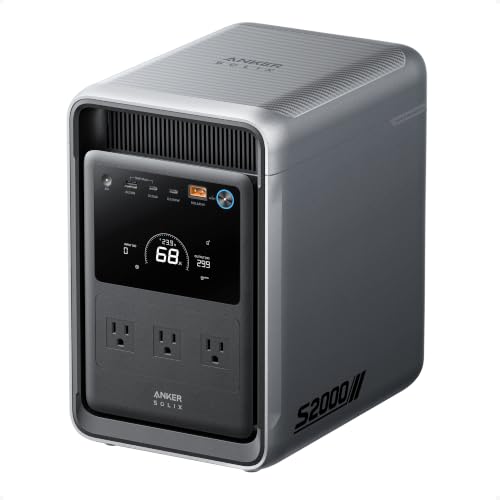
Anker SOLIX S2000
Growers on sunny sites with a settled, modest daily load who would rather buy one pack that survives a decade of daily cycling than replace a cheaper one twice.
How they compare
Scroll the table sideways to see every column.
| Product | Where to buy | Award | Capacity | AC output | Max solar input | Rated cycle life | Weight | Expandable | Best for |
|---|---|---|---|---|---|---|---|---|---|
| Anker SOLIX C1000 | Best for a greenhouse that has to refill from solar every day | 1056Wh | 1800W (2400W SurgePad) | 600W | 3,000 cycles to 80% | 28.4 lb (12.9 kg) | Yes, to 2112Wh with one expansion battery | A hobby or market greenhouse under about 200 square feet running timed fans, a small irrigation pump and a controller, on a site that gets reliable sun most days. | |
| EcoFlow DELTA 2 Max | Best for carrying a greenhouse through a run of overcast days | 2048Wh | 2400W (3400W X-Boost) | 1000W | 3,000 cycles to 80% | 50.7 lb (23.0 kg) | Yes, from 2kWh to 6kWh with up to 2 extra batteries | Growers in cloudy regions, or anyone whose greenhouse has to keep ventilating and watering unattended through a weekend of bad weather. | |
| OUPES Mega 1 | Best for starting a hard-starting irrigation or booster pump | 1024Wh | 2000W (4500W surge) | -- | 3,500+ cycles to 80% | 27.8 lb (12.6 kg) | Yes, to 5120Wh with two B2 extra batteries | Growers whose greenhouse watering runs off a jet, booster or shallow well pump that has already tripped or stalled a smaller inverter. | |
| Anker SOLIX S2000 | Best for the longest service life under daily cycling | 2010Wh | 1500W (3000W peak) | 400W | 10,000 cycles | 35.7 lb (16.2 kg) | -- | Growers on sunny sites with a settled, modest daily load who would rather buy one pack that survives a decade of daily cycling than replace a cheaper one twice. |
The full reviews
Best for a greenhouse that has to refill from solar every day
Anker SOLIX C1000
Anker
Of the four units here the C1000 accepts the most solar per watt-hour of pack it has to fill, at 600W against 1056Wh. That ratio is what decides whether a greenhouse ends the day where it started. The trade-off is that the pack itself is small enough that one sunless day empties it.
What we like about the Anker SOLIX C1000
- 600W of solar input against a 1056Wh pack is 0.57W of array per watt-hour, the highest ratio on this shortlist, so the pack refills from a short clear window rather than needing the whole day
- A 1800W continuous inverter carries a 60W exhaust fan, a 20W circulation fan and a 300W irrigation pump together at 380W, leaving 1420W of margin above the running load for the moment the pump motor starts
- At 28.4 lb one person can carry it from the greenhouse to the house at the end of the season without help
- Expandable to 2112Wh with one expansion battery, which doubles winter reserve without changing the solar array
Where it falls short for the Anker SOLIX C1000
- At 1056Wh it holds about 0.9 of our 1.17kWh reference greenhouse day, so a single overcast day ends with the fans stopping before dawn unless you cut the run hours
- SurgePad reaches 2400W by lowering output voltage, which does nothing for a motor, so a pump start has only the 1800W continuous rating behind it and this is the thinnest genuine inrush margin on the shortlist; a 1/2 hp jet pump with a stiff start is a real risk
- 3,000 rated cycles across 1056Wh is about 3,168kWh of lifetime throughput, roughly seven and a half years at our reference day, against decades for the S2000
- Only one expansion battery is supported, so the ceiling is 2112Wh and there is no path beyond it
Key specifications
- Capacity
- 1056Wh
- AC output
- 1800W (2400W SurgePad)
- Max solar input
- 600W
- Rated cycle life
- 3,000 cycles to 80%
- Weight
- 28.4 lb (12.9 kg)
- Expandable
- Yes, to 2112Wh with one expansion battery
Most greenhouse buyers start by asking how big a battery they need. For a structure that draws the same modest load every day and sits under a panel, the better first question is how quickly the pack can take that energy back.
The ratio that matters in a greenhouse
Set the solar input against the capacity it has to fill and the four units here separate sharply. The C1000 accepts 600W into 1056Wh, which is 0.57W of array per watt-hour of storage. The DELTA 2 Max manages 0.49 and the S2000 only 0.20.
In practice, derate a rated array to about 80% of its figure and the C1000 charges at roughly 480W. Our reference greenhouse day, defined in the buying guide below, draws about 1.17kWh from the pack. That is replaced in around two and a half hours of strong sun. The whole 1056Wh pack refills in about 2.2 hours.
That is the number a grower actually cares about. A short clear window between weather fronts is enough.
What it runs, and for how long
The 1800W inverter is not the limiting factor for the steady part of a greenhouse load. A 60W inline exhaust fan, a 20W horizontal airflow fan and a 300W irrigation pump running together come to 380W, well inside the rating.
The start-up instant is a different question. SurgePad’s 2400W is a voltage-lowering boost mode, so it does nothing for a motor, and the figure a pump start has to fit inside is the 1800W continuous rating, leaving about 1420W of margin above the running load. A small diaphragm or centrifugal pump fits inside that. A jet or shallow well pump with a stiff start may not.
Running only the exhaust fan, 1056Wh divided by 60W gives about 17.6 hours. That is a full summer day of ventilation from a single charge, which is the shape of load this unit fits.
Where it stops
The capacity is the ceiling. At 1056Wh it holds under one reference day. Every watt-hour the fans use has to come back from the panel that same day, and on a site that goes grey for 48 hours the arithmetic simply fails: two days of load is 2.34kWh against a pack that holds 1056Wh.
One expansion battery takes the pack to 2112Wh, which buys the second day. Beyond that there is no path, and a grower who already knows they need reserve rather than turnaround should read the DELTA 2 Max section instead.
Who should buy it
Growers whose greenhouse is a fan-and-pump load on a sunny site, who want the smallest unit that reliably ends each day full. Anyone whose weather regularly takes the sun away for more than a day should buy capacity instead of charge speed.
- Best for
- A hobby or market greenhouse under about 200 square feet running timed fans, a small irrigation pump and a controller, on a site that gets reliable sun most days.
- Choose something else if
- Your site runs cloudy for days at a time, or your irrigation pump is a deep well or jet pump whose start-up surge needs more than 2400W of headroom.
Best for carrying a greenhouse through a run of overcast days
EcoFlow DELTA 2 Max
EcoFlow
This is the unit for growers whose weather, not their fans, is the problem. A 2048Wh pack covers nearly two reference greenhouse days with no sun at all, and 1000W of solar input banks a full day's energy in about an hour and a half of clear sky. It weighs 50.7 lb, which is the cost of that reserve.
What we like about the EcoFlow DELTA 2 Max
- 2048Wh covers about 1.75 of our 1.17kWh reference greenhouse days, so ventilation and irrigation survive a full grey day without intervention
- 1000W of maximum solar input is the highest here and replaces a whole reference day in roughly 1.5 hours of strong sun, so a brief clear break refills it
- Expandable from 2kWh to 6kWh with up to two extra batteries, which is the only route on this shortlist to a genuine winter reserve
- 2400W continuous is enough headroom to run fans and a pump while a propagation mat or a small dehumidifier is also drawing
Where it falls short for the EcoFlow DELTA 2 Max
- At 50.7 lb it is 15 lb heavier than the S2000 for only 38Wh more capacity, so it becomes a fixture in the greenhouse rather than something you carry to the house
- X-Boost reaches 3400W by lowering output voltage, which does nothing for a motor, so the figure that applies to any pump is the 2400W continuous rating
- 3,000 cycles to 80% across 2048Wh is about 6,144kWh of throughput, roughly fourteen years at our reference day and under a third of the S2000's rated life
- No UPS switchover time is published in the specifications we hold, so it should not be relied on to keep a climate controller from rebooting during a handover
Key specifications
- Capacity
- 2048Wh
- AC output
- 2400W (3400W X-Boost)
- Max solar input
- 1000W
- Rated cycle life
- 3,000 cycles to 80%
- Weight
- 50.7 lb (23.0 kg)
- Expandable
- Yes, from 2kWh to 6kWh with up to 2 extra batteries
Greenhouses fail on the days the sun does not come out. That is a different problem from the one the C1000 solves, and it is the reason this heavier unit is on the page.
Nearly two days of autonomy, stated plainly
Our reference greenhouse day, set out in the buying guide, draws about 1.17kWh from the pack. Divide 2048Wh by that and you get 1.75 days. A grower who leaves on Friday evening with a full pack has ventilation and irrigation covered until some time on Sunday even if no sun arrives at all.
The C1000 and the Mega 1, at 1056Wh and 1024Wh, cover about 0.9 of a day each. That is the whole argument for the extra weight.
The refill window is short
The 1000W solar ceiling is the highest here. Derated to a realistic 80% of rated input, that is 800W of charging. Replacing the 1.17kWh a greenhouse day costs takes about an hour and a half. Refilling the entire 2048Wh pack takes about 2.6 hours.
So this unit does not trade charge speed for capacity, which is the usual compromise. It has more of both than the smaller units, and pays for it in mass.
What the boost figure does not do
EcoFlow quotes 3400W with X-Boost. That number is reached by lowering the output voltage so current stays within limits, which works for a resistive load like a propagation heat mat and does not work for a motor, which needs the voltage to develop torque.
For an irrigation pump, a circulation pump or an exhaust fan starting under load, the applicable rating is 2400W continuous. That is the highest continuous rating on this shortlist, so this is a caution rather than a disqualification. What it does mean is that the margin a stalled motor has to fit inside is narrower than the 3400W headline suggests, and narrower than the 4500W the Mega 1 quotes as a surge on its normal output.
The weight problem
Fifty point seven pounds for 2048Wh is 40.4Wh per pound. The S2000 delivers 56.3. Practically, that means the DELTA 2 Max is 15 lb heavier for 38Wh more storage, and it stops being a unit you move. In a greenhouse that is often fine, because it is going to sit on a shelf under the bench all season. It is not fine if you wanted one battery shared between the greenhouse, a shed and a camping trip.
Who should buy it
Anyone whose weather is the constraint, and anyone who expects the load to grow. The expansion path to 6kWh is the only route here to a pack that can hold a week of winter ventilation. Growers on reliably sunny sites are paying for reserve they will never draw on.
- Best for
- Growers in cloudy regions, or anyone whose greenhouse has to keep ventilating and watering unattended through a weekend of bad weather.
- Choose something else if
- You want a unit you can lift out at the end of the season, or your site is sunny enough that a smaller pack would refill every day anyway.
Best for starting a hard-starting irrigation or booster pump
OUPES Mega 1
OUPES
The Mega 1 carries the largest gap between continuous and surge rating on this shortlist, 2000W rising to 4500W, and does it in a 27.8 lb body. If your watering runs off a jet or booster pump that trips smaller inverters, this is the unit that starts it. The 1024Wh pack behind that inverter is the smallest here.
What we like about the OUPES Mega 1
- 2000W continuous with a 4500W surge is 2.25 times headroom, the widest ratio here, which is the specification that decides whether a stiff pump motor spins up or trips the unit
- 36 minutes to 80% on AC, dropping to 26 minutes with AC and solar together, so a generator or a house outlet can top it up between watering cycles in minutes
- 3,500+ cycles to 80% is a higher rating than either the C1000 or the DELTA 2 Max, worth about eight and a half years at our reference greenhouse day
- Expandable to 5120Wh with two B2 batteries, which is five times the base pack and more headroom than any other sub-30 lb unit here
- 12V DC outputs mean a 12V circulation fan can run without paying the inverter's conversion overhead
Where it falls short for the OUPES Mega 1
- The specifications we hold publish no maximum solar input figure, so a grower planning a daily solar refill cannot size an array against it the way they can with the C1000's 600W or the DELTA 2 Max's 1000W
- At 1024Wh it is the smallest pack here and holds about 0.87 of our 1.17kWh reference greenhouse day, so it depends on getting charge back every single day
- The 4500W figure is quoted as surge without a stated duration or measurement method, so it should be treated as headroom for a brief inrush and not as a rating you can design around
- The only route to real reserve is two B2 batteries to reach 5120Wh, and because no maximum solar input is published there is no stated figure to size an array against, so a bank that size has to be refilled from AC or a generator
Key specifications
- Capacity
- 1024Wh
- AC output
- 2000W (4500W surge)
- Rated cycle life
- 3,500+ cycles to 80%
- AC recharge time
- 36 minutes to 80% on AC, 26 minutes with AC and solar together
- Weight
- 27.8 lb (12.6 kg)
- Expandable
- Yes, to 5120Wh with two B2 extra batteries
Every other unit here is chosen for how it stores or replaces energy. This one is chosen for a single moment: the fraction of a second when a pump motor tries to start.
Why inrush is the greenhouse failure mode
An irrigation or booster pump draws several times its running current at the instant it starts, while the motor is stalled and generating no back-EMF. A pump whose plate says 400W can ask for well over a kilowatt for a moment. Under an undersized inverter the unit protects itself, shuts down, and the watering cycle silently does not happen. In a greenhouse in July, that is a crop.
The Mega 1’s 2000W continuous and 4500W surge is a 2.25 times ratio, the widest here, and the S2000’s 3000W peak against 1500W is 2.0. The DELTA 2 Max carries a higher continuous rating at 2400W, but its second figure of 3400W is X-Boost, which reaches that number by lowering voltage and so does nothing for a motor, and the C1000’s 2400W SurgePad works the same way. Set the boost-mode figures aside and the Mega 1 is the only unit here quoting more than twice its continuous rating as a surge on its normal output.
The pack is the compromise
At 1024Wh this is the smallest battery on the page. Against our 1.17kWh reference greenhouse day, it holds about 0.87 of a day. Running only a 60W exhaust fan it gives about 17.1 hours, and 1024Wh across 27.8 lb is 36.8Wh per pound, the lowest density here.
So this is not a reserve battery. It is a pump starter with a day’s fan energy attached, and it is bought by growers who already know their motor is the problem.
Charging around a watering schedule
Thirty-six minutes to 80% on AC is the fastest AC top-up here, and 26 minutes with AC and solar together is faster still. For a greenhouse close enough to the house to run a cord, or one that shares a generator with a workshop, that turnaround matters more than capacity does, because the pack is never far from full.
What we cannot tell you is how it behaves on solar alone. The specification set we hold does not publish a maximum solar input, so we will not estimate one. If your greenhouse has no other charging source, that gap should send you to the C1000 or the DELTA 2 Max instead.
Who should buy it
Growers with a pump that has already failed to start on something smaller, who have mains or generator access nearby, and who can add the B2 batteries later if the load grows. Anyone charging purely from a panel should choose a unit that publishes what its array can be.
- Best for
- Growers whose greenhouse watering runs off a jet, booster or shallow well pump that has already tripped or stalled a smaller inverter.
- Choose something else if
- Solar is your only charging source and you need a published maximum input figure to size the array, or you need more than about one day of reserve in the base pack.
Best for the longest service life under daily cycling
Anker SOLIX S2000
Anker
A greenhouse empties and refills the same pack 365 times a year, which is the one duty cycle where a rated cycle count stops being marketing. At 10,000 cycles across 2010Wh, the S2000 delivers more lifetime energy than the other three combined. Its 400W solar ceiling is the reason it is not the first pick here.
What we like about the Anker SOLIX S2000
- 10,000 rated cycles across 2010Wh is about 20,100kWh of lifetime throughput, which at our 1.17kWh reference greenhouse day outlasts the plausible service life of the inverter and fans around it
- 56.3Wh per pound is the best energy density here by a wide margin, so 2010Wh stays a one-person lift at 35.7 lb
- 2010Wh covers about 1.7 reference greenhouse days, enough to ventilate and water unattended through a full grey day
- 1500W continuous rising to a 3000W peak is a 2.0 times headroom ratio, second only to the Mega 1, so a typical irrigation pump start is well covered
- LFP chemistry with a 5-year warranty is the low-risk combination for a pack that will be deep-cycled daily for years
Where it falls short for the Anker SOLIX S2000
- 400W is the lowest solar ceiling here; derated to a realistic 80% that is 320W, so refilling the full 2010Wh takes about 6.3 hours of strong sun and the pack cannot catch up after two grey days inside one clear one
- There is no 12V DC port, so 12V greenhouse fans, drip timers and soil sensors have to run through an inverter and a separate adapter rather than directly
- 1500W continuous is the lowest inverter rating on this shortlist, so above a 380W fan and pump load there is 1120W of margin against 2020W on the DELTA 2 Max, and adding a dehumidifier and a bank of propagation mats runs this unit out of inverter first
- No expansion battery is listed in the specifications we hold, so growing the load means buying a second unit rather than a bigger bank
Key specifications
- Capacity
- 2010Wh
- AC output
- 1500W (3000W peak)
- Max solar input
- 400W
- Rated cycle life
- 10,000 cycles
- Weight
- 35.7 lb (16.2 kg)
- UPS switchover
- Under 10ms
Daily cycling is what separates a greenhouse from almost every other use of a portable power station. A home backup unit might see thirty cycles a year. A greenhouse pack sees 365. That single fact changes which specification matters most.
Cycle life, converted into years
Rated cycle counts are usually printed and ignored. Convert them and they become the most decisive number on the page.
Ten thousand cycles at 2010Wh is roughly 20,100kWh of energy through the pack before it is rated down to 80% of its original capacity. Our reference greenhouse day draws about 1.17kWh. That is more than 17,000 days of use.
For comparison, on the same daily load the C1000’s 3,000 cycles across 1056Wh works out at roughly seven and a half years, the Mega 1’s 3,500 cycles at about eight and a half, and the DELTA 2 Max’s 3,000 cycles across 2048Wh at about fourteen. The honest conclusion is not that this unit lasts half a century. It is that the battery stops being the part that wears out first, which is not true of any other unit here.
What you give up for it
Four hundred watts of solar input. Derate that to 80% of rated and you are charging at about 320W. Replacing the day’s 1.17kWh takes roughly 3.7 hours of strong sun, and refilling the full 2010Wh pack takes about 6.3 hours.
In July on a clear site that is fine, because the pack starts most mornings only part-empty. In a cloudy week it is the whole problem. Two grey days ask 2.34kWh of a 2010Wh pack, so it is flat before the second one ends, and the clear day that follows has to put back the full 2010Wh and cover its own 1.17kWh on top. At 320W that is close to ten hours of strong sun. The DELTA 2 Max, at 1000W in and therefore about 800W after derating, banks the same energy in about four hours.
The missing 12V port
Worth flagging because it is specific to this application. Greenhouse kit is full of 12V devices: circulation fans, drip timers, vent openers, soil probes. Most units let you run those straight off a DC port. This one has eight outlets and no 12V DC output, so every one of those loads goes through the inverter and a wall-wart, adding conversion losses to exactly the small, always-on draws you were trying to keep cheap.
Who should buy it
Growers who are sure of their site and sure of their load, who want to buy once. Anyone whose weather is unreliable, or who wants to run heat mats or a dehumidifier alongside the fans, is better served by the 2400W and 1000W solar input of the DELTA 2 Max.
- Best for
- Growers on sunny sites with a settled, modest daily load who would rather buy one pack that survives a decade of daily cycling than replace a cheaper one twice.
- Choose something else if
- Your region gives you short or overcast days for much of the growing season, because the 400W solar ceiling then becomes the limit on everything else.
How we researched this guide
Four units were compared using published manufacturer specifications and general inverter and motor documentation, then sized against a stated daily greenhouse load of 1.17kWh and an assumed 4.5 peak sun hours at 80% of rated array input. None of these units were tested by us or installed in a greenhouse, and every review states which sources it relies on and what it does not cover.
The full process is on our how we test portable power stations page, including what counts as hands-on use.
- Units evaluated
- 4
- Used hands-on
- 0
- Assessed from documentation and owner reports
- 4
Evaluation methods used: specification comparison, documentation and owner-report research
Which one should you buy?
Match your situation on the left to the recommendation on the right.
-
Your site gets reliable sun and you want the pack full again by lunchtime
Recommendation: Buy the Anker SOLIX C1000 for its 600W solar input against a 1056Wh pack
-
Your weather regularly goes grey for two or three days
Recommendation: Buy the EcoFlow DELTA 2 Max, which holds about 1.75 days of load and expands to 6kWh
-
Your irrigation pump has already tripped or stalled a smaller inverter
Recommendation: Buy the OUPES Mega 1 for its 2000W continuous rating and 4500W surge headroom
-
You expect to run this greenhouse for a decade and your daily load is settled
Recommendation: Buy the Anker SOLIX S2000, rated for 10,000 cycles, and size the array around its 400W ceiling
-
You need to carry the unit between the greenhouse, a shed and the house
Recommendation: Buy the Anker SOLIX S2000 at 56.3Wh per pound, or the C1000 at 28.4 lb if capacity matters less than mass
Mistakes buyers make
- Sizing by capacity alone and buying a pack that holds three days of energy but takes three days of sun to refill
- Assuming a headline surge figure applies to a pump, when boost modes reach it by dropping voltage and cannot start a motor
- Budgeting for a greenhouse heater on battery power, which needs an order of magnitude more energy than fans and a pump
- Ignoring rated cycle life on a load that empties and refills the same pack 365 times a year
- Siting the unit on the floor under the bench where irrigation spray, condensation drip and midday heat all reach it
- Running 12V fans and drip timers through the inverter and a wall adapter when a DC port would avoid the conversion loss
Our final recommendation
If you want one answer rather than a shortlist, this is the unit that suits the widest range of readers in this category.
Best for a greenhouse that has to refill from solar every day
A hobby or market greenhouse under about 200 square feet running timed fans, a small irrigation pump and a controller, on a site that gets reliable sun most days.
Questions buyers ask
What size solar generator do I need for a greenhouse?
Add up the watts of each device and multiply by the hours it runs. A 60W exhaust fan for 10 hours, a 20W circulation fan for 12 hours, a 300W pump for 20 minutes and a 5W controller around the clock comes to 1.06kWh, or about 1.17kWh once you allow roughly 10% for inverter overhead. Then check the solar input can return that in the sun hours your site actually gets.
Can a solar generator run a greenhouse heater?
Not meaningfully. A 1500W electric heater running eight hours on a cold night needs 12kWh, which is six times what the largest pack here holds and far more than a panel returns in a winter day. These units are for ventilation, circulation, irrigation and controls. Frost protection needs propane, paraffin, thermal mass or a mains connection.
Will an irrigation pump trip the inverter?
It can. A pump draws several times its running current for a fraction of a second at start-up, while the motor is stalled. A pump plated at 400W can ask for over a kilowatt momentarily. Judge the unit on its continuous rating plus genuine surge headroom, and treat voltage-lowering boost modes as irrelevant to motors.
How many years will one of these last if I cycle it daily?
Multiply rated cycles by capacity to get lifetime throughput, then divide by your daily draw. At 1.17kWh a day, the C1000's 3,000 cycles across 1056Wh is about seven and a half years, the Mega 1's 3,500 cycles about eight and a half, and the DELTA 2 Max's 3,000 cycles across 2048Wh about fourteen. The S2000's 10,000-cycle rating runs past the life of the electronics around it.
Can I leave the unit inside the greenhouse all summer?
Treat it as indoor equipment that happens to live outdoors. None of these units publishes a weather rating in the specifications we hold, so keep it off the floor, out of irrigation and misting spray, shaded from direct midday sun, and with the cooling vents clear. Heat is the quiet enemy: a closed glasshouse in July gets far hotter than the room these were designed for.
About the author