We Compared 4 Portable Power Stations for Construction Sites
Off-grid power editor
Published
Updated
Last fact-checked
This guide is for tradespeople working on sites with no temporary power, and for anyone doing finish work indoors where a fuel generator is not an option. We compared four battery power stations on the four specifications that decide site performance: continuous inverter output, usable capacity against a realistic tool duty cycle, how many watts the charger actually pushes back in, and rated cycle life. We did not test these units on a job, and every review states exactly what its recommendation rests on. What you get here is arithmetic no product listing shows you: watt-hours converted into hours of intermittent cutting, recharge times converted into watts so a lunch break can be planned, and cycle ratings converted into years of daily use.
What is the best portable power station for a construction site?
The BLUETTI AC200L fits the widest range of site work. Its 2400W continuous output clears a 15A tool circuit with room to spare, 2048Wh covers a working day of intermittent cutting, and a 1200W solar ceiling means it can be refilled where there is no mains power. If three trades need to run tools at once, the EcoFlow DELTA Pro is the only unit here rated for it.
Key takeaways
- Continuous output decides whether a tool runs at all; capacity only decides how long the day lasts
- A job-site circuit is 15A at 120V, which is 1800W, so any unit rated below that is choosing your tools for you
- Surge and X-Boost figures are reached by lowering voltage, so they never apply to a saw, a drill or a compressor
- Divide a published recharge time into the pack size to get average charging watts, then multiply by your break length
- Cycle life barely matters at home and matters enormously here, because a site unit is emptied and refilled every working day
Our picks at a glance
Every unit below wins a specific situation rather than a place in a ranking. Pick the row that matches how you will actually use it.
-
Best for a full working day of tool use

BLUETTI AC200L
Remodel and fit-out crews who need one unit to carry a mixed tool load from morning to knock-off, and who often work where there is no temporary power to plug into.
-
Best for fast recharge between shifts

OUPES Mega 1
Solo tradespeople and small crews working in occupied buildings where there is a live outlet somewhere, and who value carrying the unit up a flight of stairs one handed over having a big reserve.
-
Best for running several tools at once
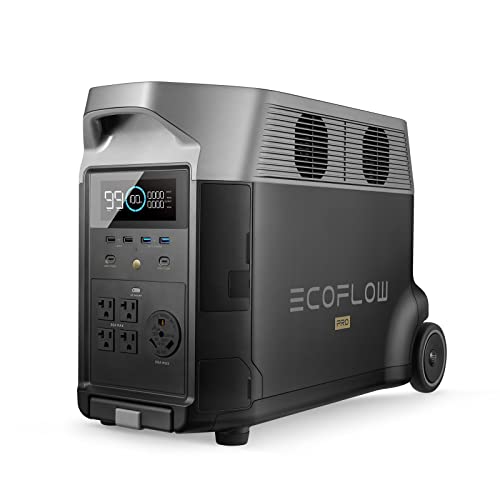
EcoFlow DELTA Pro
Crews of three or more running mains tools at the same time from a fixed position, where the unit is unloaded once in the morning and left in place all day rather than carried around.
-
Best for daily cycling over many years
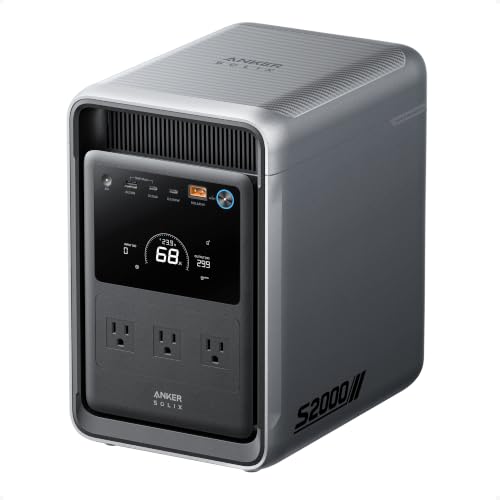
Anker SOLIX S2000
Contractors who will use the same unit every working day for years, running hand tools, chargers and lighting rather than the heaviest corded saws, and who care about what the battery looks like in year five.
How they compare
Scroll the table sideways to see every column.
| Product | Where to buy | Award | Capacity | AC output | AC recharge time | Weight | Expandable | Warranty | Best for |
|---|---|---|---|---|---|---|---|---|---|
| BLUETTI AC200L | Best for a full working day of tool use | 2048Wh | 2400W | 0-80% in 45 minutes (2400W AC input) | 61.41 lb (27.9 kg) | Yes, to 8192Wh with expansion batteries | 4-year warranty | Remodel and fit-out crews who need one unit to carry a mixed tool load from morning to knock-off, and who often work where there is no temporary power to plug into. | |
| OUPES Mega 1 | Best for fast recharge between shifts | 1024Wh | 2000W (4500W surge) | 36 minutes to 80% on AC, 26 minutes with AC and solar together | 27.8 lb (12.6 kg) | Yes, to 5120Wh with two B2 extra batteries | 5-year warranty | Solo tradespeople and small crews working in occupied buildings where there is a live outlet somewhere, and who value carrying the unit up a flight of stairs one handed over having a big reserve. | |
| EcoFlow DELTA Pro | Best for running several tools at once | 3600Wh | 3600W (4500W X-Boost) | 1.8 hours on a 240V outlet, 2.7 hours on a 1800W wall outlet | 99 lb (44.9 kg) | Yes, from 3.6kWh to 25kWh with extra batteries or smart generators | 5 years | Crews of three or more running mains tools at the same time from a fixed position, where the unit is unloaded once in the morning and left in place all day rather than carried around. | |
| Anker SOLIX S2000 | Best for daily cycling over many years | 2010Wh | 1500W (3000W peak) | -- | 35.7 lb (16.2 kg) | -- | 5 years | Contractors who will use the same unit every working day for years, running hand tools, chargers and lighting rather than the heaviest corded saws, and who care about what the battery looks like in year five. |
The full reviews
Best for a full working day of tool use
BLUETTI AC200L
BLUETTI
The AC200L pairs the second-highest continuous output here with a pack big enough that you are not watching the state of charge all afternoon. Its 1200W solar ceiling is the reason it leads: it is the only unit here with a published solar rating high enough to refill its own pack inside a working day.
What we like about the BLUETTI AC200L
- 2400W continuous drives a 15A corded saw and a shop vac at the same time without dropping into a surge mode
- 2048Wh covers roughly 6.8 hours of intermittent saw work at a 20% duty cycle, which is a full day for most trim and remodel crews
- Recharges 1638Wh in 45 minutes, an average of about 2184W, so a lunch break puts back more raw energy than any other unit here
- 1200W solar input is three times the Anker S2000 ceiling, enough to refill the pack inside a working day from panels alone
- Expandable to 8192Wh, so a long fit-out can be covered without buying a second inverter
Where it falls short for the BLUETTI AC200L
- The published specification lists no separate surge or peak rating, unlike the OUPES 4500W surge and the Anker 3000W peak, so a tool whose start-up spike exceeds 2400W has no documented headroom to fall back on
- At 61.41 lb it is 33.6 lb heavier than the OUPES Mega 1 and stores only 33 watt-hours per pound against the Anker S2000's 56, which is the worst energy-to-weight ratio of the four
- The 4-year warranty is the shortest here, and a unit cycled daily on a site is exactly the case that wears a warranty out
- BLUETTI publishes no rated cycle life for the AC200L, so the specification that decides how many years of daily emptying and refilling you get is simply absent, where Anker states 10,000 cycles and OUPES 3,500+
- A 16.5 x 11 x 14.4 in footprint is a real amount of truck-bed space to give up every day
Key specifications
- Capacity
- 2048Wh
- AC output
- 2400W
- AC recharge time
- 0-80% in 45 minutes (2400W AC input)
- Max solar input
- 1200W
- Expandable
- Yes, to 8192Wh with expansion batteries
- Weight
- 61.41 lb (27.9 kg)
The AC200L is the unit in this group that lets you stop thinking about power partway through the day. That is a function of two numbers working together, not one headline figure.
Why 2400W is the number that matters
A job-site circuit is 15A at 120V, which is 1800W. Tools are built to live inside that limit, so a full-size circular saw, a 10-inch table saw or a 1400W compressor all sit below it while running.
At 2400W continuous, the AC200L clears that ceiling by 600W. In practice that means a saw and a shop vac can run on the same unit, which is the single most common two-tool combination on a remodel and the one that trips 1500W units.
The Anker S2000 in this guide is rated 1500W continuous. A tool drawing the full 15A of its circuit is already 300W above that. The AC200L simply does not have that conversation with you.
The runtime arithmetic
Manufacturer runtime charts assume a constant draw. Tools do not work that way.
Assume a 1500W miter saw that is actually cutting for 12 minutes in every hour, a 20% duty cycle. Average draw is 300W. Against 2048Wh that gives roughly 6.8 hours before the pack is empty, and closer to five and a half once you add a work light and a radio.
That is a working day. It is not two, and anyone planning a two-day pour or a weekend framing job should read the DELTA Pro section instead.
The charge rate is a plannable number
The specification says 0 to 80% in 45 minutes. Turn that into something you can schedule with: 80% of 2048Wh is 1638Wh, delivered in three quarters of an hour, which is an average input of about 2184W.
A 30-minute lunch break therefore returns roughly 1092Wh, or a bit over half the pack. No other unit here puts that much raw energy back in half an hour. The OUPES Mega 1 refills a larger share of itself in the same window because its pack is smaller, which is a different advantage and is covered in its review.
Where the solar input earns its place
This is the specification that decides the award. At 1200W maximum solar input, 2048Wh is theoretically a 1.7-hour refill. Derate for panel angle, dust and heat and call it three to four hours of good sun.
That is the difference between a site with no shore power being viable and being a daily trip back to the shop. The S2000’s 400W ceiling means five hours at rated input before any derating, which does not fit inside a working day with any margin.
Who should skip it
If you are one person carrying tools up stairs, 61.41 lb is the wrong answer and the Mega 1 exists. If you routinely run three tools at once, 2400W is not enough and the DELTA Pro is the honest recommendation.
- Best for
- Remodel and fit-out crews who need one unit to carry a mixed tool load from morning to knock-off, and who often work where there is no temporary power to plug into.
- Choose something else if
- You have to lift the unit into a high truck bed alone every morning, or your work is spread across several floors and you would be carrying 61 lb up stairs.
Best for fast recharge between shifts
OUPES Mega 1
OUPES
Nothing else here turns a coffee break back into usable energy this quickly. The Mega 1 refills 80% of its pack in 36 minutes and carries a 4500W surge rating against 2000W continuous, so it starts tools far above its own weight class. The trade-off is a 1024Wh pack you will empty before lunch if you never plug in.
What we like about the OUPES Mega 1
- 36 minutes to 80% works out to roughly 1365W average input, which returns about two thirds of the pack in a single 30-minute break
- 4500W surge against a 2000W continuous rating is 2.25 times headroom, the largest documented start-up margin in this shortlist
- 27.8 lb is a genuine one-hand carry and 71.9 watts of inverter per pound, nearly double the DELTA Pro's 36.4
- 3,500+ rated cycles is about 14 years at one cycle per working day
- Expandable to 5120Wh with two B2 batteries, so the small pack is a starting point rather than a ceiling
- 5-year warranty and under-20ms UPS switchover, which keeps a laser level or site laptop alive through a swap to shore power
Where it falls short for the OUPES Mega 1
- 1024Wh is half the AC200L pack and covers only about 3.4 hours of intermittent saw work at a 20% duty cycle, so this unit depends on having somewhere to plug in mid-shift
- No maximum solar input is published in the specification, so you cannot size a panel array for it the way you can for the AC200L's rated 1200W
- Even at 26 minutes with AC and solar combined, refilling twice a day means the unit is tethered to a working outlet, which defeats the point on a site with no temporary power
- The port list leads with USB-C and USB-A and does not publish an AC outlet count, so a multi-tool setup may still need a power strip
Key specifications
- Capacity
- 1024Wh
- AC output
- 2000W (4500W surge)
- AC recharge time
- 36 minutes to 80% on AC, 26 minutes with AC and solar together
- Weight
- 27.8 lb (12.6 kg)
- Rated cycle life
- 3,500+ cycles to 80%
- Expandable
- Yes, to 5120Wh with two B2 extra batteries
The Mega 1 solves a different problem from the rest of this shortlist. It does not try to carry you through the day on stored energy. It tries to make refilling so quick that stored energy stops being the constraint.
What a 36-minute charge is actually worth
Convert the specification into something you can plan around. Eighty per cent of 1024Wh is 819Wh, delivered in 36 minutes. That is an average input of about 1365W.
Give it a normal 30-minute break and it takes back roughly 683Wh, which is two thirds of the whole pack. The AC200L puts more raw energy back in the same window because its charger is bigger, but it recovers barely half of itself. If your working pattern is short bursts of tool use with breaks in between, refilling a larger fraction of your reserve is the more useful behaviour.
The surge rating, and what it is not
The 4500W surge against a 2000W continuous rating is 2.25 times headroom, and that matters because tool motors spike hard on start-up. A router or a compressor asks for far more current in the first fraction of a second than it does while running.
Be careful about comparing that figure to the DELTA Pro’s 4500W. EcoFlow reaches its number through X-Boost, which lowers output voltage to keep current in check. That works on a heater. It does not work on a motor, which needs voltage to make torque. The OUPES figure is published as a plain surge rating, so it is the more useful of the two numbers for tool work.
The weight argument
At 27.8 lb the Mega 1 carries 71.9 watts of inverter for every pound. The DELTA Pro manages 36.4, the AC200L 39.1. If your day involves moving the unit between rooms, up scaffolding or into a van several times, that ratio is the specification you will feel.
Where the arithmetic turns against it
The pack. At 1024Wh, a 1500W saw cutting for 12 minutes an hour averages 300W and empties it in about 3.4 hours. That is not a working day, and no charging speed fixes it if there is no outlet.
Two B2 batteries lift it to 5120Wh, which is a genuine answer, but you are then carrying three boxes rather than one and the weight advantage is gone.
- Best for
- Solo tradespeople and small crews working in occupied buildings where there is a live outlet somewhere, and who value carrying the unit up a flight of stairs one handed over having a big reserve.
- Choose something else if
- Your site has no mains power at all, because a 1024Wh pack with no published solar rating cannot be refilled on location and will not last a full day of tool use.
Best for running several tools at once
EcoFlow DELTA Pro
EcoFlow
This is the only unit here that lets a crew stop taking turns. A 3600W inverter across five AC outlets covers a saw, a compressor and a grinder simultaneously, and 3600Wh keeps that going for most of a day. It weighs 99 lb, which decides whether it belongs on your site before any other specification does.
What we like about the EcoFlow DELTA Pro
- 3600W continuous is 1200W more than the next unit here, enough for three mains tools running together rather than in sequence
- Five AC outlets mean a crew is not queueing at a single power strip
- 3600Wh covers roughly 12 hours of intermittent saw work at a 20% duty cycle, so a long day finishes on one charge
- Wheels and a pull-up handle make it the only unit here designed to be dragged rather than lifted
- Expandable from 3.6kWh to 25kWh, which is enough to cover a site trailer rather than a single trade
Where it falls short for the EcoFlow DELTA Pro
- At 99 lb it is 71.2 lb heavier than the OUPES Mega 1 and needs two people to get it into a truck bed, and the wheels only help on level ground rather than on mud, gravel or stairs
- Recharging takes 2.7 hours on a standard 1800W outlet, an average of about 1333W, so a 30-minute break returns only 667Wh or about 18% of the pack
- The 4500W X-Boost figure is reached by reducing output voltage, so it does not apply to a motor and the number you must size tools against is 3600W
- No cycle life is published in the specification, unlike the Anker S2000's 10,000 and the OUPES 3,500, so daily-cycling service life is unknown
- The 16.4 x 25 x 11.2 in body is 25 inches long, which is a significant piece of a truck bed or a van floor
Key specifications
- Capacity
- 3600Wh
- AC output
- 3600W (4500W X-Boost)
- AC recharge time
- 1.8 hours on a 240V outlet, 2.7 hours on a 1800W wall outlet
- Weight
- 99 lb (44.9 kg)
- Expandable
- Yes, from 3.6kWh to 25kWh with extra batteries or smart generators
- Warranty
- 5 years
Every other unit in this guide answers the question “can it run my tool”. The DELTA Pro answers a different one: can it run my crew.
Three tools, one box
Work the arithmetic from the tools rather than the battery. A 1500W miter saw, a 1400W compressor and a 700W angle grinder total 3600W. That is exactly the continuous rating, which is the practical definition of a three-tool unit.
Try the same sum on the AC200L’s 2400W and you are choosing two of the three. On the Anker S2000’s 1500W you are choosing one. Five AC outlets rather than a single strip is the other half of this: three trades can plug in without unplugging each other.
Do not size against the X-Boost number
EcoFlow advertises 4500W X-Boost. It reaches that figure by lowering output voltage so current stays inside limits. A resistive load, a heater or a kettle, simply runs cooler and slower. A motor cannot do that, because it needs voltage to develop torque.
For a saw, a compressor or a pump, the number that applies is 3600W. Treat X-Boost as irrelevant to construction work and you will never be surprised by it.
Runtime, then the recharge problem
At a 20% duty cycle, a 1500W saw averages 300W. Against 3600Wh that is roughly 12 hours, so this is the only unit here where a long day is not a planning exercise.
The recharge is the trade. Full in 2.7 hours on an 1800W wall outlet means an average input of about 1333W. A 30-minute break returns 667Wh, which is only 18% of the pack. The 240V figure of 1.8 hours lifts that to about 2000W average, but a 240V outlet on a construction site is not something to assume.
So the DELTA Pro’s model is start full, finish the day, charge overnight. It is not a unit you top up between shifts.
The weight is the real decision
99 lb is not a specification you read past. It is two people lifting, or a ramp. The wheels and pull rod work on a finished slab and do very little in a trench or on a stair.
If the unit lives in one place for the day, that is fine. If it moves with you, buy something 70 lb lighter and accept fewer simultaneous tools.
- Best for
- Crews of three or more running mains tools at the same time from a fixed position, where the unit is unloaded once in the morning and left in place all day rather than carried around.
- Choose something else if
- You work alone, move between floors, or need the unit refilled quickly during breaks, because 99 lb and a 2.7-hour recharge both work against that pattern.
Best for daily cycling over many years
Anker SOLIX S2000
Anker
A site unit gets emptied and refilled every single working day, which is a duty no home backup battery ever sees. The S2000 is rated for 10,000 cycles and packs 2010Wh into the smallest body here, so it is the one built for that pattern. Its 1500W inverter is the compromise you accept in return.
What we like about the Anker SOLIX S2000
- 10,000 rated cycles is roughly 40 years at one full cycle per working day, against about 14 years for the 3,500-cycle OUPES Mega 1
- 56 watt-hours per pound against the AC200L's 33, the best energy-to-weight ratio in this shortlist by a wide margin
- Holds practically the same energy as the 2048Wh AC200L in a 8.19 x 11.1 x 12.7 in body, about 44% of the AC200L's volume
- 35.7 lb is a one-person lift into a truck bed without making it a two-man job
- Under 10ms UPS switchover, the fastest here, so a site laptop or laser level does not blink when you move to shore power
- 5-year warranty and LFP cells, which is the chemistry that survives repeated deep cycling
Where it falls short for the Anker SOLIX S2000
- 1500W continuous is below the 1800W a tool drawing the full 15A of a job-site circuit will ask for, so a large corded saw and a shop vac cannot run together on this unit
- Anker publishes no AC recharge time in the specification we hold, so you cannot plan a lunch-break top-up the way you can with the 45-minute AC200L or the 36-minute Mega 1
- The 400W solar ceiling means 2010Wh needs five hours at rated input before any real-world derating, so a site with no mains power will not refill this in a working day
- The specification lists eight outlets with no 12V DC port, so a 12V inflator or site light needs an AC adapter
- No expansion battery is listed in the specification, unlike the other three units, so 2010Wh is the ceiling unless you buy a second unit
Key specifications
- Capacity
- 2010Wh
- AC output
- 1500W (3000W peak)
- Weight
- 35.7 lb (16.2 kg)
- Rated cycle life
- 10,000 cycles
- UPS switchover
- Under 10ms
- Warranty
- 5 years
Most power station buying advice is written for a unit that gets used a handful of times a year. Construction inverts that. Yours will be flat by four o’clock and full again by seven the next morning, five days a week, for as long as you own it. That changes which specification matters.
Cycle life is the construction specification
Anker rates the S2000 at 10,000 cycles. Divide by roughly 250 working days a year and that is about 40 years of one-cycle-a-day service. The OUPES Mega 1’s 3,500+ rating gives about 14 years on the same maths, and EcoFlow publishes no figure at all for the DELTA Pro in the specification we hold.
For a homeowner cycling a unit six times a year, none of that is a real difference. For a crew, it is the difference between one purchase and three.
Density, because it lives in a truck
Two figures do the work here. At 2010Wh and 35.7 lb, the S2000 stores 56 watt-hours per pound. The AC200L manages 33 for a nearly identical pack.
The volume comparison is starker. The S2000’s 8.19 x 11.1 x 12.7 in body is about 1,150 cubic inches. The AC200L’s 16.5 x 11 x 14.4 in is about 2,610. Practically the same stored energy in 44% of the space. If your van is already full of material, that is the specification that decides.
The 1500W ceiling, stated plainly
A job-site circuit is 15A at 120V, which is 1800W, and tools are designed to use it. The S2000 stops at 1500W continuous with a 3000W peak, which is fine for drills, chargers, lighting, a small compressor or a track saw, and not fine for a 15A circular saw with a vacuum tied to it.
Work out your worst simultaneous pair before buying. If it exceeds 1500W, the AC200L’s 2400W is the smaller compromise.
The recharge gap
This is the honest weak point. The published specification gives no AC recharge time, so there is no number to plan a break around, and the 400W solar input needs five hours at rated conditions to cover 2010Wh before any derating for cloud, heat or panel angle.
The S2000 is therefore an overnight-charge unit. That suits a crew that returns to a shop or a truck with an inverter every evening. It does not suit a remote site where the plan was to run on panels.
What it will actually carry
Assume a 20V 5.0Ah tool pack holds about 100Wh and that a charger wastes some of what it draws, so call it 120Wh from the outlet per pack. 2010Wh is therefore around 16 full tool batteries, which is a day of cordless work for a small crew before you have plugged in a single corded tool.
- Best for
- Contractors who will use the same unit every working day for years, running hand tools, chargers and lighting rather than the heaviest corded saws, and who care about what the battery looks like in year five.
- Choose something else if
- You run a full-size table saw, a 15A circular saw alongside a vacuum, or you need a documented fast-charge time to schedule top-ups between shifts.
How we researched this guide
Four units were compared on published manufacturer specifications and electrical documentation. None of them were tested by us on a job site, and every review states which specifications its judgement rests on. All runtime, charge-rate, density and cycle-life figures on this page are our own arithmetic on those published numbers, with the assumptions stated in the text.
The full process is on our how we test portable power stations page, including what counts as hands-on use.
- Units evaluated
- 4
- Used hands-on
- 0
- Assessed from documentation and owner reports
- 4
Evaluation methods used: specification comparison
Which one should you buy?
Match your situation on the left to the recommendation on the right.
-
Three or more trades need to run mains tools at the same time
Recommendation: Buy the EcoFlow DELTA Pro, the only unit here rated 3600W across five AC outlets
-
You work alone and carry the unit up stairs or between floors all day
Recommendation: Buy the OUPES Mega 1 at 27.8 lb, and accept that you will refill it at lunch
-
Your site has no mains power and you plan to run on panels
Recommendation: Buy the BLUETTI AC200L for its 1200W solar ceiling, which is the only one high enough to refill a pack in a day
-
The same unit will be cycled every working day for years
Recommendation: Buy the Anker SOLIX S2000 for its 10,000 cycle rating, roughly 40 years of one cycle per working day
-
You regularly run a 15A corded saw with a shop vac tied to it
Recommendation: Buy the BLUETTI AC200L, because 2400W covers that pair and the 1500W S2000 does not
Mistakes buyers make
- Sizing by watt-hours and buying a unit whose inverter cannot start the saw it was bought for
- Reading a surge or X-Boost figure as usable headroom for a motor, when it is reached by dropping output voltage
- Planning a day from a manufacturer runtime chart, which assumes constant draw rather than a tool cutting for minutes at a time
- Buying a unit with no published recharge time and then trying to schedule top-ups around breaks
- Assuming solar will cover a site, without checking the rated solar input against the size of the pack
- Ignoring rated cycle life because home backup reviews ignore it, when a site unit cycles a hundred times more often
Our final recommendation
If you want one answer rather than a shortlist, this is the unit that suits the widest range of readers in this category.
Best for a full working day of tool use
Remodel and fit-out crews who need one unit to carry a mixed tool load from morning to knock-off, and who often work where there is no temporary power to plug into.
Questions buyers ask
Can I use one of these inside an occupied building?
Yes. A battery power station burns nothing, so there is no exhaust and no carbon monoxide, which is the whole reason they get used on interior fit-outs where an engine is banned outright. Keep the vents clear, because these units run their fans hard while fast charging.
Will these survive dust, rain and a truck bed?
Treat them as tool-box electronics rather than as tools. None of the four publishes an ingress protection rating, so none of them can be documented as dust-tight or weather sealed. Keep the unit off bare ground, out of direct rain, and covered when concrete or drywall dust is in the air.
What happens if I overload the inverter mid-cut?
The unit protects itself and shuts off the AC output. You lose the cut and you reset it, which is annoying rather than damaging. The real cost is repetition: if it happens every time the vacuum kicks in, you bought the wrong continuous rating and no setting will fix it.
Can I run a 240V welder or a large compressor from one of these?
No welder that needs 240V will work, because none of these four units produces split-phase output. A 120V compressor is a different question and comes down to its running wattage against the continuous rating, plus whatever the motor asks for on start-up.
Is it worth adding solar panels on a working site?
Only if the rated solar input is large relative to the pack. The AC200L accepts 1200W into 2048Wh, which is a realistic day. The S2000 accepts 400W into 2010Wh, which is five hours at rated conditions before you derate for cloud and panel angle. Panels are a top-up on most sites, not a power source.
About the author