We Compared 4 Battery Backups for Home Appliances

Off-grid power editor
Published
Updated
Last fact-checked

This guide is for people who already know which appliances they want to keep running. Not the whole house, not the panel, just a short list: the refrigerator, the router, a laptop, maybe the microwave. Sizing against named devices is a different problem from sizing against a house, and it is the one most buying guides skip. We shortlisted four units between 288Wh and 1024Wh and compared them on the four things that decide the match: the inverter ceiling that rules an appliance in or out, delivered watt-hours after conversion loss, watt-hours per pound, and rated cycle life converted into years. None of these units were tested by us, and every review says exactly what its judgement rests on. What you get here is the arithmetic, with the assumptions written down so you can redo it against your own appliance labels.
What is the best battery backup for home appliances?
The EcoFlow DELTA 3 Plus fits the widest range of households. Its 1800W inverter is the only one here with room for a microwave and a furnace blower at the same time, and 1024Wh covers roughly six hours of refrigerator. If your appliance list stops at a router and a laptop, the much smaller BLUETTI Elite 30 V2 does that job for a fraction of the weight.
Key takeaways
- The inverter ceiling decides which appliances are possible at all; watt-hours only decide how long they last afterwards
- Rated capacity is not delivered capacity, and a working allowance of 85% after conversion loss is close enough to plan with
- Divide rated cycle life by 365 and you get years of daily use, which is the only form of that number worth comparing
- Watt-hours per pound separates units that get carried around from units that get installed once
- A surge rating reached by lowering voltage never applies to anything with a motor in it
Our picks at a glance
Every unit below wins a specific situation rather than a place in a ranking. Pick the row that matches how you will actually use it.
-
Best for the widest range of household appliances

EcoFlow DELTA 3 Plus
Households whose appliance list includes at least one high-draw item, such as a microwave or a furnace blower, alongside the refrigerator and the router.
-
Best for refilling from solar between outages
Pecron F1000LFP
Households that own or plan to buy solar panels and want the appliance backup to keep refilling itself through a multi-day outage instead of draining once.
-
Best for years of daily cycling

Jackery Explorer 500 v2
Anyone who will use the unit constantly rather than store it for emergencies, such as a nightly CPAP, a permanently backed-up router or a daily work-from-home desk.
-
Best for keeping the router and desk electronics alive

BLUETTI Elite 30 V2
Home offices and connected households that need the internet, the computer and a lamp to survive cuts of an hour or two without anyone reacting.
How they compare
Scroll the table sideways to see every column.
| Product | Where to buy | Award | Capacity | AC output | UPS switchover | AC recharge time | Weight | Warranty | Best for |
|---|---|---|---|---|---|---|---|---|---|
| EcoFlow DELTA 3 Plus | Best for the widest range of household appliances | 1024Wh | 1800W | 10ms | 40 minutes to 80% on 1500W AC input | 27 lb (12.2 kg) | 5 years | Households whose appliance list includes at least one high-draw item, such as a microwave or a furnace blower, alongside the refrigerator and the router. | |
| Pecron F1000LFP | Best for refilling from solar between outages | 960Wh | 1500W pure sine wave | Within 20ms | 50 minutes to 80%, 70 minutes to full at 1000W AC | 23.9 lb (10.8 kg) | 2+3 years | Households that own or plan to buy solar panels and want the appliance backup to keep refilling itself through a multi-day outage instead of draining once. | |
| Jackery Explorer 500 v2 | Best for years of daily cycling | 512Wh | 500W (1000W surge) | 10ms | 52 minutes to 80% | 12.6 lb (5.7 kg) | 5 year manufacturer | Anyone who will use the unit constantly rather than store it for emergencies, such as a nightly CPAP, a permanently backed-up router or a daily work-from-home desk. | |
| BLUETTI Elite 30 V2 | Best for keeping the router and desk electronics alive | 288Wh | 600W continuous (1500W Power Lifting) | 10ms | 0-80% in 45 minutes, 0-100% in 70 minutes (380W AC) | 9.4 lb (4.3 kg) | 60 months | Home offices and connected households that need the internet, the computer and a lamp to survive cuts of an hour or two without anyone reacting. |
The full reviews
Best for the widest range of household appliances
EcoFlow DELTA 3 Plus
EcoFlow
The 1800W inverter is the highest ceiling on this shortlist, which is what lets one unit cover a microwave, a furnace blower and a refrigerator instead of forcing you to choose. You pay for that in weight, at 27 lb, and the 1024Wh pack still only holds about six hours of refrigerator.
What we like about the EcoFlow DELTA 3 Plus
- 1800W leaves room to run a 1,200W microwave and a 400W furnace blower at the same time, which no other unit here can do
- 40 minutes to 80% works out at roughly 1,230W going into the pack, the fastest refill on this list
- 10ms UPS switchover is quick enough that a desktop, a router and an ONT do not reboot
- 4,000 cycles to 80% is about 10.9 years at one full cycle every single day
- Expansion to 5kWh raises refrigerator coverage from about six hours to about a day
Where it falls short for the EcoFlow DELTA 3 Plus
- At 27 lb it is the heaviest unit here and works out at 37.9Wh per pound, below both the Pecron F1000LFP and the Jackery Explorer 500 v2
- The 5kWh ceiling is only reachable with DELTA 3, DELTA Pro 3 or DELTA 2 Max packs, so the upgrade path commits you to one manufacturer's battery range for the life of the system
- 1024Wh is under a third of the roughly 3.6kWh a full-size refrigerator uses in a day, so on its own it is an overnight unit rather than multi-day backup
- The 40-minute charge pulls over 1,200W, which is most of a 15A branch circuit and will trip a breaker shared with a kettle or a space heater
Key specifications
- Capacity
- 1024Wh
- AC output
- 1800W
- UPS switchover
- 10ms
- AC recharge time
- 40 minutes to 80% on 1500W AC input
- Weight
- 27 lb (12.2 kg)
- Expandable
- Yes, up to 5kWh with DELTA 3, DELTA Pro 3 or DELTA 2 Max battery packs
- Rated cycle life
- 4,000 cycles to 80%
Most people shopping for appliance backup start by adding up watt-hours. That is the second question. The first is whether the inverter can run the appliance at all, and this is the only unit on the shortlist that clears every load a normal house contains short of a well pump or an electric range.
What 1800W buys that 1500W does not
The difference sounds small. In practice it is the line between one unit and two.
Take three loads that commonly run together during an outage: a refrigerator averaging 150W, a gas furnace blower at roughly 400W, and a microwave at 1,200W while it is actually heating. Together that is 1,750W. The DELTA 3 Plus takes it. The 1500W Pecron F1000LFP does not, and the 500W and 600W units here are not in the conversation.
You will not run all three for long. You do not need to. You need the unit not to shut down when someone heats soup while the furnace is calling for heat.
The runtime maths, with the loss stated
Rated capacity is not what reaches the appliance. Allow 85% after inverter conversion and reserve, which puts 1024Wh at roughly 870Wh delivered.
Against that:
- A refrigerator averaging 150W across its compressor duty cycle: about 5.8 hours
- A chest freezer averaging 60W: about 14.5 hours
- A router and cable modem at 20W combined: about 43 hours
A full-size refrigerator uses somewhere near 3.6kWh a day once you account for the compressor cycling on and off. This unit holds under a third of that. Read that plainly: it carries a fridge through a night, not through a weekend.
Why the expansion path matters and where it bites
Add packs to the 5kWh ceiling and the same 85% allowance gives about 4,250Wh delivered, or roughly 28 hours of refrigerator. That turns an overnight unit into a genuine multi-day one without replacing what you already own.
The catch is that the expansion is only compatible with DELTA 3, DELTA Pro 3 and DELTA 2 Max packs. Buying this unit is a decision to stay inside one battery range for as long as you keep the system. If that manufacturer changes its connector or discontinues the packs, the ceiling you paid for goes away.
Charging is fast enough to be a planning consideration
Reaching 80% in 40 minutes means about 819Wh going in over two-thirds of an hour, or roughly 1,230W. That is fast enough to use a short grid window and heavy enough that you should think about which circuit you plug it into. On a 15A branch shared with a kettle, it will trip the breaker.
Who should choose something else
If your appliance list stops at a router, a laptop and a lamp, you are paying for 1800W you will never use and carrying 27 lb to do it. If your priority is refilling from panels rather than from the wall, the Pecron F1000LFP carries a 600W solar input, the highest rating on this shortlist.
- Best for
- Households whose appliance list includes at least one high-draw item, such as a microwave or a furnace blower, alongside the refrigerator and the router.
- Choose something else if
- You only need to hold small electronics through short cuts, or you have to carry the unit up stairs regularly, because 27 lb is awkward in one hand.
Best for refilling from solar between outages
Pecron F1000LFP
Pecron
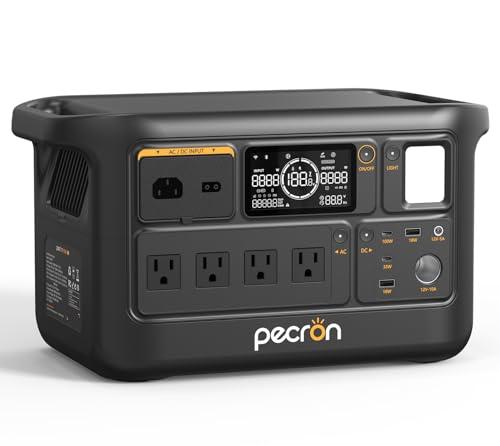
A 600W solar input on a 960Wh pack is an unusually generous ratio, and it is the reason to pick this unit over a faster-charging rival: it can be refilled by panels rather than by a wall socket. The trade is the transfer spec: rated within 20ms, against a flat 10ms on the other three units here.
What we like about the Pecron F1000LFP
- 600W solar input against 960Wh of storage means a full refill from empty in about 1.6 hours of panel output at the rated figure
- 1500W pure sine wave covers a 1,200W microwave, a 900W coffee maker or a refrigerator plus lighting
- 40.2Wh per pound at 23.9 lb, the second-highest energy density here and light enough to move between rooms one-handed
- 10 ports including four AC outlets, so a fridge, a router, a lamp and a laptop plug in directly with no power strip
- 50 minutes to 80% from the wall gives it a fast mains option as well as the solar one
Where it falls short for the Pecron F1000LFP
- UPS switchover is only specified as "within 20ms" where the other three units here commit to 10ms, and the top of that window sits at the outer edge of what many desktop power supplies ride through without rebooting
- The 1500W ceiling is 300W below the EcoFlow DELTA 3 Plus, so a microwave and a gas furnace blower cannot share this inverter at the same time
- Warranty is quoted as 2+3 years rather than a flat five, so the last three years carry conditions the first two do not
- 960Wh is roughly a quarter of a full-size refrigerator's daily use, so without panels running it is an overnight unit
Key specifications
- Capacity
- 960Wh
- AC output
- 1500W pure sine wave
- Max solar input
- 600W
- UPS switchover
- Within 20ms
- AC recharge time
- 50 minutes to 80%, 70 minutes to full at 1000W AC
- Weight
- 23.9 lb (10.8 kg)
- Ports
- 10 total, 4 AC outlets, 2x USB-A 18W, 1x USB-C 33W, 1x USB-C 100W, DC 5525, car port
Every other unit on this page is judged on how fast it refills from a wall socket. That is the right question if your outages are short and the grid comes back. It is the wrong question if the reason you are reading this is a storm that took the power out for three days.
The specification that decides this pick
600W of solar input on a 960Wh battery is a ratio worth spelling out. Divide one by the other and a completely flat pack refills in about 1.6 hours at the rated input.
Real panels do not hold their rated output. Angle, cloud and heat all take a share, so plan on something closer to two and a half or three hours of good sun. Even at that discount, this unit can be emptied and refilled inside a single day and then do it again the next day. A power station that recharges only from the wall cannot do anything at all once the wall is dead.
What 1500W actually runs
Pure sine wave at 1500W continuous is enough for essentially every plug-in appliance in a normal kitchen taken one at a time:
- A 1,200W microwave, with 300W to spare
- A 900W coffee maker alongside a 150W refrigerator
- A refrigerator, a router, a laptop and two lamps together, which lands near 250W
Where it stops is combinations. A microwave at 1,200W plus a gas furnace blower at roughly 400W is 1,600W, and this inverter will not take it. The DELTA 3 Plus will. If your outage plan involves heat and hot food at the same moment, that 300W gap is the whole decision.
Runtime, after the conversion loss
Allow 85% of rated capacity reaching the appliance and 960Wh becomes about 816Wh delivered.
- Refrigerator at 150W averaged across the compressor duty cycle: about 5.4 hours
- Chest freezer at 60W averaged: about 13.6 hours
- Router and modem at 20W: about 40 hours
At 3.6kWh for a full-size refrigerator over a day, this holds roughly a quarter of that. Paired with panels, the number stops mattering the way it does on a sealed unit, because you are topping up as you go rather than spending a fixed budget.
The switchover caveat is real
Rated within 20ms, this is the loosest transfer specification here. For a refrigerator, a lamp or a phone charger that is irrelevant, because none of them notice a gap that short. For a desktop computer or a network-attached drive it is a genuine risk, because many power supplies hold up for around 16 to 20ms and a transfer at the top of that window can still drop them.
If protecting a computer is why you are buying, the BLUETTI Elite 30 V2 and the DELTA 3 Plus are both rated at 10ms and are the safer answer.
Four outlets is a bigger deal than it sounds
Ten ports, four of them AC, means a fridge, a router, a lamp and a laptop go straight into the unit. Units with two AC outlets force a power strip, and a power strip is one more thing to find in the dark and one more connection to fail.
- Best for
- Households that own or plan to buy solar panels and want the appliance backup to keep refilling itself through a multi-day outage instead of draining once.
- Choose something else if
- You are protecting a desktop computer or a NAS where a 20ms gap can force a reboot, or you need a microwave and a furnace blower running together.
Best for years of daily cycling
Jackery Explorer 500 v2
Jackery
Rated at 6,000 charge cycles, this is the one unit here you can drain and refill every day for well over a decade without treating that as abuse. It is also the most energy-dense on the list at 40.6Wh per pound. The 500W inverter is what you give up for both.
What we like about the Jackery Explorer 500 v2
- 6,000 charge cycles is about sixteen years at one full cycle every day, half again as long as the 4,000-cycle EcoFlow DELTA 3 Plus
- 40.6Wh per pound is the best energy density on this shortlist, packing 512Wh into 12.6 lb
- 10ms UPS switchover keeps a router, an ONT and a desktop running through a cut
- 52 minutes to 80% means roughly 410Wh back in the pack in under an hour
- A 12.2 x 6.2 x 8.1 in footprint fits behind a media unit or inside a kitchen cupboard
Where it falls short for the Jackery Explorer 500 v2
- 500W continuous with a 1000W surge rules out a microwave, a coffee maker and the compressor start on most full-size refrigerators, so this cannot be your food-safety plan
- Only 2 AC outlets, so a refrigerator, a router and a lamp already need a power strip
- 512Wh delivers about 435Wh after conversion loss, which is roughly an eighth of what a full-size refrigerator uses in a day
- 512Wh is a fixed ceiling with no expansion battery published for it, so the only way to buy more hours later is to buy a second unit, where the EcoFlow DELTA 3 Plus grows to 5kWh on the original purchase
Key specifications
- Capacity
- 512Wh
- AC output
- 500W (1000W surge)
- Rated cycle life
- 6,000 charge cycles
- UPS switchover
- 10ms
- AC recharge time
- 52 minutes to 80%
- Weight
- 12.6 lb (5.7 kg)
- Warranty
- 5 year manufacturer
The interesting number on this unit is not the capacity. It is 6,000 cycles, and almost nobody translates that into anything a buyer can use.
Sixteen years, stated plainly
Take 6,000 full charge cycles and divide by 365. That is 16.4 years of draining this pack flat and refilling it, every single day, before the rating is used up.
Compare it with the EcoFlow DELTA 3 Plus on the same page: 4,000 cycles is about 10.9 years on the same daily schedule. Half again as long is not a rounding difference.
The caveat matters as much as the figure. A cycle rating is only relevant if you cycle. A unit that sits in a cupboard and comes out twice a year will die of calendar ageing, heat and long storage at full charge long before it approaches 6,000 cycles. Buy this one because you will use it constantly. Do not buy it as a longer-lasting emergency box, because that is not how the number works.
What it will and will not run
500W continuous is the boundary that shapes everything else. Allow 85% of rated capacity reaching the appliance and 512Wh becomes about 435Wh delivered.
- Router and cable modem at 20W combined: about 21.8 hours
- CPAP without a humidifier at roughly 40W: about 10.9 hours
- Laptop at 60W: about 7.2 hours
- Chest freezer averaging 60W: about 7.2 hours
What is missing from that list is the thing most people came for. A microwave draws around 1,200W and a coffee maker around 900W, so both are out on the continuous rating alone. A full-size refrigerator running at 150W looks comfortable until the compressor kicks in, and a 1000W surge allowance leaves no useful margin for that start.
Treat this as electronics backup, not food backup.
The density argument
512Wh in 12.6 lb works out at 40.6Wh per pound, the highest figure on this page. The Pecron F1000LFP is close at 40.2, the DELTA 3 Plus is 37.9 and the BLUETTI Elite 30 V2 trails at 30.6.
That matters more than it sounds for an appliance backup, because a unit this size actually gets moved. Carrying it from the office to the bedside so the CPAP runs overnight is a one-handed job, not a two-handed one.
The outlet count is a real constraint
Two AC outlets is thin. A router, a modem and a lamp is already three plugs, so a power strip joins the setup permanently. That is fine, but it changes what the thing looks like on a shelf and adds a connection that can be knocked loose.
Who should look at something else
If keeping the freezer cold is the job, go up to the Pecron F1000LFP for its 1500W inverter and nearly double the capacity. If you want one unit that covers both electronics and kitchen loads, that is the DELTA 3 Plus. This one is for the person who knows exactly which small devices they are protecting and intends to protect them every day.
- Best for
- Anyone who will use the unit constantly rather than store it for emergencies, such as a nightly CPAP, a permanently backed-up router or a daily work-from-home desk.
- Choose something else if
- Keeping food cold is the reason you are buying, because 500W continuous will not reliably start a full-size refrigerator compressor.
Best for keeping the router and desk electronics alive
BLUETTI Elite 30 V2
BLUETTI
At 9.4 lb this is a unit you leave plugged in behind the desk rather than fetch from a cupboard, and the 10ms switchover means the router and the computer never notice a cut. As appliance backup it is honest about its limits: 288Wh is a bridge across a short outage, not a way to keep food cold.
What we like about the BLUETTI Elite 30 V2
- 10ms UPS switchover holds a desktop, a router and an ONT through a cut with no reboot
- 9.4 lb and a full refill in 70 minutes make it practical to leave permanently on charge and still carry to another room
- LFP chemistry tolerates being kept at high state of charge far better than the older cells used in this size class
- 45 minutes to 80% puts about 230Wh back before a second outage arrives
- 600W continuous carries a whole desk at once, a laptop, two monitors, a router and an ONT, rather than forcing you to pick which machine stays up
Where it falls short for the BLUETTI Elite 30 V2
- The headline 1500W Power Lifting figure is reached by lowering output voltage, so it applies only to resistive loads and never to a refrigerator compressor, a pump or a power tool
- 288Wh is under a tenth of the roughly 3.6kWh a full-size refrigerator uses in a day, which makes it useless as food-safety backup
- 30.6Wh per pound is the worst energy density on this shortlist, well behind the 40.6 of the Jackery Explorer 500 v2
- A 12.5 x 13.4 x 9.7 in footprint is deeper than its low weight suggests and takes real desk or shelf space
Key specifications
- Capacity
- 288Wh
- AC output
- 600W continuous (1500W Power Lifting)
- UPS switchover
- 10ms
- AC recharge time
- 0-80% in 45 minutes, 0-100% in 70 minutes (380W AC)
- Weight
- 9.4 lb (4.3 kg)
- Battery chemistry
- LFP
The other three units here are things you fetch when the lights go out. This one is meant to sit under the desk on permanent charge and never be fetched at all, which makes it a different product even though the category name is the same.
Why it belongs in an appliance backup guide
The appliances people actually lose first in a cut are not the fridge and the furnace. They are the router, the modem or ONT, and whatever computer was in the middle of something. Those loads are small, constant and extremely intolerant of a gap.
10ms switchover covers that gap. A router and a desktop power supply both ride through 10ms without noticing. The Pecron F1000LFP on this page is rated within 20ms, which is at the edge of what many computer power supplies survive.
The arithmetic, and it is short
Allow 85% of rated capacity reaching the socket and 288Wh becomes about 245Wh delivered.
- Router and cable modem at 20W combined: about 12 hours
- The same pair plus a 10W LED lamp: about 8 hours
- Laptop at 60W: about 4 hours
- CPAP without a humidifier at roughly 40W: about 6 hours
Now the number that rules things out. A full-size refrigerator uses somewhere near 3.6kWh across a day once you allow for the compressor cycling. 245Wh is under a tenth of that, and even that assumes the 600W inverter could start the compressor, which is not a safe assumption.
Read the 1500W figure correctly
BLUETTI calls it Power Lifting, and it is a genuine feature that gets misread constantly. The unit reaches 1500W by reducing output voltage so current stays inside its limits. A kettle or a heater simply runs cooler and slower, which is fine. A motor needs full voltage to develop torque, so the mode does nothing for a compressor, a pump or a drill.
For anything with a motor, the number that applies is 600W. Buy on 600W.
The case for leaving it plugged in
LFP cells handle sitting at high state of charge better than the chemistries this size class used to ship with, which is what makes permanent installation reasonable rather than a slow way of wearing the pack out. Combined with 45 minutes to 80%, that means it is topped up again well before a second cut in the same evening.
The trade is density. 288Wh in 9.4 lb is 30.6Wh per pound, the weakest figure here, and the 12.5 x 13.4 x 9.7 in case is deeper than the weight implies. It is light to carry and not small to store.
Who should size up
If the list of things you want protected includes anything that gets warm, cold or turns, this is the wrong unit and no amount of capacity maths will change that. Start at the Jackery Explorer 500 v2 if the loads stay small, and at the Pecron F1000LFP the moment a compressor is involved.
- Best for
- Home offices and connected households that need the internet, the computer and a lamp to survive cuts of an hour or two without anyone reacting.
- Choose something else if
- Your reason for buying is a refrigerator or a freezer, because neither the 288Wh pack nor the 600W continuous rating is anywhere near that job.
How we researched this guide
Four units between 288Wh and 1024Wh were compared using published manufacturer specifications and retailer specification listings. None were tested by us. Every runtime, density and service-life figure on this page is arithmetic we performed on those published numbers, with the assumptions stated in the buying guide, and every review names the sources its judgement rests on.
The full process is on our how we test portable power stations page, including what counts as hands-on use.
- Units evaluated
- 4
- Used hands-on
- 0
- Assessed from documentation and owner reports
- 4
Evaluation methods used: specification comparison
Which one should you buy?
Match your situation on the left to the recommendation on the right.
-
Your appliance list includes a microwave, a coffee maker or a furnace blower
Recommendation: Buy the EcoFlow DELTA 3 Plus for its 1800W ceiling, the only one here that takes two of those together
-
You own solar panels or plan to buy them
Recommendation: Buy the Pecron F1000LFP for its 600W solar input against 960Wh of storage
-
You will drain and refill the unit most days rather than store it
Recommendation: Buy the Jackery Explorer 500 v2, rated 6,000 cycles, about sixteen years at one full cycle a day
-
You only need the internet and a computer to survive short cuts
Recommendation: Buy the BLUETTI Elite 30 V2 and leave it plugged in permanently behind the desk
-
You expect outages measured in days rather than hours
Recommendation: Buy the EcoFlow DELTA 3 Plus and budget for expansion packs, which take it to 5kWh
Mistakes buyers make
- Adding up watt-hours before checking whether the inverter can start the appliance at all, which is the wrong order
- Taking a surge or boost rating at face value when the unit reaches it by dropping output voltage, so it never applies to a compressor
- Planning from a refrigerator's running watts instead of its daily total, which is several times larger once the compressor duty cycle is counted
- Buying a high cycle-life unit and then storing it in a cupboard, where calendar ageing decides its life instead
- Reading a microwave's labelled cooking power as the load it puts on the inverter, when the draw from the socket is considerably higher
- Assuming rated watt-hours all reach the appliance, when inverter conversion and reserve take a meaningful share first
Our final recommendation
If you want one answer rather than a shortlist, this is the unit that suits the widest range of readers in this category.
Best for the widest range of household appliances
Households whose appliance list includes at least one high-draw item, such as a microwave or a furnace blower, alongside the refrigerator and the router.
Questions buyers ask
Can I leave a battery backup plugged into the wall all the time?
With LiFePO4 or LFP cells, yes, and that is how the smallest unit here is meant to be used. Those chemistries tolerate sitting at a high state of charge far better than older lithium types. Heat is the real enemy, so keep it out of a hot cupboard and leave the vents clear rather than worrying about the charge level.
Can any of these run a microwave?
Only if you read the label correctly. The wattage printed on a microwave is its cooking output, not its draw. A unit labelled 700W of cooking power typically pulls somewhere near 1,200W from the socket. That rules out both the 500W and the 600W units on this page outright, and leaves the 1500W and 1800W units with 300W and 600W of headroom respectively.
Do I need an electrician to install one of these?
No. Every unit here powers appliances through its own outlets, using ordinary plugs or an extension lead. None of them can feed a breaker panel, and none of them should be wired to one. Whole-house backup through a transfer switch is a different class of equipment and a different budget entirely.
How do I find the real wattage of my own appliance?
The nameplate on the back or inside the door gives amps or watts, and amps times 120 gives you watts. That figure is the maximum, not the average. For anything that cycles, such as a fridge or a freezer, a plug-in energy meter left on for a day gives you the kilowatt-hours you actually need, which is the number that matters for sizing.
Will one of these lose capacity in an unheated garage?
Yes. Every lithium chemistry delivers less when cold, and LiFePO4 packs also refuse to charge below freezing to protect the cells. A unit stored in a winter garage may hold noticeably less than its rating and may not accept a charge at all until it warms up, which is an argument for keeping appliance backup inside the heated envelope of the house.
About the author