1000W Portable Power Stations: 4 Compared on the Runtime Maths

Off-grid power editor
Published
Updated
Last fact-checked
This guide is for people who have already settled on the size and now have to choose between a dozen near-identical 1000W class units. We compared four of them on the specifications that separate them: inverter headroom, watt-hours per pound, recharge rate and rated cycle life. We did not test these units, and every review says exactly what its recommendation rests on. What you get here is the arithmetic the listings leave out. We divide capacity by load to show real runtime, publish watt-hours per pound for every pick, convert recharge claims into watt-hours per minute so units quoting different end points can be compared, and say plainly where this whole class is the wrong size for the job.
What is the best 1000W portable power station?
The EcoFlow DELTA 3 Plus suits the widest range of buyers in this class. It pairs 1024Wh with an 1800W inverter, refills to 80% in 40 minutes, switches over in 10ms and carries the highest cycle rating here at 4,000. If your loads are heavy starters such as a saw or a compressor, the OUPES Mega 1 and its 2000W inverter is the better buy.
Key takeaways
- 1000W and 1000Wh are different specifications; the first decides what will start, the second decides how long it runs
- Divide capacity by the inverter rating and every unit in this class empties in 31 to 40 minutes at full output
- Watt-hours per pound runs from 32.0 to 40.2 across this shortlist, a 26% spread for roughly the same stored energy
- Recharge claims use different end points, so convert them to watt-hours per minute before treating one as faster
- If you need more than 1500W for hours rather than minutes, nothing in this class fits and a larger one is the honest answer
Our picks at a glance
Every unit below wins a specific situation rather than a place in a ranking. Pick the row that matches how you will actually use it.
-
Best for everyday UPS duty

EcoFlow DELTA 3 Plus
A unit that lives plugged in behind a desk, a rack or a media cabinet and cycles most days, where switchover speed and pack longevity matter more than what it weighs.
-
Best for high-draw tools and appliances

OUPES Mega 1
Circular saws, air compressors, microwaves and other high-start loads that trip smaller inverters, run in short bursts with charging time between them.
-
Best for solar recharging off-grid
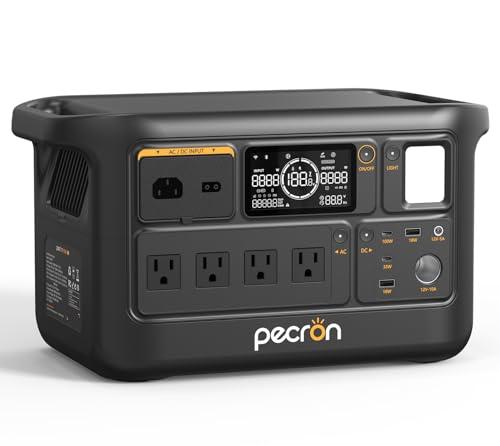
Pecron F1000LFP
Campsites, vans and off-grid stays where the unit is lifted several times a day and refilled from panels rather than a wall socket.
-
Best for running a whole desk from one unit

ALLPOWERS R1500 LITE
A home office, desk or utility room where the unit is installed once as standby backup and almost never lifted again.
How they compare
Scroll the table sideways to see every column.
| Product | Where to buy | Award | Capacity | AC output | Weight | AC recharge time | UPS switchover | Rated cycle life | Warranty | Best for |
|---|---|---|---|---|---|---|---|---|---|---|
| EcoFlow DELTA 3 Plus | Best for everyday UPS duty | 1024Wh | 1800W | 27 lb (12.2 kg) | 40 minutes to 80% on 1500W AC input | 10ms | 4,000 cycles to 80% | 5 years | A unit that lives plugged in behind a desk, a rack or a media cabinet and cycles most days, where switchover speed and pack longevity matter more than what it weighs. | |
| OUPES Mega 1 | Best for high-draw tools and appliances | 1024Wh | 2000W (4500W surge) | 27.8 lb (12.6 kg) | 36 minutes to 80% on AC, 26 minutes with AC and solar together | Under 20ms | 3,500+ cycles to 80% | 5-year warranty | Circular saws, air compressors, microwaves and other high-start loads that trip smaller inverters, run in short bursts with charging time between them. | |
| Pecron F1000LFP | Best for solar recharging off-grid | 960Wh | 1500W pure sine wave | 23.9 lb (10.8 kg) | 50 minutes to 80%, 70 minutes to full at 1000W AC | Within 20ms | -- | 2+3 years | Campsites, vans and off-grid stays where the unit is lifted several times a day and refilled from panels rather than a wall socket. | |
| ALLPOWERS R1500 LITE | Best for running a whole desk from one unit | 1056Wh | 1600W (3200W surge) | 33 lb (15.0 kg) | About 1 hour, 1000W standard or 1200W fast AC charging | 15ms | 3,500+ cycles | 5-year warranty | A home office, desk or utility room where the unit is installed once as standby backup and almost never lifted again. |
The full reviews
Best for everyday UPS duty
EcoFlow DELTA 3 Plus
EcoFlow
The DELTA 3 Plus is the 1000W class unit built to be left plugged in. A 10ms switchover and 4,000 rated cycles suit a machine that takes over several times a month and cycles most days, which is a different job from the ones the rest of this shortlist are shaped for.
What we like about the EcoFlow DELTA 3 Plus
- 10ms UPS switchover is the tightest here, short enough that a desktop or a NAS does not reboot when the grid drops
- 4,000 cycles to 80% is the highest rating on this shortlist, about 10.9 years at one full cycle a day
- 40 minutes to 80% returns roughly 819Wh, near 20Wh for every minute it is plugged in
- 5-year warranty covers a realistic share of the rated cycle life rather than the first year of it
Where it falls short for the EcoFlow DELTA 3 Plus
- Reaching the advertised 5kWh means buying DELTA 3, DELTA Pro 3 or DELTA 2 Max packs separately, so what arrives is a 1024Wh unit and the ceiling is a second purchase
- At 1024Wh the 1800W inverter drains the pack in about 34 minutes at full output, so the headline wattage buys starting headroom rather than runtime
- The port set is published as running 13 appliances at once instead of an AC outlet count, so you cannot plan a socket layout from the specification
- Neither a maximum solar input nor a surge rating appears in the specification we compared, so you cannot size a panel array or check starting headroom for a compressor before buying
Key specifications
- Capacity
- 1024Wh
- AC output
- 1800W
- UPS switchover
- 10ms
- AC recharge time
- 40 minutes to 80% on 1500W AC input
- Rated cycle life
- 4,000 cycles to 80%
- Warranty
- 5 years
Most units in this class are bought, used a few times a year during outages, and then left on a shelf. The DELTA 3 Plus is the one that makes more sense doing the opposite: sitting between the wall and something that must not lose power.
Why switchover and cycle life decide this job
Two specifications matter for a unit that never leaves its socket, and neither appears in the marketing headline.
The first is switchover. At 10ms this is the fastest on the shortlist. That is inside the ride-through window a desktop power supply and most network gear can absorb, so a cut becomes a flicker on a light rather than a reboot and a lost file. The other three here quote 15ms or “under 20ms”, which is usually enough but leaves less margin.
The second is cycle life. A unit doing daily UPS duty gets cycled far harder than one used for storms. At 4,000 cycles to 80%, one full cycle a day works out at roughly 10.9 years before the pack falls to 80% of rating. The 3,500-cycle units here reach the same point at around 9.6 years. In storm-only service the difference is meaningless; in daily service it is a year or more of useful life.
What the 1800W inverter is actually for
Divide the battery by the inverter and the answer stops being flattering: 1024Wh divided by 1800W is 0.57 hours, or about 34 minutes at full output.
That is not a criticism of this unit specifically. It is the shape of the whole class, and it explains what the inverter rating is for. The 1800W figure decides whether a fridge compressor or a pump starts at all. It does not describe how long anything runs. If you plan to hold 1500W or more for hours, you are shopping in the wrong size bracket and no unit on this page will change that.
Recharge speed, expressed properly
Manufacturers quote recharge times to different end points, which makes them hard to compare. Converting to watt-hours per minute fixes that.
Eighty per cent of 1024Wh is 819Wh. Delivered in 40 minutes, that is about 20Wh every minute. The OUPES Mega 1 manages roughly 23Wh a minute, and the Pecron about 15Wh. For UPS duty, none of those gaps matter much: the unit refills while you are asleep. They matter for the person chasing short grid windows, which is a different guide.
Where it disappoints
The published 5kWh ceiling is a system figure, not a product figure. Getting there means buying DELTA 3, DELTA Pro 3 or DELTA 2 Max packs on top of the unit you already own. The box that arrives holds 1024Wh, and anyone reading 5kWh as what they are buying will be disappointed.
The port description is also unhelpfully vague. “Runs 13 appliances at once” tells you nothing about how many AC outlets you get, which is exactly the number you need to plan a desk or a rack around. Count your sockets before you commit.
Two numbers are missing entirely from the specification we compared, and both are numbers people buy on. There is no maximum solar input, so anyone intending to refill from panels is buying before they can size an array. And there is no surge rating, so the 1800W continuous figure is all you have when you are trying to work out whether a fridge or a pump will start. The OUPES Mega 1 publishes 4500W of surge and the ALLPOWERS R1500 LITE publishes 3200W. Here you are asked to take the inverter on trust.
- Best for
- A unit that lives plugged in behind a desk, a rack or a media cabinet and cycles most days, where switchover speed and pack longevity matter more than what it weighs.
- Choose something else if
- You intend to refill from solar panels, since no input ceiling is published, or you want the full 5kWh in one box rather than assembled from separate battery packs bought later.
Best for high-draw tools and appliances
OUPES Mega 1
OUPES
The Mega 1 carries a 2000W inverter on a 1024Wh battery, which is an unusual ratio and a deliberate one. It starts loads the 1500W units in this class refuse, then empties faster than any of them, so it rewards short heavy bursts and punishes long heavy sessions.
What we like about the OUPES Mega 1
- 2000W continuous with a 4500W surge is the largest inverter in this shortlist and clears loads a 1500W unit turns down
- 36 minutes to 80% is the fastest refill here, roughly 23Wh returned every minute
- Drops to 26 minutes with AC and solar feeding it together, so a lunch break covers most of a charge
- Expands to 5120Wh with two B2 batteries, giving the big inverter somewhere to draw from on a long job
- 3,500+ cycles to 80% backed by a 5-year warranty, about 9.6 years at a cycle a day
Where it falls short for the OUPES Mega 1
- At 1024Wh the pack empties in about 31 minutes at the full 2000W, the shortest full-output runtime on this shortlist
- 27.8 lb for 1024Wh is 36.8Wh per pound, second worst here and 3.9 lb heavier than the Pecron F1000LFP for only 64Wh more capacity
- The 26-minute AC-plus-solar refill is quoted without a maximum solar input anywhere in the specification, so there is no way to work out what array you need to reach it
- The expansion path runs through OUPES B2 packs specifically, which ties the ceiling to one brand's availability
Key specifications
- AC output
- 2000W (4500W surge)
- Capacity
- 1024Wh
- AC recharge time
- 36 minutes to 80% on AC, 26 minutes with AC and solar together
- Weight
- 27.8 lb (12.6 kg)
- Expandable
- Yes, to 5120Wh with two B2 extra batteries
- Rated cycle life
- 3,500+ cycles to 80%
Every other unit on this page pairs about a kilowatt-hour with an inverter between 1500W and 1800W. The Mega 1 puts 2000W on the same size battery. That single decision is what it is for and what is wrong with it.
What the extra inverter headroom buys
A 1500W inverter is comfortable with a fridge, a laptop and lights. It gets nervous around a circular saw, a shop vac or a microwave, because those loads either start hard or run close to the ceiling.
At 2000W continuous with a 4500W surge, the Mega 1 has the most margin here. It is the unit on this page most likely to start something awkward on the first attempt without tripping. If you have already had a smaller station cut out on a tool, this is the specification that fixes it.
The trade you are making
Now the arithmetic that no listing shows. Divide capacity by the inverter rating and you get how long the headline wattage can last:
- Mega 1: 1024Wh at 2000W is about 31 minutes
- EcoFlow DELTA 3 Plus: 1024Wh at 1800W is about 34 minutes
- ALLPOWERS R1500 LITE: 1056Wh at 1600W is about 40 minutes
- Pecron F1000LFP: 960Wh at 1500W is about 38 minutes
The Mega 1 has the biggest inverter and the shortest full-output runtime on the same page. Both are true and they are the same fact seen from two sides. Assume inverter conversion losses of roughly 15%, a planning assumption rather than a measured figure, and 31 minutes becomes closer to 26.
So this is a burst tool. A saw that cuts for ninety seconds, then sits idle while you measure, will get through a long afternoon. A 1800W heater will not get through an episode of anything.
Recharge speed makes the burst pattern work
The other half of the design is refill rate. Eighty per cent of 1024Wh is 819Wh, delivered in 36 minutes on AC alone. That is about 23Wh a minute, the fastest here, and it drops to 26 minutes with AC and solar running together.
Pair those two numbers and the intended pattern becomes obvious: work the unit hard, plug it back in, work it again. A job site with a socket somewhere on it suits this unit better than a campsite does.
The 26-minute figure needs an asterisk, though. It depends on solar arriving at the same time as the wall socket, and the specification never states a maximum solar input, so you cannot work out what array would deliver it. Treat 36 minutes on AC alone as the number you can actually plan around.
Who should pick something else
If your loads are steady rather than spiky, the inverter advantage evaporates and you are carrying 27.8 lb for the same 1024Wh the DELTA 3 Plus holds in 27 lb. If you carry the unit daily, the Pecron holds 960Wh in 23.9 lb and will annoy you less. And if you genuinely need 2000W for hours rather than minutes, the honest answer is that the whole 1000W class is undersized for you and two B2 batteries is a large detour to arrive at that conclusion.
- Best for
- Circular saws, air compressors, microwaves and other high-start loads that trip smaller inverters, run in short bursts with charging time between them.
- Choose something else if
- You want sustained high-wattage runtime from a single box, or you need the lightest unit in the class because you carry it every day.
Best for solar recharging off-grid
Pecron F1000LFP
Pecron
The F1000LFP is the lightest unit here and the only one that publishes how much solar it will accept, which is the pairing that decides whether a stay away from mains power lasts three days or ends after one. It gives up inverter headroom to get there, and that is a real cost rather than a rounding error.
What we like about the Pecron F1000LFP
- 600W solar input ceiling is the only one published on this shortlist, and it covers the 960Wh pack in about 1.6 hours of full-ceiling input
- 23.9 lb for 960Wh is 40.2Wh per pound, the best capacity-to-weight ratio here
- Ten ports including a 100W USB-C, so laptops charge on DC without the inverter running at all
- Switches over within 20ms despite being the lightest unit in the comparison
- The 8.4 in height is the shallowest here, so it slides under a bench or into a footwell
Where it falls short for the Pecron F1000LFP
- The 1500W inverter is the smallest of the four and 500W below the OUPES Mega 1, which leaves the least headroom for a full-size fridge compressor start
- 960Wh is the smallest battery here, 96Wh under the ALLPOWERS R1500 LITE, and covers a 150W fridge for about 6.4 hours before any derating
- The warranty is published as 2+3 years rather than the flat 5 years the other three carry, so check what the additional three years require
- No cycle life rating appears in the published specification, so pack longevity cannot be compared against the 3,500 and 4,000 cycle claims here
Key specifications
- Max solar input
- 600W
- Capacity
- 960Wh
- Weight
- 23.9 lb (10.8 kg)
- AC output
- 1500W pure sine wave
- AC recharge time
- 50 minutes to 80%, 70 minutes to full at 1000W AC
- Ports
- 10 total, 4 AC outlets, 2x USB-A 18W, 1x USB-C 33W, 1x USB-C 100W, DC 5525, car port
Weight and solar input are the two specifications that decide whether a power station works away from mains power. The F1000LFP is the lightest unit on this shortlist and the only one that publishes a solar input figure, which is why it is here despite having the smallest battery and the smallest inverter in the comparison.
Capacity per pound, and why it beats capacity
A unit used at home gets carried once. A unit used off-grid gets carried in and out of a vehicle, up a slope, and back again, usually while holding something else. Watt-hours per pound is the honest measure:
- Pecron F1000LFP: 40.2Wh per pound
- EcoFlow DELTA 3 Plus: 37.9Wh per pound
- OUPES Mega 1: 36.8Wh per pound
- ALLPOWERS R1500 LITE: 32.0Wh per pound
The F1000LFP holds 96Wh less than the ALLPOWERS while weighing 9.1 lb less. Every pound you save is a pound you carry, and the energy you gave up to save it works out at roughly 10Wh per pound of extra weight avoided.
The solar ceiling is the real reason to buy it
The input ceiling sets how fast the unit can accept energy, and 600W is the only such figure published on this page. The other three specifications we compared do not state a maximum solar input at all, which means you cannot size an array for them before buying.
The arithmetic that matters: 960Wh divided by 600W is 1.6 hours to refill from empty, if the array ever delivers its full rating. It will not. Panels lose to angle, cloud, heat and cable, so treat a real day as delivering a fraction of the nameplate figure and plan on several hours rather than 1.6. That is a planning assumption, not a measurement.
The important part is that the ceiling is not the limiter. On a unit capped at 400W, adding panels stops helping long before the sun does. At 600W, you can throw a genuinely large array at it and it will take what the array gives.
What you give up
The 1500W inverter. It is 300W below the DELTA 3 Plus and 500W below the Mega 1, and a full-size fridge is exactly the load where that margin is spent at the moment the compressor starts. If the fridge is the reason you are buying, this is the wrong pick on this page.
Two things also missing from the specification are worth flagging honestly. There is no cycle life figure, so you cannot line its expected lifespan up against the 4,000 cycles the DELTA 3 Plus claims. And the warranty is written as 2+3 years rather than a flat five, which is a different promise from the one the other three make. Neither is disqualifying for camping duty. Both would matter more if this were going to cycle daily.
Who it is for
The camper, the van traveller and the person who works out of a vehicle. Loads are small, the unit moves constantly, and the sun does the refilling. Under those conditions the smallest inverter here costs you nothing and the lightest chassis pays you back every single day.
- Best for
- Campsites, vans and off-grid stays where the unit is lifted several times a day and refilled from panels rather than a wall socket.
- Choose something else if
- You need to start a full-size refrigerator compressor or a 1500W tool, where the smallest inverter in this class leaves the least margin for error.
Best for running a whole desk from one unit
ALLPOWERS R1500 LITE
ALLPOWERS
The R1500 LITE holds the largest battery on this page and pays for it in weight, which is a bad trade for anyone who carries a power station and an irrelevant one for anyone who does not. Bought as a fixture for a desk, an office or a utility room, it is the most sensible unit here.
What we like about the ALLPOWERS R1500 LITE
- 1056Wh is the largest battery in this comparison, about 7 hours on a 150W refrigerator before derating
- 15ms switchover is quick enough that a desktop, router and modem carry on through a cut without restarting
- Four AC outlets plus two 100W USB-C ports run a whole desk without a power strip or a charger nest
- 3,500+ cycles behind a 5-year warranty, roughly 9.6 years at one full cycle a day
- The 3200W surge rating is double the 1600W continuous figure, and it is published at all, unlike on the DELTA 3 Plus and the Pecron F1000LFP
Where it falls short for the ALLPOWERS R1500 LITE
- At 33 lb it returns 32.0Wh per pound, the worst ratio here, and weighs 9.1 lb more than the Pecron F1000LFP for only 96Wh more capacity
- The recharge claim is about an hour without stating whether that reaches 80% or full, so it cannot be compared cleanly against the 36 and 40 minute claims on this page
- The specification lists an XT60 solar socket with no maximum input wattage, so a panel array has to be sized after buying instead of before
- At 16.3 in it stands nearly 5 in taller than anything else here, so it wants a floor rather than a shelf and is awkward in a moving vehicle
Key specifications
- Capacity
- 1056Wh
- UPS switchover
- 15ms
- AC output
- 1600W (3200W surge)
- Weight
- 33 lb (15.0 kg)
- Rated cycle life
- 3,500+ cycles
- Ports
- 4 AC outlets, 2x USB-C 100W, 2x USB-A 18W, 120W car outlet, XT60 solar input
This is the unit to buy when you have decided the power station is furniture. It loses the portability arguments on this page badly and then wins the argument those arguments were standing in for.
The weight problem, stated plainly
At 33 lb holding 1056Wh, the R1500 LITE delivers 32.0Wh per pound. That is the weakest figure in this comparison by a clear margin, and the comparison against the Pecron F1000LFP is unflattering: 9.1 lb more weight for 96Wh more capacity, which is about 10Wh gained per extra pound carried.
If you lift the unit, that is the whole review and you should stop reading here.
Why none of that matters in a fixed installation
A unit bolted to a job never gets weighed. What it gets judged on is how long it holds up, how quickly it takes over, and how many things it can feed.
Runtime first. 1056Wh is the most stored energy on this page. Against a refrigerator averaging 150W across its duty cycle, that is 1056 divided by 150, or about 7.0 hours. Apply a 15% allowance for inverter conversion losses, a planning assumption rather than a measured figure, and roughly 6.0 hours is the number to work with. The 1024Wh units come in about 12 minutes behind and the 960Wh Pecron about 40 minutes behind.
Now a desk instead. A tower, two monitors, a router and a modem pulling a combined 250W run for 1056 divided by 250, about 4.2 hours nominal or 3.6 hours after the same allowance. That is long enough to cover almost any outage that is not a genuine emergency, and it is the case this unit is actually built for.
Sockets and switchover
Fifteen milliseconds is fast enough that a desktop power supply rides through the cut. The machine does not restart, nothing unsaved is lost, and the fans do not even change pitch. The DELTA 3 Plus is faster at 10ms, but both sit comfortably inside the window that matters.
The port layout is the quieter advantage. Four AC outlets covers a tower, a monitor, a second monitor and a network stack without a power strip in the chain. Two 100W USB-C ports then charge two laptops on DC directly, which avoids the inverter entirely and is the efficient way to run portable machines off a battery.
The gaps worth knowing
Two specification omissions should shape your expectations. The recharge time is given as about an hour with no stated end point, so it cannot be lined up against the 36 and 40 minute claims elsewhere on this page. And there is a solar socket but no published input ceiling, so anyone planning to add panels is buying before they can size the array. Neither hurts a unit that lives beside a wall outlet. Both would rule it out for off-grid use.
- Best for
- A home office, desk or utility room where the unit is installed once as standby backup and almost never lifted again.
- Choose something else if
- You will carry it to a campsite or lift it into a vehicle regularly, where 33 lb costs you far more than the extra 96Wh returns.
How we researched this guide
Four units in the 1000W class were compared using published manufacturer specifications, then set against each other using arithmetic derived from those figures: watt-hours per pound, runtime at a stated load, full-output runtime and watt-hours returned per minute of charging. None of these units were tested by us, and every review names the sources behind its recommendation.
The full process is on our how we test portable power stations page, including what counts as hands-on use.
- Units evaluated
- 4
- Used hands-on
- 0
- Assessed from documentation and owner reports
- 4
Evaluation methods used: specification comparison
Which one should you buy?
Match your situation on the left to the recommendation on the right.
-
The unit will stay plugged in and take over automatically
Recommendation: Buy the EcoFlow DELTA 3 Plus for its 10ms switchover and 4,000 cycle rating
-
You run power tools, an air compressor or a microwave
Recommendation: Buy the OUPES Mega 1, the only unit here with a 2000W continuous inverter
-
You refill from solar panels rather than a wall socket
Recommendation: Buy the Pecron F1000LFP, the only unit here that publishes a solar input ceiling at all, at 600W
-
You lift the unit in and out of a vehicle most days
Recommendation: Buy the Pecron F1000LFP at 23.9 lb, which is 40.2Wh per pound, the best ratio here
-
You need to feed several things at once, such as a tower, two monitors and a network stack
Recommendation: Buy the ALLPOWERS R1500 LITE for its four AC outlets, two 100W USB-C ports and the largest battery here at 1056Wh
Mistakes buyers make
- Reading the 1000W inverter rating as 1000Wh of stored energy, then finding the unit empties in well under an hour at full output
- Sizing on capacity when the failure that actually happens is an inverter refusing to start a compressor
- Comparing recharge claims that quote different end points, so a unit quoting an hour to full looks slower than one quoting 40 minutes to 80%
- Buying the heaviest unit in the class for a job that involves carrying it, then leaving it in the garage because lifting it is a chore
- Planning a solar array before checking whether the unit publishes a maximum solar input at all
- Shopping in this class when the real requirement is 1500W for several hours, which needs a bigger battery rather than a bigger inverter
Our final recommendation
If you want one answer rather than a shortlist, this is the unit that suits the widest range of readers in this category.
Best for everyday UPS duty
A unit that lives plugged in behind a desk, a rack or a media cabinet and cycles most days, where switchover speed and pack longevity matter more than what it weighs.
Questions buyers ask
Will a 1000W portable power station run a refrigerator?
Usually, but the inverter rating is what decides it rather than the battery. A compressor pulls several times its running draw for a fraction of a second as it starts, and that spike is what trips an undersized inverter. The 2000W and 1800W units here have the most margin. The 1500W Pecron has the least. If a fridge is the reason you are buying, treat 1500W as the floor, not the target.
Can one of these run a space heater or a window air conditioner?
Start one, probably. Run one usefully, no. A 1500W heater against a 1024Wh battery gives about 41 minutes before the pack is flat, and that is before conversion losses. Anything with a heating element or a permanently running compressor belongs on a much larger system. This is the single most common reason people are disappointed by a unit in this class.
How many years should one of these last?
Convert the cycle rating. The DELTA 3 Plus is rated at 4,000 cycles to 80%, which is about 10.9 years at one full cycle a day. The 3,500-cycle units reach the same point at about 9.6 years. Most people cycle far less than daily, so these are floors rather than forecasts. Heat shortens them and the Pecron publishes no cycle figure at all.
Should I buy two 1000W units instead of one larger one?
Two units give you redundancy and two separate inverters, which is genuinely useful if you want power in two places at once. What they do not give you is a combined inverter rating, so two 1500W units still will not start a 2500W load. If your problem is starting something big, buy the bigger inverter. If it is covering two rooms, two units make sense.
Does UPS switchover time matter for a unit this size?
Only if something plugged into it would restart. A desktop, a NAS, a router or a modem all care, and anything under 20ms keeps them running. A fridge, a lamp or a phone charger does not care at all and will never notice the gap. If nothing on your list reboots, ignore the specification entirely and spend the attention on capacity instead.
About the author