4 Power Stations With a 1500W Inverter, Compared on Real Runtime

Off-grid power editor
Published
Updated
Last fact-checked

This guide is for people who have already decided that 1500W is the inverter size they need, usually because an appliance nameplate said so, and now face four units whose listings all repeat the same number. We compared four power stations with an identical 1500W continuous rating, all LiFePO4, on the things that actually separate them once that rating is set aside: how long each one lasts at a genuine 1500W draw, watt-hours per pound, how much energy each puts back per minute of charging, and how much solar each will accept. We did not test these units, and every review states what its recommendation rests on. What you get here is the arithmetic a retailer listing leaves out, a straight explanation of why 1500W and 1500Wh are unrelated numbers, and the reason the lightest unit is not the densest one.
What is the best 1500W portable power station?
The Anker SOLIX S2000 suits the most buyers in this class. Its 2010Wh pack is the largest here, giving roughly 68 minutes at a genuine full-rate 1500W draw where two of these four manage under 40, and 56.3 watt-hours per pound is the best density of the group. If you will recharge mainly from panels, the Pecron F1000LFP takes 600W of solar where the Anker takes 400W.
Key takeaways
- 1500W is an inverter rating and says nothing about stored energy; watt-hours is the capacity number and it varies from 960Wh to 2010Wh across these four
- Loaded to a full 1500W, these units last between roughly 33 and 68 minutes, which is far shorter than most buyers assume
- Watt-hours per pound runs from 37.3 to 56.3 here, and the lightest unit is not the densest one
- Recharge times on the clock hide how much energy actually moved; the VTOMAN finishes ten minutes ahead of the Pecron while putting back 588Wh more
- Only one of these four can be expanded, so the capacity you buy is usually the capacity you keep
Our picks at a glance
Every unit below wins a specific situation rather than a place in a ranking. Pick the row that matches how you will actually use it.
-
Best for long outages and UPS duty
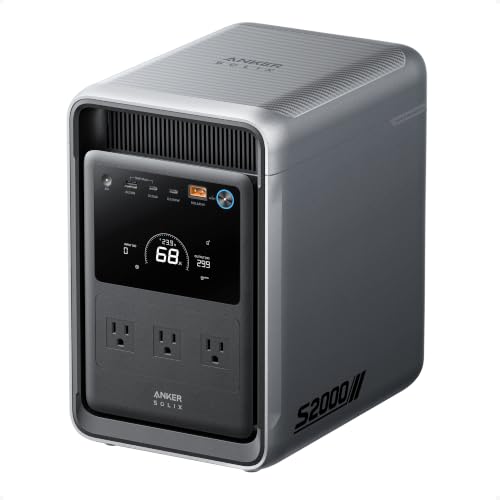
Anker SOLIX S2000
Households that want the longest runtime available on a 1500W inverter, and anyone keeping a computer, router or medical device online through grid cuts.
-
Best for growing capacity later

VTOMAN FlashSpeed 1500
Buyers who want a 1500W unit now but expect the energy requirement to grow, and anyone recharging from a wall outlet on a short turnaround.
-
Best for solar recharging
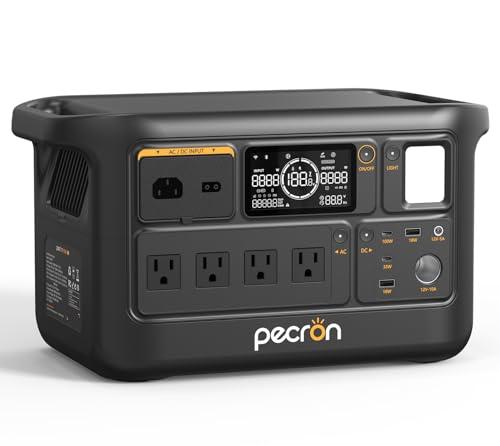
Pecron F1000LFP
Off-grid and outdoor use where panels are the main power source and the unit needs to recover its charge inside a single day.
-
Best for carrying by hand

Jackery Explorer 1000 v2
Anyone who will actually move the unit regularly, between a house, a car boot and a campsite, rather than leaving it in one corner.
How they compare
Scroll the table sideways to see every column.
| Product | Where to buy | Award | Capacity | AC output | Weight | AC recharge time | Max solar input | Rated cycle life | Ports | Best for |
|---|---|---|---|---|---|---|---|---|---|---|
| Anker SOLIX S2000 | Best for long outages and UPS duty | 2010Wh | 1500W (3000W peak) | 35.7 lb (16.2 kg) | -- | 400W | 10,000 cycles | 8 outlets, front and rear, no 12V DC port | Households that want the longest runtime available on a 1500W inverter, and anyone keeping a computer, router or medical device online through grid cuts. | |
| VTOMAN FlashSpeed 1500 | Best for growing capacity later | 1548Wh | 1500W (3000W peak) | 41.5 lb (18.8 kg) | 1 hour to full on 1500W AC input, 45 minutes with AC, solar and DC combined | 400W | 3,000+ cycles to 80% | 12 total, 3 AC outlets, 4x USB-A, 2x USB-C, 2x DC5521, car port | Buyers who want a 1500W unit now but expect the energy requirement to grow, and anyone recharging from a wall outlet on a short turnaround. | |
| Pecron F1000LFP | Best for solar recharging | 960Wh | 1500W pure sine wave | 23.9 lb (10.8 kg) | 50 minutes to 80%, 70 minutes to full at 1000W AC | 600W | -- | 10 total, 4 AC outlets, 2x USB-A 18W, 1x USB-C 33W, 1x USB-C 100W, DC 5525, car port | Off-grid and outdoor use where panels are the main power source and the unit needs to recover its charge inside a single day. | |
| Jackery Explorer 1000 v2 | Best for carrying by hand | 1070Wh | 1500W (3000W surge) | 23.8 lb (10.8 kg) | 1.7 hours to full | 400W | 4,000 cycles to 70% | 7 total, 3 AC outlets | Anyone who will actually move the unit regularly, between a house, a car boot and a campsite, rather than leaving it in one corner. |
The full reviews
Best for long outages and UPS duty
Anker SOLIX S2000
Anker
The S2000 pairs the same 1500W inverter as the rest of this shortlist with 2010Wh, roughly double the smallest pack here, and it is the only one rated for 10,000 cycles. The trade-off is a 400W solar ceiling feeding a tank that size, which makes it the slowest of the four to refill from panels alone.
What we like about the Anker SOLIX S2000
- 2010Wh is the largest pack in the 1500W class, so it holds about 68 minutes of a genuine full-rate 1500W draw
- 56.3 watt-hours per pound is the best energy density here despite the unit weighing 35.7 lb
- Under 10ms UPS switchover is fast enough that a desktop or a network rack rides through a cut without rebooting
- 10,000 rated cycles works out to roughly 27 years at one full cycle a day, well past the 3,000 and 4,000 cycle ratings of the others
- Five year warranty, matched only by the Pecron's two plus three years, with Jackery and VTOMAN stating no warranty term at all
Where it falls short for the Anker SOLIX S2000
- The 400W solar ceiling against a 2010Wh pack means a full refill from panels takes close to seven hours of strong sun, so an off-grid week never fully catches up
- There is no 12V DC port, which rules out running a car fridge, a DC water pump or most 12V camping gear without adding an inverter step
- Anker publishes no AC recharge time for this unit, so the one specification that decides how fast you recover between outages cannot be compared against the others here
- At 35.7 lb it is 11.9 lb heavier than the Jackery, which is the difference between a one-hand carry and a two-hand carry
Key specifications
- Capacity
- 2010Wh
- AC output
- 1500W (3000W peak)
- Weight
- 35.7 lb (16.2 kg)
- UPS switchover
- Under 10ms
- Rated cycle life
- 10,000 cycles
- Max solar input
- 400W
- Warranty
- 5 years
Every unit in this guide shares the same 1500W inverter. The S2000 is the one that changes what that inverter can do with its time.
The tank is the whole argument
At 2010Wh it holds roughly double the Pecron’s 960Wh and about 30% more than the VTOMAN. Assuming 85% inverter efficiency, that is about 1708Wh reaching the outlets. Run a genuine full-rate 1500W load and it lasts around 68 minutes. Every other unit here is under an hour, and two of them are under 40 minutes.
Drop to something realistic instead. A full-size refrigerator averaging 150W across its compressor duty cycle draws about 3.6kWh a day. The S2000 covers roughly 11 hours of that, which is an overnight outage and then some. The Pecron covers about five and a half.
Why the density number surprises people
The S2000 weighs 35.7 lb, which reads heavy next to the 23.8 lb Jackery. But 2010Wh divided by 35.7 lb is 56.3 watt-hours per pound, and that is the best ratio in this group by a wide margin. The Jackery manages 45.0 and the VTOMAN only 37.3.
So this is not a heavy unit. It is a dense unit that happens to hold a lot. If you are carrying stored energy rather than carrying a box, you carry fewer pounds per watt-hour with this one than with anything else here.
Where it genuinely falls down
Two things, and both are worth ruling it out over.
The solar ceiling is 400W, identical to the Jackery and the VTOMAN, but it is feeding a pack twice the size. Panels rarely deliver more than about three quarters of their rating in good conditions, so call it 300W real. Refilling 2010Wh at 300W takes close to seven hours. That is an entire usable solar day for one charge cycle, and it means the S2000 is the wrong unit for off-grid living where the pack has to recover every day.
The second is simpler. There is no 12V DC port. The port list is eight outlets front and rear with nothing at 12V, so a car fridge, a DC pump or a 12V light string has no native connection. For a house that is irrelevant. For a van or a campsite it is disqualifying.
Who should buy it
People backing up a home who want the longest 1500W runtime they can get, and people protecting equipment that cannot tolerate a gap. Under 10ms switchover keeps a desktop alive. Ten thousand cycles means the pack outlives the use case rather than the other way around.
If the unit will live outdoors and recharge from panels, buy the Pecron instead.
- Best for
- Households that want the longest runtime available on a 1500W inverter, and anyone keeping a computer, router or medical device online through grid cuts.
- Choose something else if
- You plan to recharge mainly from solar panels, or you need a 12V DC port for a car fridge or other 12V gear.
Best for growing capacity later
VTOMAN FlashSpeed 1500
VTOMAN
The FlashSpeed 1500 is the only unit in this class that can double its pack without being replaced, going from 1548Wh to 3096Wh with one extra battery. It also puts energy back faster than anything else here in watt-hours per minute. What you pay for that is weight, and it is the worst carry ratio of the four.
What we like about the VTOMAN FlashSpeed 1500
- Expandable to 3096Wh with one extra battery, the only unit in this class with a route past its starting capacity
- Restores about 25.8 watt-hours per minute on a 1500W AC input, more than double the Jackery's rate
- A full recharge takes about an hour, which is roughly the same time a full-rate 1500W load takes to empty it
- Twelve ports including three AC outlets, a car port and two DC5521 outputs, so 12V gear connects without an adapter
- 1548Wh covers around 8.8 hours of a 150W refrigerator average, comfortably an overnight outage
Where it falls short for the VTOMAN FlashSpeed 1500
- At 41.5 lb it is the heaviest unit here and manages only 37.3 watt-hours per pound, the worst density in the group, so you carry 17.7 lb more than the Jackery for 478Wh more energy
- The 3,000 cycle rating to 80% is the shortest in this shortlist and works out to roughly eight years at one cycle a day, against 27 for the Anker
- Solar input caps at 400W, so refilling the 1548Wh pack from panels takes over five hours of strong sun even though the AC recharge is quick
- VTOMAN publishes no UPS switchover figure, so it cannot be relied on to keep a desktop or router alive through a cut
Key specifications
- Capacity
- 1548Wh
- AC output
- 1500W (3000W peak)
- Weight
- 41.5 lb (18.8 kg)
- AC recharge time
- 1 hour to full on 1500W AC input, 45 minutes with AC, solar and DC combined
- Expandable
- Yes, to 3096Wh with one extra battery
- Rated cycle life
- 3,000+ cycles to 80%
- Ports
- 12 total, 3 AC outlets, 4x USB-A, 2x USB-C, 2x DC5521, car port
Most 1500W units are a fixed decision. Buy the capacity, live with it. The FlashSpeed 1500 is the exception, and that is the entire reason it is here.
The expansion path is the point
It starts at 1548Wh and takes one extra battery to 3096Wh. Nothing else in this class offers that. The Jackery is explicitly not expandable, and the Anker and Pecron publish no expansion option at all.
The arithmetic matters more than the headline. At a genuine full-rate 1500W draw, assuming 85% inverter efficiency, 1548Wh delivers about 1316Wh to the outlets and lasts roughly 53 minutes. Expanded to 3096Wh that becomes about 105 minutes. Against a 150W refrigerator average it moves from around 8.8 hours to about 17.5 hours, which is the step from an overnight outage to a full day.
What the expansion route buys is the option to defer the sizing decision until you know whether you need the extra pack, rather than guessing at purchase time.
Recharge, compared properly
Recharge comparisons in this category are usually reported as minutes on the clock, which says nothing about how much energy moved in those minutes. Divide watt-hours by minutes instead and the size of the gap becomes visible.
The FlashSpeed restores 1548Wh in about an hour on a 1500W AC input. That is roughly 25.8 watt-hours per minute. The Pecron reaches full in about 70 minutes but only moves 960Wh on a 1000W input, so about 13.7 per minute. The Jackery needs 1.7 hours for 1070Wh, about 10.5 per minute. The FlashSpeed is first on both measures, and the ten minutes it beats the Pecron by understate a 588Wh difference in what got put back.
There is a neater way to say it. This unit refills in about the same hour that a full-rate 1500W load takes to empty it. Nothing else here comes close to a one to one ratio, and it means a day of heavy intermittent use is genuinely sustainable if there is a wall outlet nearby.
The weight is real
41.5 lb, and 1548Wh divided by that is 37.3 watt-hours per pound. That is the worst density of the four. The Anker holds 56.3 per pound and the Jackery 45.0.
Put concretely, you carry 17.7 lb more than the Jackery to gain 478Wh. If the unit lives in one place, that is a non-issue. If it moves between a house, a truck bed and a campsite, it is the wrong unit and the Jackery is the right one.
Who should buy it
People with a wall outlet, a stationary spot for it, and a suspicion that 1500Wh will not be enough in a year. Twelve ports including native 12V outputs also make it a better fit for a trailer or a cabin than the port-limited Anker.
- Best for
- Buyers who want a 1500W unit now but expect the energy requirement to grow, and anyone recharging from a wall outlet on a short turnaround.
- Choose something else if
- You will be lifting the unit regularly, or you need it to recharge mainly from solar panels rather than mains power.
Best for solar recharging
Pecron F1000LFP
Pecron
The F1000LFP accepts 600W of solar, half again as much as anything else in this class, and that intake against the smallest pack here is what lets it recover inside a single solar day. The catch is the pack itself. At 960Wh it is the smallest tank in the group, and it refills quickly because there is less to refill.
What we like about the Pecron F1000LFP
- 600W maximum solar input is 200W more than the other three, cutting a full panel refill to roughly two hours of strong sun
- Reaches 80% in 50 minutes and full in 70 minutes on a 1000W AC input, so a short grid window or a lunch stop refills most of the pack
- Ten ports including four AC outlets and a 100W USB-C, the most AC sockets of the four
- UPS switchover within 20ms is fast enough to keep a router or a desk setup running through a cut
- At 23.9 lb it is within a tenth of a pound of the lightest unit here
Where it falls short for the Pecron F1000LFP
- The 960Wh pack empties in about 33 minutes at a genuine full-rate 1500W draw, less than half the Anker S2000's 68 minutes, so this is a short-burst unit rather than an outage unit
- Pecron publishes no cycle life rating, so pack longevity cannot be compared against the Anker's 10,000 cycles or the Jackery's 4,000
- Capacity is fixed at 960Wh with no expansion battery, unlike the VTOMAN's route to 3096Wh
- Pecron publishes no peak or surge rating at all, where the other three all state 3000W, so there is no stated headroom figure for starting a fridge compressor, a pump or a corded tool
Key specifications
- Capacity
- 960Wh
- AC output
- 1500W pure sine wave
- Weight
- 23.9 lb (10.8 kg)
- AC recharge time
- 50 minutes to 80%, 70 minutes to full at 1000W AC
- Max solar input
- 600W
- UPS switchover
- Within 20ms
- Ports
- 10 total, 4 AC outlets, 2x USB-A 18W, 1x USB-C 33W, 1x USB-C 100W, DC 5525, car port
Pecron is the least familiar name on this shortlist, and the specification that justifies its place is one most buyers never check.
Solar input is the differentiator
Three of these four units cap solar at 400W. The F1000LFP takes 600W. That is a 50% larger intake on the smallest pack in the group, and the combination is what makes it work off-grid.
Panels rarely deliver their rated figure. Angle, haze, panel temperature and cable loss all take a cut, so plan on roughly three quarters of the rating in good conditions. Call it 450W real. Refilling 960Wh at 450W takes a little over two hours.
Run the same assumption across the others. The Jackery pulls about 300W real into 1070Wh, so around three and a half hours. The VTOMAN needs over five. The Anker S2000 needs close to seven, effectively an entire usable solar day for one cycle.
If the sun is your outlet, that gap decides the purchase, and nothing about the 1500W inverter rating tells you it exists.
The AC recharge is quick for the same reason
Fifty minutes to 80%, seventy to full on a 1000W AC input. That genuinely helps when you are refilling during a lunch stop or a short grid window.
Be honest about why, though. It is not the fastest clock time here. The VTOMAN reaches full in about 60 minutes, ten minutes sooner, and it does that while putting back 1548Wh against the Pecron’s 960Wh. Expressed as throughput, 960Wh in 70 minutes is about 13.7 watt-hours per minute against the VTOMAN’s 25.8. The Pecron looks quick on a stopwatch because it has the least work to do, not because it charges harder.
Where the small pack hurts
This is the trade and it is not subtle. Assume 85% inverter efficiency and 960Wh delivers about 816Wh to the outlets. At a genuine full-rate 1500W draw that is roughly 33 minutes. The Anker S2000 gives about 68.
Against a 150W refrigerator average it covers around five and a half hours. That is an evening, not a night. Anyone buying a 1500W unit specifically to sit out a power cut should be looking at the S2000 or the VTOMAN instead.
The other gap is documentation, and it runs to two specifications. Pecron states LiFePO4 chemistry and a two plus three year warranty but publishes no cycle count, where Anker states 10,000 cycles and Jackery 4,000 to 70%. Without a number there is no way to place this pack’s expected life next to theirs. It also publishes no peak or surge figure, only a 1500W pure sine wave rating, while the other three all state 3000W. That is the specification you want in front of you before a fridge compressor or a pump start is the whole reason you are buying.
Who should buy it
Campers, cabin owners and anyone whose power comes from panels rather than a wall. Four AC outlets, a 100W USB-C and 23.9 lb make it easy to live with, and the 600W intake means it can genuinely recover between days.
- Best for
- Off-grid and outdoor use where panels are the main power source and the unit needs to recover its charge inside a single day.
- Choose something else if
- You are sizing for a multi-hour outage, or you want the option to add capacity to the system later.
Best for carrying by hand
Jackery Explorer 1000 v2
Jackery
At 23.8 lb the Explorer 1000 v2 is the lightest 1500W unit here and the only one a typical adult moves comfortably in one hand. It gives up capacity to get there, holding 1070Wh against the Anker's 2010Wh, and Jackery has closed off the usual escape route by making it non-expandable.
What we like about the Jackery Explorer 1000 v2
- 23.8 lb is 17.7 lb lighter than the VTOMAN, which is the difference between carrying it and dragging it
- 45.0 watt-hours per pound beats both the VTOMAN and the Pecron, so the weight saving does not come from a poor pack
- 3000W surge on a 1500W continuous inverter gives genuine headroom for a compressor or a corded tool start
- 4,000 rated cycles to 70% works out to roughly 11 years at one full cycle a day
- Jackery states a full AC recharge in 1.7 hours, and unlike the Anker it publishes the figure at all
Where it falls short for the Jackery Explorer 1000 v2
- Capacity is fixed at 1070Wh with expansion explicitly listed as No, so the only way to add energy later is to buy a second unit
- 1070Wh delivers roughly 36 minutes at a genuine full-rate 1500W draw, so this is not the unit for anyone actually planning to load the inverter to its rating
- The 1.7 hour recharge restores about 10.5 watt-hours per minute, the slowest throughput of the four, so short grid windows are less useful here
- Jackery publishes no UPS switchover time, so it should not be trusted to keep a desktop from rebooting during a cut
Key specifications
- Capacity
- 1070Wh
- AC output
- 1500W (3000W surge)
- Weight
- 23.8 lb (10.8 kg)
- AC recharge time
- 1.7 hours to full
- Rated cycle life
- 4,000 cycles to 70%
- Expandable
- No
- Max solar input
- 400W
Weight is the specification people underrate until the second time they carry a power station up a flight of stairs. This is the unit that solves it.
The lightest way to get 1500W
23.8 lb. The Pecron is within a tenth of a pound at 23.9, the Anker is 35.7 and the VTOMAN is 41.5. So the practical choice for a unit that moves is between the Jackery and the Pecron, and on energy carried the Jackery wins.
1070Wh divided by 23.8 lb is 45.0 watt-hours per pound. The Pecron manages 40.2 at essentially identical weight, and the VTOMAN only 37.3. Only the Anker beats it, at 56.3, and it does that by being twelve pounds heavier.
That is the honest framing. The Jackery is not the densest pack in this class. It is the lightest absolute weight that still carries a respectable ratio, which is what matters when the limit is your arm rather than your floor.
Surge headroom the others do not all state
A 1500W continuous rating tells you what the inverter sustains. It does not tell you whether a compressor start trips it. Jackery states 3000W surge, double the continuous figure.
That is real headroom for a fridge compressor, a circular saw or a pump kicking in. The VTOMAN and the Anker both state a 3000W peak as well, so this is not unique, but the Pecron publishes only a 1500W pure sine wave rating with no surge figure at all. If you are starting a motor, that difference is worth knowing before you buy.
What the small pack costs you
Assume 85% inverter efficiency and 1070Wh puts about 909Wh out through the sockets. Load the inverter to its full 1500W rating and that lasts roughly 36 minutes. The Anker S2000 gives about 68.
Against a refrigerator averaging 150W across its duty cycle, the Jackery covers about six hours. An evening and part of a night, not a full outage.
Normally the answer to that is an expansion battery. Here there is not one. The specification sheet lists expandable as No, flatly. If 1070Wh turns out to be short, your only move is buying a second complete unit, with a second inverter and a second case you did not need, where the VTOMAN adds a battery alone to reach 3096Wh.
Recharge is the other soft spot. A 1.7 hour full refill restores about 10.5 watt-hours per minute, the lowest throughput here. The Pecron manages 13.7 and the VTOMAN 25.8.
Who should buy it
People whose unit will not stay put. Camping, tailgating, a job site, a second home, anywhere the thing gets picked up more than once a month. If it will sit in a basement and never move, the weight advantage is worth nothing and the Anker’s extra 940Wh is worth a great deal.
- Best for
- Anyone who will actually move the unit regularly, between a house, a car boot and a campsite, rather than leaving it in one corner.
- Choose something else if
- You expect your energy needs to grow, or you intend to run loads near the full 1500W rating for more than a few minutes at a time.
How we researched this guide
Four units sharing an identical 1500W continuous inverter rating were compared using published manufacturer specifications. None were tested by us. Runtime, watt-hours per pound, recharge throughput and solar refill figures in this guide are our own arithmetic from the published capacity, weight, recharge and solar input ratings, with the assumptions stated wherever a calculation appears.
The full process is on our how we test portable power stations page, including what counts as hands-on use.
- Units evaluated
- 4
- Used hands-on
- 0
- Assessed from documentation and owner reports
- 4
Evaluation methods used: specification comparison
Which one should you buy?
Match your situation on the left to the recommendation on the right.
-
You want the longest runtime available on a 1500W inverter
Recommendation: Buy the Anker SOLIX S2000, whose 2010Wh pack is roughly double the smallest unit here
-
You are keeping a desktop, router or medical device online through grid cuts
Recommendation: Buy the Anker SOLIX S2000 for its under 10ms UPS switchover
-
Solar panels will be your main way of recharging
Recommendation: Buy the Pecron F1000LFP, the only unit here accepting 600W of solar input
-
You will carry the unit regularly between a house, a vehicle and a campsite
Recommendation: Buy the Jackery Explorer 1000 v2 at 23.8 lb, the lightest here and 11.9 lb under the Anker, with more watt-hours per pound than the near-identical 23.9 lb Pecron
-
You suspect your energy needs will grow within a year or two
Recommendation: Buy the VTOMAN FlashSpeed 1500, the only unit here that expands, to 3096Wh
-
You need to run a 12V car fridge or other 12V gear
Recommendation: Buy the VTOMAN FlashSpeed 1500 or Pecron F1000LFP, since the Anker S2000 has no 12V DC port
Mistakes buyers make
- Reading the 1500W inverter rating as 1500Wh of stored energy, which are unrelated specifications that happen to share a number
- Sizing for a 1500W appliance without checking runtime, then discovering the unit empties in about half an hour at that load
- Assuming the lightest unit has the weakest pack, when the 23.8 lb Jackery beats the 41.5 lb VTOMAN on watt-hours per pound
- Comparing recharge times as minutes to full, which flatters the smallest battery in the group
- Buying a large pack for off-grid use without checking the solar input ceiling that has to refill it
- Expecting a 1500W unit to run a well pump, an electric dryer or a range, all of which need 240V that none of these provide
Our final recommendation
If you want one answer rather than a shortlist, this is the unit that suits the widest range of readers in this category.
Best for long outages and UPS duty
Households that want the longest runtime available on a 1500W inverter, and anyone keeping a computer, router or medical device online through grid cuts.
Questions buyers ask
What is the difference between 1500W and 1500Wh?
1500W is the inverter rating, the maximum an appliance may draw at any instant. 1500Wh is stored energy, how much the battery holds. They are unrelated, and none of the four units here holds exactly 1500Wh. Capacity in this class ranges from 960Wh on the Pecron to 2010Wh on the Anker while every one of them is rated 1500W.
Is a 1500W power station enough to run a refrigerator?
For a full-size household fridge, yes. The compressor draws roughly 150W once you average across its duty cycle, and the start-up surge is what needs headroom rather than the running load. Three of these units publish a 3000W peak or surge figure, which covers that comfortably. The Pecron publishes no surge rating at all, which is worth knowing before you rely on it for a motor.
Can a 1500W power station run a space heater?
It can start one, but not for long. A 1500W heater sits at the inverter's ceiling with no margin, and at that draw these units last between roughly 33 and 68 minutes depending on the pack. Heating is the single worst use of stored battery energy, and no unit in this class is a sensible way to do it.
How long do these actually last at a full 1500W load?
Assuming 85% inverter efficiency, the 960Wh Pecron gives about 33 minutes, the 1070Wh Jackery about 36, the 1548Wh VTOMAN about 53 and the 2010Wh Anker about 68. Most real loads are far below 1500W, so these are floor figures rather than what you will see day to day, but they are the honest answer to the question the inverter rating invites.
Do any of these run 240V appliances like a dryer or a well pump?
No. None of the four publishes a 240V output. A well pump, an electric range, a dryer or a central air handler needs 240V split phase, which is a different and much larger class of unit. If that is your requirement, nothing in the 1500W bracket will meet it and you should not buy here.
About the author