We Compared 4 Big Power Stations Against the 5000W Claim

Off-grid power editor
Published
Updated
Last fact-checked
This guide is for people who added up their appliance nameplates, landed near 5000 watts, and started shopping. The problem is that "5000 watt solar generator" is a phrase retailers use loosely: most units carrying it have inverters rated 2400W to 3600W and reach a bigger number only in a boost mode that does not apply to motors. We compared four of the largest units in our catalogue on continuous inverter rating, watt-hours, recharge time and weight, and we state the exact wattage gap on each. We did not test any of them, and every review says what its assessment is based on. What you get here is the arithmetic: how long 5000W actually lasts from a fixed battery, what circuit you need to refill one, and whether you needed 5000W in the first place.
Is there a portable power station that really delivers 5000W?
On this shortlist, only the Anker SOLIX F3800. It is rated 6000W continuous with 120V and 240V split phase, so a 5000W load leaves 1000W of headroom. The other three top out at 3600W, 3000W and 2400W. Be aware that 3840Wh divided by a 5000W draw is about 46 minutes, so even the F3800 holds that output only briefly without expansion batteries.
Key takeaways
- Only the 6000W Anker SOLIX F3800 clears 5000W continuous; the other three fall 1400W, 2000W and 2600W short
- A 5000W draw empties a 3840Wh battery in about 46 minutes, so wattage and runtime pull against each other
- Boost modes such as X-Boost reach their headline figure by lowering voltage, which works for heaters and not for motors
- 5000W at 120V is roughly 42A, more than double what a standard household receptacle can carry
- Expansion batteries add watt-hours and never raise the inverter rating, so they cannot fix a wattage shortfall
Our picks at a glance
Every unit below wins a specific situation rather than a place in a ranking. Pick the row that matches how you will actually use it.
-
Best for a true 5000W continuous load

Anker SOLIX F3800
Anyone whose load list genuinely peaks above 3600W, or who needs 240V split phase for a well pump, an electric range or a shop circuit.
-
Best for refilling from a 240V outlet
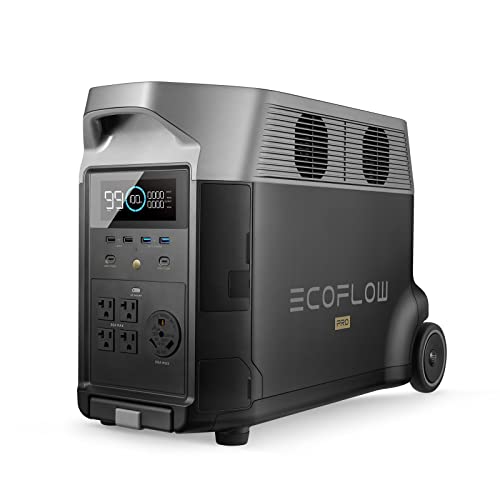
EcoFlow DELTA Pro
Owners with a 240V dryer or range outlet who need the bank back to full between short outages, and whose real peak load sits under 3600W.
-
Best for carrying a 3kWh battery between a house and a truck

Jackery Explorer 3000 Pro (Renewed)
Buyers who have to move a 3kWh battery regularly, between a house and a truck or a job site, and whose loads stay under 3000W.
-
Best for RV shore-power hookups

BLUETTI AC200L
RV and camper owners who want shore power without an adapter chain, and who value a 45-minute refill over a bigger inverter.
How they compare
Scroll the table sideways to see every column.
| Product | Where to buy | Award | Capacity | AC output | Weight | AC recharge time | Expandable | Ports | Best for |
|---|---|---|---|---|---|---|---|---|---|
| Anker SOLIX F3800 | Best for a true 5000W continuous load | 3840Wh | 6000W | 132 lb (60 kg) | About 1.5 hours to full | Yes, to 26.9kWh with expansion batteries | 13 total, including 30A RV and 120V/240V split phase | Anyone whose load list genuinely peaks above 3600W, or who needs 240V split phase for a well pump, an electric range or a shop circuit. | |
| EcoFlow DELTA Pro | Best for refilling from a 240V outlet | 3600Wh | 3600W (4500W X-Boost) | 99 lb (44.9 kg) | 1.8 hours on a 240V outlet, 2.7 hours on a 1800W wall outlet | Yes, from 3.6kWh to 25kWh with extra batteries or smart generators | 15 outputs total, 5 AC outlets | Owners with a 240V dryer or range outlet who need the bank back to full between short outages, and whose real peak load sits under 3600W. | |
| Jackery Explorer 3000 Pro (Renewed) | Best for carrying a 3kWh battery between a house and a truck | 3024Wh | 3000W | 63.9 lb (29.0 kg) | 2.4 hours to full | -- | 2 x 100W PD ports | Buyers who have to move a 3kWh battery regularly, between a house and a truck or a job site, and whose loads stay under 3000W. | |
| BLUETTI AC200L | Best for RV shore-power hookups | 2048Wh | 2400W | 61.41 lb (27.9 kg) | 0-80% in 45 minutes (2400W AC input) | Yes, to 8192Wh with expansion batteries | 11 ports, including a 30A RV port and a 48V/8A DC port | RV and camper owners who want shore power without an adapter chain, and who value a 45-minute refill over a bigger inverter. |
The full reviews
Best for a true 5000W continuous load
Anker SOLIX F3800
Anker
The F3800 is the only unit on this shortlist whose inverter is rated above the 5000W figure people search for, at 6000W with 120V and 240V split phase. The catch is that its 3840Wh battery empties in about 46 minutes at that draw, so the headline wattage is a ceiling you visit, not a level you sit at.
What we like about the Anker SOLIX F3800
- 6000W continuous inverter clears a 5000W load with 1000W of headroom, which nothing else here does
- 120V and 240V split phase drives a well pump or an electric range directly
- 2400W solar input refills the 3840Wh pack in about 1.6 hours at full rated input
- Expandable to 26.9kWh, which turns 46 minutes at 5000W into about 33 hours of an 800W household load
- Rated 3,000 cycles to 80%, roughly 8 years at one full cycle every day
Where it falls short for the Anker SOLIX F3800
- The 3840Wh pack lasts about 46 minutes at 5000W and about 38 minutes at the full 6000W rating, so a sustained job at either level needs expansion batteries rather than this unit alone
- 132 lb means the built-in wheels are the only realistic way to move it, and a single step or a gravel path stops it
- Refilling in the quoted 1.5 hours means drawing roughly 2560W, which a standard 15A household outlet cannot supply
- Hitting 2400W of solar means about six 400W panels and the ground or roof space to mount them
Key specifications
- AC output
- 6000W
- Capacity
- 3840Wh
- Max solar input
- 2400W
- UPS switchover
- Under 20ms
- Weight
- 132 lb (60 kg)
- Expandable
- Yes, to 26.9kWh with expansion batteries
If you typed 5000 watts into a search box, this is the only unit here that answers you literally. Everything else on this page is a compromise dressed up with a surge rating.
The wattage gap, stated plainly
The F3800 is rated 6000W continuous. Against a 5000W target that is 1000W of headroom. The EcoFlow DELTA Pro is 3600W, which is 1400W short. The Jackery Explorer 3000 Pro is 3000W, 2000W short. The BLUETTI AC200L is 2400W, less than half the figure.
That gap is not a detail you can argue around with a boost mode. A load that draws 5000W continuously will trip a 3600W inverter every time.
What 5000W costs you in runtime
Here is the division nobody puts in a listing. 3840Wh divided by 5000W is 0.77 hours, which is about 46 minutes. That is the whole answer to “how long will a 5000 watt solar generator run at 5000 watts”. Push it to the full 6000W rating and the same pack gives you about 38 minutes.
Move to a realistic outage load instead. A fridge, a chest freezer, a router, lights and a laptop average roughly 800W between them. 3840Wh divided by 800W is 4.8 hours. The same battery is either a 46-minute tool or a half-day of house, depending entirely on what you plug in.
Expansion changes this and nothing else does. At the full 26.9kWh ceiling, that same 800W load runs about 33 hours.
The 240V line
This is the practical reason to buy it. A well pump, an electric range, a dryer and a central air handler are 240V split-phase loads. No amount of 120V capacity substitutes for that. The F3800 supplies split phase; the other three units on this page supply 120V only.
If you are on municipal water and heat with gas, that capability is weight and expense you will never use.
Refilling it is its own problem
The quoted recharge is about 1.5 hours to full. Divide 3840Wh by 1.5 hours and the unit is pulling roughly 2560W to do it. A standard 15A/120V receptacle tops out near 1800W, so that figure assumes a circuit most garages do not have.
Solar is cleaner arithmetic: 3840Wh against the 2400W rated input is about 1.6 hours in perfect conditions. Panels rarely deliver their rating, so plan on longer, and plan on roughly six 400W panels plus somewhere to put them.
Living with 132 lb
The wheels work on a flat garage floor. They do not work on grass, gravel or a single step. Decide where this unit will live before you buy it, because moving it is a two-person job the moment the surface stops being smooth concrete.
- Best for
- Anyone whose load list genuinely peaks above 3600W, or who needs 240V split phase for a well pump, an electric range or a shop circuit.
- Choose something else if
- Your real peak is under 3000W and you only wanted the biggest number available, because you will carry 132 lb and pay for inverter headroom you never touch.
Best for refilling from a 240V outlet
EcoFlow DELTA Pro
EcoFlow
A 3600Wh battery that recharges in 1.8 hours from a 240V outlet, which is the fastest way back to full on this shortlist for anyone with a dryer or range socket to borrow. Its 3600W inverter is 1400W below the number you searched for, and the 4500W X-Boost figure does not close that gap for motors.
What we like about the EcoFlow DELTA Pro
- 1.8 hours to full on a 240V outlet, against 2.7 hours from a 1800W wall socket
- 3600Wh in a 99 lb body works out at 36 watt-hours per pound, better than the heavier F3800
- Expandable from 3.6kWh to 25kWh with extra batteries or smart generators
- 5-year warranty, against 4 years on the AC200L and 90 days on the renewed Jackery
- 15 outputs including 5 AC outlets, so a whole appliance group runs without a power strip
Where it falls short for the EcoFlow DELTA Pro
- The 3600W continuous rating is 1400W below a 5000W target, so a genuine 5000W load will trip it
- X-Boost reaches 4500W by reducing output voltage, which suits a heater or kettle and does nothing for a compressor or pump
- No 240V output, so the same dryer socket that recharges it fastest cannot be backed up by it
- 99 lb and 16.4 by 25 by 11.2 inches is a permanent floor footprint, not something that lives in a closet
Key specifications
- Capacity
- 3600Wh
- AC output
- 3600W (4500W X-Boost)
- AC recharge time
- 1.8 hours on a 240V outlet, 2.7 hours on a 1800W wall outlet
- Weight
- 99 lb (44.9 kg)
- Expandable
- Yes, from 3.6kWh to 25kWh with extra batteries or smart generators
- Warranty
- 5 years
The DELTA Pro is the unit people land on when the F3800 is more machine than they want. It gets close on capacity and misses badly on the one number this page is about.
Where it falls short of 5000W
3600W continuous. That is 1400W below the target, or 72% of it. A 5000W load does not run on this unit, and no setting changes that.
X-Boost is advertised at 4500W and is where most listings stop explaining. The mode reaches that figure by lowering output voltage so current stays inside the inverter’s limits. A resistive load tolerates that: a space heater at reduced voltage simply produces less heat. A motor does not, because it needs the voltage to develop torque. So for a pump, a compressor or a saw, 3600W is the number that applies.
What it is genuinely best at
Recharge. 1.8 hours to full on a 240V outlet against 2.7 hours from an 1800W wall socket. Work through it: 3600Wh across 2.7 hours is roughly 1330W of average input, and across 1.8 hours it is closer to 2000W.
If your outages come in bursts with grid windows between them, that difference compounds. In the 2.7 hours one 120V refill takes, the 240V socket delivers one and a half, which is roughly 1800Wh of extra stored energy every time the grid comes back.
There is an irony worth naming. The 240V socket that refills it fastest is attached to a dryer this unit cannot back up, because its output is 120V only.
Weight against capacity
99 lb for 3600Wh is 36 watt-hours per pound. The F3800 carries 3840Wh in 132 lb, which is 29 watt-hours per pound. So the DELTA Pro stores 94% as much energy in 75% of the weight. That is the trade you are making when you give up 2400W of inverter and the 240V output.
The expansion path
3.6kWh to 25kWh is a real ceiling, and it changes what the unit is for. At an 800W household load, the base 3600Wh runs about 4.5 hours. At 25kWh it runs about 31 hours. Whether that path is worth starting depends on having the floor space for the extra batteries, because each one is another object roughly the size of the unit itself.
- Best for
- Owners with a 240V dryer or range outlet who need the bank back to full between short outages, and whose real peak load sits under 3600W.
- Choose something else if
- You need to start a well pump or run a 5000W tool, because the continuous rating is 3600W and the boost mode does not apply to motor loads.
Best for carrying a 3kWh battery between a house and a truck
Jackery Explorer 3000 Pro (Renewed)
Jackery
3024Wh in 63.9 lb works out at 47 watt-hours per pound, the best density on this shortlist by a wide margin and the only unit here one reasonably fit person can lift into a truck bed. It is sold renewed with a 90-day warranty, which is the reason to think hard before choosing it over the units carrying five years.
What we like about the Jackery Explorer 3000 Pro (Renewed)
- 47 watt-hours per pound, against 36 for the DELTA Pro and 29 for the F3800
- 63.9 lb is 35 lb lighter than the DELTA Pro for 84% of its capacity
- 2.4 hours to a full recharge, roughly 1260W of average input, which a normal 20A circuit can supply
- Its longest side is 18.6 inches, against 25 inches on the DELTA Pro, so it sits in a truck bed footwell instead of across it
Where it falls short for the Jackery Explorer 3000 Pro (Renewed)
- The 90-day limited warranty, against 5 years on the DELTA Pro and 4 on the AC200L, is the single biggest risk in this comparison on a renewed high-capacity battery
- The 3000W inverter is 2000W below a 5000W target, so anything genuinely rated 5000W is out of scope
- No expansion battery path is published for it, so 3024Wh is a permanent ceiling rather than a starting point
- Only 2 x 100W PD ports are listed, so device charging is thin for a unit this size
Key specifications
- Capacity
- 3024Wh
- AC output
- 3000W
- Weight
- 63.9 lb (29.0 kg)
- AC recharge time
- 2.4 hours to full
- Dimensions
- 18.6 x 14.1 x 14.7 in
- Warranty
- 90 days limited warranty
The Explorer 3000 Pro is the unit that makes the weight of this category obvious. It is not the biggest battery here and it is not close to 5000W, but it is the only one you can pick up without a plan.
The density arithmetic
Divide capacity by weight for all four units and the ranking is not the one the spec sheets imply.
- Explorer 3000 Pro: 3024Wh in 63.9 lb, 47 watt-hours per pound
- DELTA Pro: 3600Wh in 99 lb, 36 watt-hours per pound
- AC200L: 2048Wh in 61.41 lb, 33 watt-hours per pound
- F3800: 3840Wh in 132 lb, 29 watt-hours per pound
Look at the AC200L line in particular. It weighs almost exactly what the Jackery weighs and holds about a thousand watt-hours less. If the unit has to move, that is a full extra hour of an 800W load for no extra lifting.
Where the 5000W search ends
3000W continuous. That is 60% of the figure you searched for, and only the 2400W AC200L sits further away.
What 3000W does cover is broad: a full-size fridge and freezer together, a microwave, a coffee maker, a circular saw, a window air conditioner. What it does not cover is a well pump on a 240V circuit, an electric range element, or any two large motor loads starting at once. If your load list has one 3000W-plus item on it, this unit is the wrong shape of answer.
The renewed warranty, honestly
90 days. The DELTA Pro carries five years and the AC200L four, and no warranty term for the F3800 appears in our record, so treat that one as unknown rather than as long. On a battery this size that gap matters more than any spec on the sheet, because the failure mode you care about is cell degradation, and cell degradation shows up after year two, not after month three.
We are not saying this unit will fail. We are saying that if it does, you carry the cost, and that is a real trade against the weight advantage.
Recharge and the circuit it needs
3024Wh over the quoted 2.4 hours is roughly 1260W of average input. That is a figure a standard 20A household circuit supplies without complaint, which is quietly one of the better things about this unit. The F3800 needs roughly 2560W to hit its recharge time and the AC200L needs a 2400W input for its 45-minute figure. Neither is a normal wall socket. This one is.
- Best for
- Buyers who have to move a 3kWh battery regularly, between a house and a truck or a job site, and whose loads stay under 3000W.
- Choose something else if
- You want long warranty cover on a large battery, or you expect to add capacity later, because neither is available on this unit.
Best for RV shore-power hookups
BLUETTI AC200L
BLUETTI
The AC200L is the only unit here with a 30A RV port on the box, so a camper shore cord plugs straight in with no adapter chain. Its 2400W inverter is the smallest on this page and less than half the 5000W figure, which makes it the unit to buy for the connector and the 8192Wh ceiling rather than for raw output.
What we like about the BLUETTI AC200L
- 30A RV port lets a camper shore cord plug in directly instead of running an adapter and a power strip
- 0-80% in 45 minutes, the fastest refill on this shortlist by a clear margin
- Expandable to 8192Wh, four times the base capacity, which is about ten hours of an 800W household load
- 1200W solar input refills the 2048Wh pack in around 1.7 hours at the rated ceiling
- 4-year warranty on a unit that is easier to move than the two big wheeled boxes
Where it falls short for the BLUETTI AC200L
- The 30A RV port cannot supply 30A, because the 2400W inverter caps output near 20A at 120V, so a rooftop air conditioner and a microwave together will still trip it
- 2400W continuous is 2600W below a 5000W target, less than half the figure most buyers arrive at this page with
- 61.41 lb holds 2048Wh, which is 33 watt-hours per pound against 47 for the Jackery, a unit that weighs 2.5 lb more and stores nearly 1000Wh more
- The 45-minute charge needs a 2400W AC input, which is more than a standard 15A household receptacle can deliver
Key specifications
- Capacity
- 2048Wh
- AC output
- 2400W
- AC recharge time
- 0-80% in 45 minutes (2400W AC input)
- Max solar input
- 1200W
- Ports
- 11 ports, including a 30A RV port and a 48V/8A DC port
- Expandable
- Yes, to 8192Wh with expansion batteries
The AC200L is on this page for one reason that has nothing to do with wattage: it is the only unit with an RV connector built into the case.
The connector is the feature
A camper shore cord ends in a TT-30 plug. Every other unit here forces you into an adapter, then an extension, then a decision about which appliances to leave off. The AC200L takes the cord.
But read the arithmetic before you plan around it. The inverter is rated 2400W. Divide that by 120V and you get 20A. The port accepts a 30A plug; the inverter behind it passes about two-thirds of 30A. Treat it as a convenient shape, not as a 30A service, and do not expect a rooftop air conditioner and a microwave to coexist on it.
How far it sits from 5000W
2400W continuous is 48% of the figure in the search that probably brought you here. That is the largest gap on this page. The F3800 is rated 6000W, the DELTA Pro 3600W, the Explorer 3000 Pro 3000W. This unit is last, and by a lot.
If a single 3000W appliance is on your list, stop here and read the F3800 section instead.
Speed, which is where it wins
0 to 80% in 45 minutes. Work out what that means in energy: 80% of 2048Wh is about 1638Wh, delivered in three-quarters of an hour, which is roughly 2184W of average input. That is genuinely fast, and it is the reason this unit suits a grid that drops and returns rather than one that dies for a day.
The cost of that speed is the circuit. 2400W of input is more than a 15A household socket supplies, so on a normal outlet you will see a slower figure.
The expansion ceiling
Base capacity is 2048Wh. At a household load of roughly 800W, covering a fridge, a freezer, lights and a router, that is about 2.6 hours. Expanded to 8192Wh it is about 10 hours.
That is the honest way to read this unit. As bought it is a short-outage and weekend-camping battery. As a system it reaches into overnight territory. What it never becomes is a 5000W machine, because expansion batteries add watt-hours and never touch the inverter rating.
- Best for
- RV and camper owners who want shore power without an adapter chain, and who value a 45-minute refill over a bigger inverter.
- Choose something else if
- You are shopping for 5000W of output, because this unit delivers under half of that and no expansion battery raises the inverter rating.
How we researched this guide
Four of the largest units in our catalogue were compared on published continuous inverter rating, rated capacity, recharge time, expansion ceiling and weight. Every runtime and density figure on this page is arithmetic on those published numbers, shown so you can check it. None of these units were tested by us, and each review states which sources it relies on.
The full process is on our how we test portable power stations page, including what counts as hands-on use.
- Units evaluated
- 4
- Used hands-on
- 0
- Assessed from documentation and owner reports
- 4
Evaluation methods used: specification comparison, documentation and owner-report research
Which one should you buy?
Match your situation on the left to the recommendation on the right.
-
You have a well pump, an electric range or a 240V shop circuit
Recommendation: Buy the Anker SOLIX F3800, the only unit here with 240V split-phase output
-
You have a 240V dryer or range outlet to recharge from between outages
Recommendation: Buy the EcoFlow DELTA Pro for its 1.8-hour refill on 240V
-
You have to lift and move a 3kWh battery on your own
Recommendation: Buy the Jackery Explorer 3000 Pro at 63.9 lb, but accept its 90-day warranty
-
You are powering an RV and want the shore cord to plug straight in
Recommendation: Buy the BLUETTI AC200L for its 30A RV port, treating it as a 2400W supply
-
Your true peak load is under 2400W and you only wanted the biggest number
Recommendation: Buy the BLUETTI AC200L and spend the difference on panels instead
Mistakes buyers make
- Adding up appliance nameplates and buying for that total, when almost nothing on the list ever runs at the same moment
- Reading a surge or boost figure as a continuous rating, then wondering why a pump trips the inverter
- Assuming expansion batteries increase output wattage when they only increase stored watt-hours
- Buying 240V capability for a house with no 240V loads, which is inverter weight and expense that never gets used
- Planning a recharge time that needs a 2400W circuit while the only socket available is a standard 15A outlet
- Sizing a solar array from the unit's rated input rather than from what panels actually deliver on an average day
Our final recommendation
If you want one answer rather than a shortlist, this is the unit that suits the widest range of readers in this category.
Best for a true 5000W continuous load
Anyone whose load list genuinely peaks above 3600W, or who needs 240V split phase for a well pump, an electric range or a shop circuit.
Questions buyers ask
Do expansion batteries increase the wattage a unit can output?
No. An expansion battery adds stored watt-hours and nothing else. The inverter rating is fixed in the main unit, so a BLUETTI AC200L expanded to 8192Wh still outputs 2400W. If your problem is that an appliance will not start, more capacity is the wrong purchase.
How many solar panels does a unit this size need?
Work backwards from the rated solar input. The F3800 accepts 2400W, which is about six 400W panels, and the AC200L accepts 1200W, or about three. Panels rarely produce their rating in real conditions, so treat those counts as the ceiling rather than the plan, and add ground or roof space accordingly.
Why does a tool rated well below the inverter still trip the unit?
Motors draw a brief inrush current at start-up that is several times their running draw. A 1200W saw can spike far above that for a fraction of a second. The continuous rating is what carries the running load; the surge headroom is what survives the spike, and undersized inverters shut down rather than risk the fault.
Are these safe to run inside a house or a camper?
Yes. A battery power station produces no exhaust, so unlike a fuel generator there is no carbon monoxide risk indoors. Keep the vents clear, because units this size run cooling fans hard when charging fast or delivering high output, and heat is the main thing that shortens their life.
How many years of use should I expect before capacity drops?
Look for a cycle rating. The F3800 is rated 3,000 cycles to 80% capacity, so at one full cycle every day that is around eight years, and at one a week it is far longer. Most home backup owners never approach a full cycle a day, which is why cycle life matters less than warranty length for this use.
About the author