Solar Generators for Food Trucks: 4 Picks Sized Against a Full Service Day
Off-grid power editor
Published
Last fact-checked

This guide is for people running a food truck, a coffee trailer or a market cart who are replacing a petrol generator, usually because a venue banned the noise or the fumes. We compared four units on the four specifications that decide commercial use: sustained inverter output, capacity against a modelled service-day watt-hour figure, rated cycle life, and how much energy a plug-in break actually restores. We did not test these units, and every review states exactly what its recommendation rests on. What you get here is the arithmetic a spec sheet leaves out: how to turn your appliance list into watt-hours, why the cold side and the cooking equipment have to be sized separately, and what a cycle rating means when you empty the pack 250 times a year instead of twice.
What is the best solar generator for a food truck?
The Anker SOLIX F3800 suits the widest range of trucks. Its 6000W inverter is the only one here that carries a griddle and a fryer together, and 3840Wh covers about 11 hours of a truck's sustained cold-side load. If your menu is cold or assembled and nothing on board heats, the lighter BLUETTI AC200L or Anker SOLIX S2000 will do the same job for far less weight.
Key takeaways
- Size the sustained cold-side load first; cooking equipment is a separate peak-output problem, not extra watt-hours to add on
- A working truck's fridge, freezer, lights and point-of-sale kit come to roughly 350W continuous, or about 3.5kWh across a ten-hour day
- Cycle life matters far more in a truck than in a house, because you empty the pack every service instead of twice a year
- Recharge speed is only real if the venue can supply the amps the specification assumes
- Solar on a truck roof is a top-up that extends a shift, not the way the vehicle gets its energy
Our picks at a glance
Every unit below wins a specific situation rather than a place in a ranking. Pick the row that matches how you will actually use it.
-
Best for trucks with cooking equipment

Anker SOLIX F3800
Full-size trucks that cook on board, run a reach-in fridge and a freezer, and need one battery to carry a ten-hour festival day without a mid-shift refill.
-
Best for split lunch and dinner services

BLUETTI AC200L
Trucks and trailers working two separate service blocks a day with a break in between and access to a decent shore-power outlet during it.
-
Best for daily cycling and point-of-sale uptime
Anker SOLIX S2000
Cold-menu trucks, dessert trailers and market carts that run every day and want the battery to outlast the vehicle rather than the season.
-
Best for coffee trailers and small prep carts

OUPES Mega 1
Coffee trailers, dessert carts and market stalls with one small fridge, a grinder or blender, lighting and a card terminal to run.
How they compare
Scroll the table sideways to see every column.
| Product | Where to buy | Award | Capacity | AC output | AC recharge time | Rated cycle life | Max solar input | Weight | Best for |
|---|---|---|---|---|---|---|---|---|---|
| Anker SOLIX F3800 | Best for trucks with cooking equipment | 3840Wh | 6000W | About 1.5 hours to full | 3,000 cycles to 80% | 2400W | 132 lb (60 kg) | Full-size trucks that cook on board, run a reach-in fridge and a freezer, and need one battery to carry a ten-hour festival day without a mid-shift refill. | |
| BLUETTI AC200L | Best for split lunch and dinner services | 2048Wh | 2400W | 0-80% in 45 minutes (2400W AC input) | -- | 1200W | 61.41 lb (27.9 kg) | Trucks and trailers working two separate service blocks a day with a break in between and access to a decent shore-power outlet during it. | |
| Anker SOLIX S2000 | Best for daily cycling and point-of-sale uptime | 2010Wh | 1500W (3000W peak) | -- | 10,000 cycles | 400W | 35.7 lb (16.2 kg) | Cold-menu trucks, dessert trailers and market carts that run every day and want the battery to outlast the vehicle rather than the season. | |
| OUPES Mega 1 | Best for coffee trailers and small prep carts | 1024Wh | 2000W (4500W surge) | 36 minutes to 80% on AC, 26 minutes with AC and solar together | 3,500+ cycles to 80% | -- | 27.8 lb (12.6 kg) | Coffee trailers, dessert carts and market stalls with one small fridge, a grinder or blender, lighting and a card terminal to run. |
The full reviews
Best for trucks with cooking equipment
Anker SOLIX F3800
Anker
This is the only unit on the shortlist that can carry a mobile kitchen's cooking load rather than just its cold side. A 6000W inverter and 120V/240V split phase cover a flat-top and a fryer together, and 3840Wh clears a ten-hour festival day on the fridge and freezer. The price of that is 132 lb bolted into the vehicle for good.
What we like about the Anker SOLIX F3800
- 6000W continuous output runs a flat-top griddle and a fryer at the same time instead of forcing you to alternate
- 3840Wh covers roughly 11 hours of a 350W sustained cold-side load, which clears a full festival day without a mid-shift plug-in
- 120V/240V split phase means a 240V flat-top or a three-phase-free convection oven is in scope, which no other unit here can claim
- The 30A RV port accepts the same shore-power cordset most trucks already carry, so hookup at a venue needs no adapter chain
- Expandable to 26.9kWh, so a two-day event can be covered by adding batteries rather than replacing the system
Where it falls short for the Anker SOLIX F3800
- At 132 lb it is a permanent installation with a floor mount, not a unit one person moves in and out of the truck between events
- 29 watt-hours per pound is the worst energy-to-weight ratio on this shortlist, so it eats payload that a truck usually needs for water and stock
- The 3,000-cycle rating works out to roughly 12 years at 250 service days a year, against about 40 years for the Anker SOLIX S2000
- A full cooking day exceeds 3840Wh, so the one job this unit is bought for cannot be done on the base pack alone, and griddling and frying all service still needs shore power or expansion batteries
Key specifications
- Capacity
- 3840Wh
- AC output
- 6000W
- AC recharge time
- About 1.5 hours to full
- Max solar input
- 2400W
- Rated cycle life
- 3,000 cycles to 80%
- Weight
- 132 lb (60 kg)
Most food truck power questions get answered with capacity. On a truck that cooks, capacity is the second question. The first is whether the inverter can carry the cooking equipment at all, and that is where this unit stops being one option among four and becomes the only one.
Why the inverter rating decides which trucks this suits
A commercial flat-top griddle sits around 1800W. A countertop fryer sits around 1500W. Run them together and you are at 3300W before the fridge cycles on, the hood fan spins and the POS tablet charges.
The other three units here top out at 2400W, 2000W and 1500W continuous. None of them can hold that. The 6000W rating on this one clears it with room left over, which means the cook does not have to choreograph the menu around the battery.
The 120V/240V split-phase output extends that further. If your build has a 240V flat-top or a 240V convection oven, this is the only unit on the shortlist that can drive it. If it does not, that capability is dead weight, and there are two cheaper-to-carry options below.
The service-day arithmetic
Take a working truck’s sustained load, which is the cold side plus lights plus the point-of-sale kit rather than the cooking peaks: a reach-in fridge averaging roughly 140W across its duty cycle, a chest freezer at about 120W, LED lighting at 40W and a tablet, card reader and router at about 35W. That is close to 350W continuous.
At 350W, 3840Wh runs for roughly 11 hours. That is a ten-hour festival day with an hour in hand, on the battery alone, with no mid-shift refill. The 2048Wh BLUETTI AC200L covers under six hours of the same load and therefore needs a plug-in break.
Cooking sits on top of that as short peaks. A fryer pulling 1500W for a ten minute recovery cycle spends 250Wh. Six of those across a service is 1500Wh, which takes the day’s total to roughly 5kWh and puts you past this unit’s capacity. That is the honest ceiling: it covers a cold-only day comfortably and a cooking day only with shore power or expansion batteries.
Where the weight lands
At 132 lb this is 29 watt-hours per pound. The Anker SOLIX S2000 delivers 56. In a vehicle already carrying fresh water, waste water, propane and stock, 132 lb is a real payload decision, and it argues for mounting the unit low and permanently rather than treating it as portable equipment.
That, more than anything else, is the trade. You get cooking-capable output and a full day of cold-side runtime, and you give up the ability to lift it out.
- Best for
- Full-size trucks that cook on board, run a reach-in fridge and a freezer, and need one battery to carry a ten-hour festival day without a mid-shift refill.
- Choose something else if
- Your menu is cold, assembled or reheated only, or your vehicle has no spare payload for a 132 lb permanently mounted battery.
Best for split lunch and dinner services
BLUETTI AC200L
BLUETTI
Trucks that work a lunch rush, break, then work a dinner rush do not need a battery that lasts all day. They need one that refills inside the break. This unit takes 0 to 80% in 45 minutes on a 2400W input, which is the shortest useful plug-in window here, and it can grow to 8192Wh later if the route changes.
What we like about the BLUETTI AC200L
- 0 to 80% in 45 minutes on a 2400W input restores roughly 1638Wh inside a normal mid-day break
- 2400W continuous carries a reach-in fridge, a freezer, a panini press and a blender running together
- Expandable to 8192Wh, which is four times the base pack and enough for a two-day market without a generator
- The 30A RV port takes a standard shore-power cordset, so a venue hookup does not need an adapter
- 1200W solar input is high enough that a modest roof array actually contributes to the day rather than trickling
Where it falls short for the BLUETTI AC200L
- The 45-minute refill needs a 2400W supply, which is 20A at 120V; on the 15A circuit most vendor pitches provide, the plug-in window stretches well past the break
- BLUETTI publishes no rated cycle life for this model in the specification we hold, so an operator cycling it hard every service day has no manufacturer number to plan replacement against
- 2048Wh covers under six hours of a 350W truck load, so a ten-hour festival with no hookup is out of reach on the base pack
- 2400W will not carry a flat-top griddle and a fryer at once, so cooking-heavy menus still need the F3800 class
Key specifications
- Capacity
- 2048Wh
- AC output
- 2400W
- AC recharge time
- 0-80% in 45 minutes (2400W AC input)
- Max solar input
- 1200W
- Weight
- 61.41 lb (27.9 kg)
- Expandable
- Yes, to 8192Wh with expansion batteries
The most common food truck schedule is not one long shift. It is a lunch block, a dead couple of hours, then a dinner block. Sizing a battery for the whole day when the middle of it is spent parked next to an outlet is buying capacity you will never use.
What a 45-minute window actually buys
This unit reaches 80% from empty in 45 minutes on a 2400W input. Eighty percent of 2048Wh is 1638Wh. At a 350W sustained truck load, that is nearly five more hours of fridge, freezer, lighting and POS, bought back during a break you were taking anyway.
Compare that with the Anker SOLIX F3800, which restores more watt-hours per hour in absolute terms but wants a full 90 minutes plugged in to reach full. If your break is short and predictable, the shorter window is worth more than the higher rate.
The condition that decides whether this works for you
The 45-minute figure is conditional on a 2400W supply. At 120V that is 20 amps. A 15A household circuit, which is what a lot of vendor pitches and event organisers hand out, tops out around 1800W and cannot deliver it. On that supply the refill takes noticeably longer than the specification implies and can outrun your break.
Before this unit makes sense, check what your regular pitches actually offer. A 30A RV hookup or a 20A dedicated outlet makes the number real. A shared 15A extension run from a marquee does not.
Output, and what it will not carry
2400W continuous is comfortable for a truck’s electrical load. A reach-in fridge, a chest freezer, a panini press and a blender running together sit under it. A 1800W flat-top griddle and a 1500W fryer together do not, and no surge mode changes that, because sustained cooking draw is a continuous rating problem.
So the dividing line is menu, not truck size. Cold builds, assembly, coffee, pressed sandwiches and reheating are all in scope. Frying and griddling at volume are not.
The gap in the sheet
The specification we hold carries no rated cycle life for this model. That matters more in a truck than in a house. A home unit might see 30 deep cycles a year. A truck working 250 days a year takes the pack from full to nearly empty 250 times, so the cycle rating is the single number that predicts when you buy the next one. The Anker SOLIX S2000 publishes 10,000 cycles. This one publishes nothing we can verify, and that absence is worth weighing.
The expansion path softens it. Going to 8192Wh means each individual cycle is shallower, and shallow cycles are gentler on any lithium pack. It also puts a ten-hour unhooked day back on the table.
- Best for
- Trucks and trailers working two separate service blocks a day with a break in between and access to a decent shore-power outlet during it.
- Choose something else if
- You work single ten-hour festival days with no hookup, or your venue only offers a standard 15A household outlet for recharging.
Best for daily cycling and point-of-sale uptime
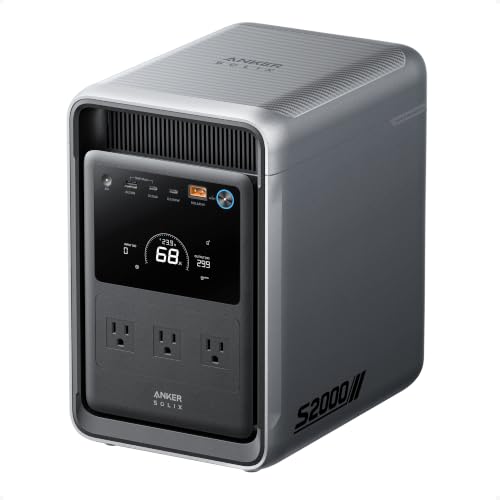
Anker SOLIX S2000
Anker
A truck empties its battery roughly 250 times a year, which makes cycle life the spec that decides when you buy the next one. This unit is rated for 10,000 cycles, nearly three times the highest rating anywhere else on this shortlist, and it carries 2010Wh in only 35.7 lb. The catch is a 1500W inverter that rules out anything that heats.
What we like about the Anker SOLIX S2000
- Rated for 10,000 cycles, which at 250 service days a year is about 40 years of daily deep cycling
- 2010Wh in 35.7 lb works out to 56 watt-hours per pound, nearly double the F3800 and the best on this shortlist
- Under 10ms UPS switchover means the card reader, tablet and router do not reboot when shore power drops mid-transaction
- LFP chemistry with a 5-year warranty, so the durability claim is backed rather than implied
- At 8.19 x 11.1 x 12.7 in it fits in a counter cavity that a wider unit cannot use
Where it falls short for the Anker SOLIX S2000
- The 1500W inverter is 900W below the AC200L and cannot run a panini press and a blender together, let alone a griddle or a fryer
- 400W maximum solar input is the lowest here, so even a good day of sun replaces well under a full 2010Wh charge
- Anker lists no expansion battery for it in the specification we hold, so 2010Wh is the ceiling you have to plan against and a longer day means buying a second unit
- Anker publishes no AC recharge time in the specification we hold, so you cannot plan a mid-shift turnaround from the sheet
- No 12V DC port, which is a problem if your build already runs 12V lighting or a 12V compressor fridge
Key specifications
- Capacity
- 2010Wh
- AC output
- 1500W (3000W peak)
- Rated cycle life
- 10,000 cycles
- Max solar input
- 400W
- Weight
- 35.7 lb (16.2 kg)
- UPS switchover
- Under 10ms
Home backup buyers can ignore cycle life. A house battery might see 30 deep cycles a year, so a 3,000-cycle pack outlives the warranty by decades. A truck is a different machine: it fills every night and empties every service, so the cycle count is a countdown that runs 250 times faster.
What 10,000 cycles means in a working year
At one full cycle a service day and 250 service days a year, a 3,000-cycle pack gives about 12 years. A 3,500-cycle pack gives about 14. This unit’s 10,000-cycle rating gives roughly 40, which is longer than the vehicle it sits in will last.
That is the argument for it. Every other unit here is a replacement decision you will eventually make. This one, on paper, is not.
The honest caveat is that lab cycle ratings assume controlled temperature. A battery living behind a hood fan in an August service window is not in lab conditions, and no manufacturer figure accounts for that.
The weight it does not add
2010Wh at 35.7 lb is 56 watt-hours per pound. The BLUETTI AC200L stores almost exactly the same energy, 2048Wh, and weighs 61.41 lb to do it. That is 26 lb of payload back, on a vehicle where fresh water, waste water and stock have already claimed most of it.
At 8.19 x 11.1 x 12.7 in, it is also the narrowest unit here, which matters when the only free space is a gap under a prep counter.
The 1500W wall
This is the specification that decides whether the rest of the review is relevant. 1500W continuous covers a reach-in fridge, a chest freezer, LED lighting, a router, a tablet and a card reader at once, which is a complete cold-menu truck. It does not cover a panini press and a blender running together, and it does not come close to a griddle or a fryer.
Peak output reaches 3000W, but that headroom is for compressor start-up surges, not for a heating element that draws continuously. If anything on your menu is cooked on board, this is the wrong unit and the Anker SOLIX F3800 is the right one.
Where it runs out and how you refill it
At a 350W sustained truck load, 2010Wh runs about 5.7 hours, so a ten-hour day needs a hookup or a second unit, because no expansion battery is listed for it in the specification we hold.
Solar is not the answer either. 400W maximum input is the lowest on this list. A 400W array in five good sun hours, derated for heat and angle, contributes on the order of 1500Wh, which is not a full charge. Treat panels here as a top-up that extends the shift, not as the way the truck gets its energy.
The under-10ms switchover, by contrast, is genuinely useful: when the venue’s supply drops mid-transaction, the terminal does not reboot and the sale does not vanish.
- Best for
- Cold-menu trucks, dessert trailers and market carts that run every day and want the battery to outlast the vehicle rather than the season.
- Choose something else if
- Anything on your menu heats, or your build depends on 12V DC output for fridges and lighting rather than AC outlets.
Best for coffee trailers and small prep carts
OUPES Mega 1
OUPES
Not every mobile food business is a truck. A coffee trailer or a market cart draws a fraction of a kitchen's sustained load but still needs a hard 2000W punch for an espresso machine or a grinder. This unit delivers that from 27.8 lb and refills to 80% in 36 minutes, which is the fastest turnaround here.
What we like about the OUPES Mega 1
- 2000W continuous with a 4500W surge starts an espresso machine or a commercial blender without tripping
- 0 to 80% in 36 minutes on AC, or 26 minutes with AC and solar together, which is the shortest refill on this shortlist
- At 27.8 lb and 15.1 x 9.1 x 11.6 in it fits under a cart counter and one person can carry it to the pitch
- Expandable to 5120Wh with two B2 batteries, so the same unit scales from a cart to a small trailer
- 3,500-plus cycles to 80% works out to roughly 14 years at 250 trading days a year
Where it falls short for the OUPES Mega 1
- At 1024Wh it covers under three hours of a full truck's 350W cold-side load, so a truck with a reach-in fridge and a freezer needs the expansion batteries from day one rather than as an upgrade
- OUPES publishes no maximum solar input in the specification we hold, so a roof or awning array cannot be sized against it without contacting the manufacturer
- The 26-minute figure requires AC and solar together, which means it only applies in daylight with panels already deployed
- Half the capacity of the AC200L for only 34 lb less, so on watt-hours per pound it is only marginally ahead of a much larger unit
Key specifications
- Capacity
- 1024Wh
- AC output
- 2000W (4500W surge)
- AC recharge time
- 36 minutes to 80% on AC, 26 minutes with AC and solar together
- Rated cycle life
- 3,500+ cycles to 80%
- Weight
- 27.8 lb (12.6 kg)
- Dimensions
- 15.1 x 9.1 x 11.6 in
The other three units on this shortlist assume a vehicle with a reach-in fridge and a freezer. Plenty of mobile food businesses have neither. A coffee trailer, a crepe cart or a dessert stall runs a very different load, and buying truck-sized capacity for it is money spent on weight you then have to push across a field.
Sizing a cart, not a kitchen
A cart’s sustained load looks like this: an under-counter fridge averaging around 60W across its duty cycle, LED lighting at 25W, a tablet, card reader and hotspot at about 35W. That is roughly 120W continuous.
At 120W, 1024Wh runs for about 8.5 hours. That is a full market day on the base pack, with no hookup, from a unit one person carries.
Run the same 1024Wh against a full truck’s 350W load and it lasts under three hours. Same battery, completely different answer, which is why capacity numbers mean nothing until you have named the appliances.
The peaks a cart actually has
Carts do not have sustained cooking draw, but they do have violent short ones. A single-group espresso machine heating its boiler, a commercial grinder starting under load, a high-torque blender: these spike hard and briefly.
2000W continuous with a 4500W surge covers that. The Anker SOLIX S2000, at 1500W continuous, is the unit on this list most likely to trip when the boiler element and the grinder coincide, which is exactly the sort of thing that happens at 8am with a queue forming.
Turnaround
36 minutes from empty to 80% restores about 819Wh, which at a 120W cart load is nearly seven more hours. Plugged into a venue outlet during a slow period, this is effectively a second trading day.
The 26-minute figure OUPES also quotes needs AC and solar simultaneously, so it applies in daylight with panels out, not at 6am in a car park. Take the 36-minute number as the planning figure.
The gap you have to plan around
The specification we hold lists no maximum solar input. For a cart that recharges from a mains outlet between markets, that is irrelevant. For anyone intending to mount a fixed array on an awning or a trailer roof, it is a blocker: you cannot size panels against a limit that has not been published, and overshooting a solar input is not a harmless mistake.
If solar is central to your plan, the BLUETTI AC200L publishes 1200W and is the safer choice. If your recharge story is a wall outlet during the quiet hour, this is the smallest, lightest and fastest way to trade all day without an engine running behind you.
- Best for
- Coffee trailers, dessert carts and market stalls with one small fridge, a grinder or blender, lighting and a card terminal to run.
- Choose something else if
- You operate a full truck with a reach-in fridge and a separate freezer, or you need to size a fixed solar array against a published input limit.
How we researched this guide
Four units were compared using published manufacturer specifications and aggregated owner reports, then sized against a modelled mobile kitchen load of roughly 350W sustained and a coffee cart load of roughly 120W. None of these units were tested by us in a food truck, and every review states which sources it relies on and what the assessment does not cover.
The full process is on our how we test portable power stations page, including what counts as hands-on use.
- Units evaluated
- 4
- Used hands-on
- 0
- Assessed from documentation and owner reports
- 4
Evaluation methods used: specification comparison
Which one should you buy?
Match your situation on the left to the recommendation on the right.
-
Anything on your menu is griddled, fried or cooked on board
Recommendation: Buy the Anker SOLIX F3800, the only unit here with 6000W continuous and 120V/240V split phase
-
You work a lunch block and a dinner block with a break and an outlet in between
Recommendation: Buy the BLUETTI AC200L for its 45-minute refill to 80%, but confirm your pitch supplies 20A rather than 15A
-
You trade every day and want the battery to outlast the vehicle
Recommendation: Buy the Anker SOLIX S2000 for its 10,000-cycle rating, provided nothing on your menu heats
-
You run a coffee trailer or a market cart rather than a full kitchen
Recommendation: Buy the OUPES Mega 1, which covers a 120W cart load for about 8.5 hours at 27.8 lb
-
Your vehicle has almost no payload left for battery weight
Recommendation: Buy the Anker SOLIX S2000 at 56 watt-hours per pound, roughly double the F3800
Mistakes buyers make
- Adding cooking peaks to the sustained load and buying capacity for a number the truck never actually draws for long
- Sizing by watt-hours alone and finding the inverter trips the moment the griddle and the fryer coincide
- Trusting a fast-charge figure without checking the venue supplies the amps it assumes, then losing the whole break to a slow refill
- Ignoring cycle life because home backup guides say it never matters, when a truck runs 250 deep cycles a year
- Planning to run the truck on roof solar, when a realistic array replaces a fraction of a service day
- Buying a unit with no expansion path and then needing a second complete system when the route grows
Our final recommendation
If you want one answer rather than a shortlist, this is the unit that suits the widest range of readers in this category.
Best for trucks with cooking equipment
Full-size trucks that cook on board, run a reach-in fridge and a freezer, and need one battery to carry a ten-hour festival day without a mid-shift refill.
Questions buyers ask
Can a battery power station really replace my petrol generator?
For the cold side, lighting and the point-of-sale kit, yes, and it does it without noise or exhaust, which is why some markets now allow it where an engine is banned. For sustained cooking, only the 6000W class comes close, and even then a full cooking day exceeds 3840Wh and needs shore power or expansion batteries.
How many watt-hours does a food truck need for one service day?
Work it out from your own appliance list rather than a chart. A reach-in fridge averages roughly 140W across its duty cycle, a chest freezer about 120W, LED lighting 40W and a tablet with a card reader and router about 35W. That is close to 350W continuous, or about 3.5kWh across a ten-hour day before any cooking.
Will a portable power station run a commercial griddle or a fryer?
Only the Anker SOLIX F3800 on this shortlist can. A flat-top sits around 1800W and a countertop fryer around 1500W, so running both is 3300W continuous. The other three units top out at 2400W, 2000W and 1500W and will trip. Surge ratings do not help, because a heating element draws continuously rather than in a brief spike.
Is the fast recharge time on the specification sheet realistic at a venue?
Only if the venue can supply the amps. The AC200L reaches 80% in 45 minutes on a 2400W input, which is 20A at 120V. A standard 15A circuit tops out near 1800W and cannot deliver it, so on a shared extension run the refill takes considerably longer than the figure implies. Check what your regular pitches actually offer.
How many years will one of these last if I trade every day?
Divide the cycle rating by your trading days. At 250 days a year, the F3800's 3,000 cycles is about 12 years and the Mega 1's 3,500 is about 14. The S2000's 10,000-cycle rating works out near 40 years. BLUETTI publishes no cycle figure for the AC200L in the specification we hold, so it cannot be planned the same way.
About the author