Portable Power Stations for Outdoor Use: 4 Picks That Earn Their Weight
Off-grid power editor
Published
Updated
Last fact-checked
This guide is for people who want mains power in the open air: a backyard evening, a tailgate, a market stall, a sports sideline, or a day of deck work with no socket in reach. We compared four units on the things that actually decide outdoor use, which are what the inverter can start, how many watt-hours you carry per pound, how fast the pack refills when there is no outlet, and what each manufacturer does and does not say about weather. We did not test these units, and every review states exactly what its recommendation rests on. What you get here is the arithmetic the listings leave out: what a 12V cooler really costs you over a day, why watt-hours per pound barely changes across this shortlist, and a plain statement about rain that most outdoor guides step around.
What is the best portable power station for outdoor use?
The Pecron F1000LFP suits the widest range of outdoor use. Its 1500W inverter starts a griddle or a kettle, 960Wh covers a long evening, and at 23.9 lb one person carries it from the car in a single trip. If your loads are corded tools rather than cooking, the OUPES Mega 1 has the surge headroom to start them.
Key takeaways
- Watt-hours per pound barely moves across this shortlist, from 36.8 to 41.1, so the weight you carry is set by the capacity you choose rather than by finding a cleverer unit
- The inverter rating, not the battery size, decides whether a griddle, kettle or saw works at all
- None of these four publish an ingress-protection rating, so plan shelter rather than assuming outdoor units are sealed against rain
- A 12V cooler averaging 18W across its duty cycle uses roughly 430Wh a day before anything else is plugged in
- Surge modes that work by lowering output voltage apply to heating elements and never to motors
Our picks at a glance
Every unit below wins a specific situation rather than a place in a ranking. Pick the row that matches how you will actually use it.
-
Best for outdoor cooking and hosting
Pecron F1000LFP
Backyard evenings, tailgates, outdoor markets and day-long setups where one person carries the unit and several people share the outlets.
-
Best for corded power tools outdoors

OUPES Mega 1
Deck building, fence repairs, yard work and outdoor trade jobs where corded tools run in bursts and there is no socket within extension-lead range.
-
Best for a weekend outdoors on solar

BLUETTI Elite 200 V2
Multi-day outdoor stays at a fixed pitch, outdoor events and market stalls where the unit is unloaded once and panels do the recharging.
-
Best for carrying by hand all day

Jackery Explorer 300
Day trips, sports sidelines, market stalls and photo work where the unit is carried on foot and the load is cameras, laptops, phones, lights and a small cooler.
How they compare
Scroll the table sideways to see every column.
| Product | Where to buy | Award | Capacity | AC output | Weight | Dimensions | AC recharge time | Warranty | Best for |
|---|---|---|---|---|---|---|---|---|---|
| Pecron F1000LFP | Best for outdoor cooking and hosting | 960Wh | 1500W pure sine wave | 23.9 lb (10.8 kg) | 15.0 x 8.5 x 8.4 in | 50 minutes to 80%, 70 minutes to full at 1000W AC | 2+3 years | Backyard evenings, tailgates, outdoor markets and day-long setups where one person carries the unit and several people share the outlets. | |
| OUPES Mega 1 | Best for corded power tools outdoors | 1024Wh | 2000W (4500W surge) | 27.8 lb (12.6 kg) | 15.1 x 9.1 x 11.6 in | 36 minutes to 80% on AC, 26 minutes with AC and solar together | 5-year warranty | Deck building, fence repairs, yard work and outdoor trade jobs where corded tools run in bursts and there is no socket within extension-lead range. | |
| BLUETTI Elite 200 V2 | Best for a weekend outdoors on solar | 2073.6Wh | 2600W continuous (3900W Power Lifting) | 53.35 lb (24.2 kg) | 13.78 x 9.84 x 12.74 in | 0-80% in 1 hour on Turbo mode (1800W AC), full in 1.6 hours on Standard mode | -- | Multi-day outdoor stays at a fixed pitch, outdoor events and market stalls where the unit is unloaded once and panels do the recharging. | |
| Jackery Explorer 300 | Best for carrying by hand all day | 292Wh | 300W (600W peak surge) | 7.1 lb (3.2 kg) | 9.1 x 5.2 x 7.8 in | -- | 2 year manufacturer | Day trips, sports sidelines, market stalls and photo work where the unit is carried on foot and the load is cameras, laptops, phones, lights and a small cooler. |
The full reviews
Best for outdoor cooking and hosting
Pecron F1000LFP
Pecron
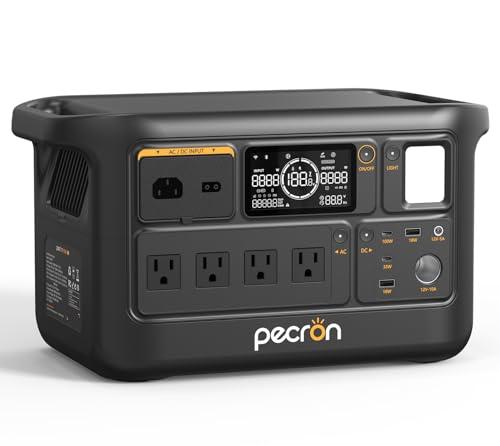
The F1000LFP puts 960Wh and a 1500W pure sine wave inverter into a 23.9 lb case, which is the balance most outdoor buyers actually want: enough inverter to run a griddle, enough capacity for a long evening, and light enough that one person carries it from the car in a single trip. Its 600W solar ceiling is the highest per watt-hour on this list.
What we like about the Pecron F1000LFP
- 960Wh in 23.9 lb works out to 40 watt-hours per pound, within 3% of the best ratio here from a unit that is three times the size
- 1500W pure sine wave starts griddles, kettles and coffee makers that trip 1000W and 1200W units
- 600W maximum solar input refills the whole 960Wh pack in about 1.6 hours at rated input, the fastest field recharge in this group
- Ten ports including four AC outlets, so a table of six people is not queueing for one socket
- 50 minutes to 80% on AC turns any short stop near a wall socket into a useful top-up
Where it falls short for the Pecron F1000LFP
- Pecron publishes no rated cycle life for this pack, so you cannot compare its expected lifespan against the 6,000 cycles BLUETTI claims for the Elite 200 V2 or the 3,500+ from OUPES
- The warranty is quoted as 2+3 years rather than a flat five, so three of those five years depend on meeting the extension conditions rather than being granted at purchase
- A mixed outdoor load of cooler, string lights and device charging averaging about 50W drains the usable pack in roughly 16 hours, so a two-night trip depends on the sun turning up
- 1500W is enough for one heating appliance at a time, so a griddle and a kettle together will trip it where the BLUETTI Elite 200 V2's 2600W would carry both
Key specifications
- Capacity
- 960Wh
- AC output
- 1500W pure sine wave
- Weight
- 23.9 lb (10.8 kg)
- Max solar input
- 600W
- AC recharge time
- 50 minutes to 80%, 70 minutes to full at 1000W AC
- Ports
- 10 total, 4 AC outlets, 2x USB-A 18W, 1x USB-C 33W, 1x USB-C 100W, DC 5525, car port
Most outdoor buying goes wrong in one of two directions. People either buy a handbag-sized unit that cannot start the thing they bought it for, or a 50 lb unit that never leaves the garage. The F1000LFP sits at the point where neither happens.
The inverter is what makes it useful outdoors
Outdoor loads split cleanly. Phones, laptops, speakers, lights and a 12V cooler all sit under 200W and almost anything runs them. Then there is the second group: a griddle, a kettle, a coffee maker, a heat gun. Those have a heating element and they draw between 1000W and 1500W the moment they are switched on.
A 1500W pure sine wave inverter clears that second group. A 1200W unit does not, and the failure mode is not gradual: the unit trips and the appliance stays cold. If your outdoor plans involve cooking or hot drinks, this is the specification that decides everything else.
What 960Wh covers, in hours
Assume roughly 85% of rated capacity reaches an AC load once conversion losses are counted. That gives about 816Wh to work with.
- String lights, a Bluetooth speaker and rolling phone charging draw around 50W together, which is about 16 hours
- A 12V cooler averaging 18W across its duty cycle draws about 430Wh a day, so 816Wh covers just under two days of cooling and nothing else
- A 1500W griddle draws 816Wh in roughly 33 minutes of continuous cooking, which in practice is enough for a meal for several people because a griddle cycles
Run all three at once and you are at a full evening plus the following morning. That is the honest ceiling.
Why the solar ceiling matters more here than elsewhere
600W of solar input against 960Wh of capacity is the best ratio in this guide. At rated input the pack fills in about 1.6 hours. Real panels in real sun deliver well below their nameplate, so plan on a longer window centred on the middle of the day, but the point stands: this unit can be reset inside a single good afternoon.
Compare that with a unit whose solar ceiling is not published at all, where you cannot plan a field recharge because you do not know what the charge controller will accept.
Where it falls short
The missing cycle-life rating is the real gap. Two of the other three units here publish one, and for something that will be charged and discharged every weekend for years, an unstated figure is a genuine unknown rather than a detail.
The 2+3 year warranty structure is the second. It is not the same promise as five years granted at purchase, and outdoor equipment gets knocked about.
If you need more than a day of stored energy without sun, the Elite 200 V2 is the better answer. If your loads are corded tools rather than cooking, the OUPES Mega 1 has 500W more inverter to work with.
- Best for
- Backyard evenings, tailgates, outdoor markets and day-long setups where one person carries the unit and several people share the outlets.
- Choose something else if
- You need a published cycle-life figure to justify the purchase, or you want a flat five-year warranty rather than a two-year term with a three-year extension.
Best for corded power tools outdoors
OUPES Mega 1
OUPES
A 2000W inverter backed by 4500W of surge gives this the largest genuine motor-starting headroom on the shortlist, in a 27.8 lb case one person lifts into a truck bed. The 1024Wh pack behind it is modest, so it is built for intermittent heavy work rather than sustained draw.
What we like about the OUPES Mega 1
- 2000W continuous clears a 1500W corded saw with 500W of headroom, so the tool decides the pace rather than the inverter
- 4500W of surge absorbs the start-up spike of a motor, and unlike voltage-reducing modes such as Power Lifting it applies to motors rather than only to heating elements
- 36 minutes to 80% on AC, or 26 minutes with AC and solar together, so a lunch break puts most of the pack back
- Expandable to 5120Wh with two B2 batteries, so a job that outgrows the base unit does not mean replacing it
- 3,500+ cycles to 80% is about nine and a half years at one full cycle a day
Where it falls short for the OUPES Mega 1
- 1024Wh behind a 2000W inverter is only about 26 minutes of flat-out draw, so the headroom is there for surges and intermittent cuts, not for sustained high load
- No maximum solar input appears in the published specification we compared, which makes a field recharge impossible to plan; the Pecron and the BLUETTI both state theirs
- At 27.8 lb it is 3.9 lb heavier than the Pecron F1000LFP for only 64Wh more capacity, so you carry weight the arithmetic does not repay
- The port list published for this unit does not state how many AC outlets it carries, which matters if you intend to run a tool and a charger at once
Key specifications
- Capacity
- 1024Wh
- AC output
- 2000W (4500W surge)
- Weight
- 27.8 lb (12.6 kg)
- AC recharge time
- 36 minutes to 80% on AC, 26 minutes with AC and solar together
- Expandable
- Yes, to 5120Wh with two B2 extra batteries
- Rated cycle life
- 3,500+ cycles to 80%
Everything else on this list is a general outdoor unit. This one exists because corded tools break the rules the others are built around.
Why tools need surge, not capacity
A tool’s plate rating is what it draws once it is running. The number that trips an inverter is the spike at the moment the motor starts, which can be several times the running figure for a fraction of a second.
That is the whole case for the Mega 1. 2000W continuous handles the running draw of a 1500W saw with room to spare, and 4500W of surge covers the start. A 1500W-rated unit can technically match the plate figure of that saw and still shut down every time you pull the trigger.
The BLUETTI Elite 200 V2 has a higher continuous rating at 2600W, but its headline 3900W comes from Power Lifting, which holds current down by reducing voltage. That is fine for a kettle and useless for a motor, so for tool work the 4500W here is the number that counts.
The arithmetic that limits it
Now the other side. Take roughly 85% of the 1024Wh rating as usable through the inverter, which is about 870Wh.
- At 2000W flat out, that is about 26 minutes
- At 1500W, about 35 minutes
- A realistic cutting job runs the saw perhaps 20% of the time, which turns 35 minutes of cutting into around three hours on site
- Add a work light at 30W and a battery charger at 60W and you lose roughly a further 90Wh an hour
So the honest description is a unit that starts anything you plug into it and runs for an afternoon of normal, intermittent work. It is not a unit you leave pulling 2000W while you go to lunch.
Expansion is the real answer to that
Two B2 batteries take the system to 5120Wh, five times the base pack, without changing the inverter. That is the correct upgrade path for anyone whose jobs run past an afternoon, and it is why the modest base capacity is a design decision rather than an oversight.
The gap that would stop us recommending it universally
There is no published maximum solar input. For a unit sold into outdoor work, that is a meaningful omission: you cannot size a panel array against a ceiling you do not know, and you cannot compare its field recharge against the Pecron’s stated 600W or the BLUETTI’s 1000W.
If your work is near a vehicle or a generator, that does not matter, because 36 minutes on AC is the fastest recharge here. If your only source of energy is the sun, buy one of the units that tells you what it will accept.
Cycle life is the quiet strength. 3,500+ cycles to 80% is about nine and a half years at a full cycle every day, and outdoor work units get cycled harder than anything kept for emergencies.
- Best for
- Deck building, fence repairs, yard work and outdoor trade jobs where corded tools run in bursts and there is no socket within extension-lead range.
- Choose something else if
- You need sustained high draw for more than half an hour at a time, or you plan to recharge from solar panels and need a stated input ceiling to size an array.
Best for a weekend outdoors on solar
BLUETTI Elite 200 V2
BLUETTI
2073.6Wh paired with a 1000W solar ceiling is the only combination here that can run a full weekend outdoors and reset itself in a single sunny afternoon. You pay for that in mass: at 53.35 lb this is a two-handed lift that gets carried once and then stays where you put it.
What we like about the BLUETTI Elite 200 V2
- 2073.6Wh is more than double the Pecron F1000LFP, enough to carry a cooler, lights and charging for about 35 hours of mixed use
- A full solar charge in 2.4 hours with 1000W of panels means one good afternoon of sun resets the entire pack
- 2600W continuous runs an induction hob, a full-size kettle or two heating appliances at once
- Over 6,000 rated cycles is about 16 years at one full cycle a day, the longest expected life on this list
- Turbo mode reaches 80% in an hour on 1800W AC input, so a stop at home between trips is enough
Where it falls short for the BLUETTI Elite 200 V2
- At 53.35 lb it weighs 7.5 times the Jackery Explorer 300 for 7.1 times the capacity, so the extra mass buys no efficiency at all and it is a two-person carry over rough ground
- Power Lifting reaches 3900W by lowering output voltage, which works for a heating element but never for a motor, so that figure does not apply to a pump, saw or compressor
- The published specification we compared states no warranty term, which is a real unknown on a unit this size that lives outdoors
- Reaching the 2.4-hour solar figure needs 1000W of panels, which is a large array to transport, set up and keep pointed at the sun
Key specifications
- Capacity
- 2073.6Wh
- AC output
- 2600W continuous (3900W Power Lifting)
- Weight
- 53.35 lb (24.2 kg)
- Solar input
- Full charge in 2.4 hours with 1000W panels
- AC recharge time
- 0-80% in 1 hour on Turbo mode (1800W AC), full in 1.6 hours on Standard mode
- Rated cycle life
- Over 6,000 cycles
This is the unit you buy when the outdoor plan is measured in nights rather than hours, and when a vehicle does the carrying.
Capacity that changes what you can plan
Take about 85% of the 2073.6Wh rating as usable through the inverter, or roughly 1760Wh.
- A mixed outdoor load of lights, speaker and charging at around 50W runs for about 35 hours
- A 12V cooler averaging 18W across its duty cycle uses about 430Wh a day, so the pack alone covers four days of cooling
- A 1200W kettle uses about 40Wh for a two-minute boil, which is roughly 44 boils
Those numbers are what separate a weekend from an evening. Everything smaller on this list is planning around a single day.
The solar figure is the actual argument
A 1000W input ceiling with a stated 2.4-hour full charge means the pack is not a fixed budget for the trip, it is a daily allowance. Run 1700Wh on Saturday, put it back on Sunday, keep going.
The catch is that 1000W of panels is a physically large array. If your setup is a single 200W folding panel, the ceiling is irrelevant and the recharge takes most of a clear day. Buy this for the capacity, and treat the solar figure as headroom you can grow into rather than something you get on day one.
What 53.35 lb actually means
Weight is the reason this is not our lead pick. At 13.78 x 9.84 x 12.74 in it is a compact block, which makes it worse to carry, not better, because the handles sit close together and the mass is concentrated.
Divide capacity by weight and it delivers 38.9 watt-hours per pound. The Jackery Explorer 300 delivers 41.1. In other words, going large gains you nothing in carrying efficiency: you are simply carrying more. Plan for the unit to be unloaded from a vehicle to its final position once.
Where the rating claims need care
Power Lifting is the same technique EcoFlow and others use: hold current within limits by dropping voltage. A kettle or a heater does not mind, it just takes longer. A motor does mind, because voltage is what develops torque. The number that applies to anything with a compressor or a brush motor is the 2600W continuous rating, which is the highest on this list, though the OUPES Mega 1 still holds more true surge headroom at 4500W.
Over 6,000 cycles is the other standout. At one full cycle a day that is more than sixteen years, which is well past the point where the rest of the unit becomes the limiting factor.
- Best for
- Multi-day outdoor stays at a fixed pitch, outdoor events and market stalls where the unit is unloaded once and panels do the recharging.
- Choose something else if
- You will move the unit on foot, up steps or over sand and grass, or you cannot transport and set up a large panel array.
Best for carrying by hand all day
Jackery Explorer 300
Jackery
At 7.1 lb the Explorer 300 is the only unit here you can carry any distance without planning the route, and it still delivers 41 watt-hours per pound, the best ratio on this list. The 300W inverter is what that portability costs you: this powers devices, a cooler and lights, and nothing with a heating element.
What we like about the Jackery Explorer 300
- 292Wh in 7.1 lb is 41.1 watt-hours per pound, better than the 53 lb BLUETTI manages at 38.9
- 9.1 x 5.2 x 7.8 in fits a daypack, a bike pannier or the footwell of a car with the rest of the kit still aboard
- A 100W USB-C PD port charges a laptop directly, skipping the inverter and the conversion loss that comes with it
- Over 4,000 rated cycles is about eleven years at a full cycle every day
- Six ports covering two AC outlets, USB-C, two USB-A and a 120W car socket, so mains, USB and 12V gear all run from one case
Where it falls short for the Jackery Explorer 300
- The 300W inverter rules out every heating appliance; a 1000W kettle, a griddle or a hairdryer will not start, and the 600W peak does not change that
- Its cycle life is rated to 70% of original capacity while OUPES quotes 3,500+ to 80%, so the two figures are measured to different thresholds and 4,000 is the more forgiving number
- The two-year warranty is the shortest here, against five years from OUPES, which matters on a unit that gets thrown in a car boot every weekend
- No AC recharge time or solar input figure appears in the published specification we compared, so neither a mains top-up nor a panel recharge can be planned in advance
Key specifications
- Capacity
- 292Wh
- AC output
- 300W (600W peak surge)
- Weight
- 7.1 lb (3.2 kg)
- Ports
- 6 total, 2 AC outlets, 1 USB-C PD 100W, 2 USB-A, 1 car port 120W
- Rated cycle life
- Over 4,000 cycles to 70%
- Warranty
- 2 year manufacturer
The interesting thing about the Explorer 300 is not that it is small. It is that being small costs you nothing in efficiency.
Weight per watt-hour, which is the point
Divide capacity by weight across this shortlist and the numbers land between 36.8 and 41.1 watt-hours per pound. The Explorer 300 tops that range at 41.1. The 53.35 lb BLUETTI Elite 200 V2 sits at 38.9.
That means going large gains nothing per pound carried. You buy more capacity and you carry proportionally more weight, full stop. So the honest question is not which unit is most efficient to carry, it is how much energy you actually need, because the weight follows directly from that answer.
If your load list is a camera kit, a laptop, phones, a work light and a small cooler, 292Wh is the answer and 7.1 lb is what it costs.
What 292Wh covers
Assume roughly 85% reaches an AC load after inverter losses, about 248Wh.
- Phones at around 12Wh a full charge: about 20 charges
- A 60Wh laptop battery: about four full recharges, and more over USB-C because that path skips the inverter entirely
- A 12V cooler averaging 18W across its duty cycle: about 14 hours, so one night rather than a weekend
- String lights and a speaker at 35W together: about seven hours
The wall you will hit
300W. That is the ceiling and it is a hard one. Anything that makes heat, a kettle, a griddle, a coffee maker, a heat gun, will not start, and no surge mode changes that because the shortfall is not momentary.
If your outdoor plans include hot food or hot drinks, stop here and read the Pecron F1000LFP section instead. If they do not, this is the unit that will actually come with you, because everything else on this list gets left in the car at some point.
Where the specification is thin
Two figures are missing that would help: an AC recharge time and a solar input ceiling. Neither stops the unit being useful, but both mean you plan its recharging by trial rather than by arithmetic. For a unit this size that is a minor annoyance rather than a fault, and the two-year warranty is the more serious gap.
- Best for
- Day trips, sports sidelines, market stalls and photo work where the unit is carried on foot and the load is cameras, laptops, phones, lights and a small cooler.
- Choose something else if
- Anything you plan to plug in has a heating element, or you want one unit that can cover both devices and cooking outdoors.
How we researched this guide
Four units were compared using published manufacturer specifications and the runtime, weight and recharge arithmetic derived from them. None of these units were tested by us, and each review names the specifications its recommendation rests on and the questions those specifications cannot answer.
The full process is on our how we test portable power stations page, including what counts as hands-on use.
- Units evaluated
- 4
- Used hands-on
- 0
- Assessed from documentation and owner reports
- 4
Evaluation methods used: specification comparison
Which one should you buy?
Match your situation on the left to the recommendation on the right.
-
You run corded tools, a wet saw or a small compressor outdoors
Recommendation: Buy the OUPES Mega 1 for its 2000W inverter and 4500W of genuine motor-starting surge
-
You are out for a weekend with no socket and will bring panels
Recommendation: Buy the BLUETTI Elite 200 V2, which accepts 1000W of solar and reaches a full charge in 2.4 hours
-
You carry the unit on foot, by bike or across a field
Recommendation: Buy the Jackery Explorer 300 at 7.1 lb, provided nothing on your list has a heating element
-
You want one unit for lights, a cooler, charging and hot food
Recommendation: Buy the Pecron F1000LFP for its 1500W pure sine inverter and 600W solar ceiling
-
You get short breaks near a socket and need the pack back quickly
Recommendation: Buy the OUPES Mega 1, which reaches 80% in 36 minutes on AC or 26 with solar assisting
Mistakes buyers make
- Sizing by watt-hours alone and finding the inverter cannot start the griddle or kettle the unit was bought for
- Assuming a unit sold for outdoor use is sealed against rain, when none of these four publish an ingress-protection rating at all
- Forgetting the 12V cooler, which averages around 18W and quietly takes about 430Wh a day before lights or charging
- Buying the largest pack in the name of being prepared, then leaving 53 lb in the car because it is a two-handed lift
- Planning a solar recharge without checking the unit's maximum solar input, which caps how fast any array can refill it
- Reading a surge figure as usable power, when the unit that surges to 4500W holds 1024Wh behind a 2000W inverter, which is about 26 minutes of flat-out draw
Our final recommendation
If you want one answer rather than a shortlist, this is the unit that suits the widest range of readers in this category.
Best for outdoor cooking and hosting
Backyard evenings, tailgates, outdoor markets and day-long setups where one person carries the unit and several people share the outlets.
Questions buyers ask
Can I leave a portable power station out in the rain?
Not safely. None of the four units here publish an ingress-protection rating, which means neither we nor the manufacturer can tell you what they survive. Keep the unit under a table, an awning or a plastic tote with the lid propped, raise it off wet ground, and leave the vents clear because these units run cooling fans while charging.
What size do I need for a backyard party?
Add the loads. String lights are usually 20W to 40W, a Bluetooth speaker about 15W, a run of phone charging maybe 20W, and a 12V cooler averages roughly 18W. That is around 90W, so a 960Wh unit covers about nine hours once conversion losses are counted. Add a griddle and the inverter rating, not the capacity, becomes the deciding number.
Can these run power tools outdoors?
A corded drill or sander is fine on any of the larger units. A circular saw or wet saw needs both a continuous rating above the tool's plate figure and real surge headroom for the motor starting, which is why the OUPES Mega 1 with its 4500W surge is the pick here. The 300W Jackery cannot run tools at all.
Does cold or hot weather change what I get?
Yes. Every lithium pack delivers less in the cold, and LiFePO4 cells will refuse to charge below freezing to protect themselves, so a unit left overnight in winter may not accept a charge until it warms up. Heat is the other end of the problem: a unit in direct sun works its fans harder and may reduce charging speed.
Do I need solar panels, or is charging at home enough?
For day trips, charging at home is enough and panels are money you do not need to spend. Panels earn their place from the second night onward, or when the unit lives at a market stall or a job site. Before buying any array, check the unit's maximum solar input, because that ceiling caps what the panels can deliver no matter how many you connect.
About the author