We Compared 4 3000W Solar Generators and Power Stations

Off-grid power editor
Published
Updated
Last fact-checked
This guide is for people who already know they want something in the 3000W tier and now have to work out which 3000W they are being sold. Plenty of the units advertised at this size are 1500W inverters with a 3000W peak, and the two figures behave nothing alike once a compressor is involved. We compared four units that reach the class, one of them only as a pair, on continuous inverter output, rated capacity, watt-hours per pound, solar input ceiling and rated cycle life. We did not test any of them, and every review says exactly what its recommendation rests on. What you get here is the arithmetic the listings leave out: runtime from capacity divided by a stated load, energy stored per pound carried, and cycle ratings converted into lifetime kilowatt-hours.
What is the best 3000 watt solar generator?
The EcoFlow DELTA Pro suits the widest range of buyers. It clears the class on a 3600W continuous rating rather than a peak figure, holds 3600Wh, and scales to 25kWh without being replaced. If you have 240V loads such as a well pump, or you are building a real panel array, the Anker SOLIX F3800 is the only unit here that covers both.
Key takeaways
- Continuous inverter rating is the number that governs what you can plug in; a peak or surge figure describes a fraction of a second at start-up
- Boost modes reach their headline wattage by lowering output voltage, so they never apply to a motor such as a pump or compressor
- Energy per pound varies from 29.1Wh to 47.3Wh across this shortlist, so two units in the same class can differ by 68 lb
- A solar input ceiling of a few hundred watts means panels top the unit up; a ceiling in the thousands means panels can actually refill it
- Rated cycle life matters only if you cycle daily; for storm-season backup a 1,000-cycle pack outlives the house
Our picks at a glance
Every unit below wins a specific situation rather than a place in a ranking. Pick the row that matches how you will actually use it.
-
Best for growing past 3000W later
EcoFlow DELTA Pro
Buyers who want a 3000W-class unit today but expect to add batteries as loads grow, and who have somewhere permanent to park a 99 lb cabinet on wheels.
-
Best for 3000W at the lowest carry weight

Jackery Explorer 3000 Pro (Renewed)
Buyers who need to move a 3000W-class unit between a garage, a truck bed and a worksite on their own, and who accept a short warranty in exchange for that.
-
Best for solar refills and 240V appliances

Anker SOLIX F3800
Households on a well or with 240V appliances, and anyone building a genuine solar setup where panel input ceiling matters more than how easily the unit moves.
-
Best for reaching 3000W in two one-person loads

Generac GB2000
Buyers who need 3000W-class output but cannot handle a single heavy cabinet, and who are happy to build the system in two purchases rather than one.
How they compare
Scroll the table sideways to see every column.
| Product | Where to buy | Award | Capacity | AC output | Weight | AC recharge time | Expandable | Ports | Warranty | Best for |
|---|---|---|---|---|---|---|---|---|---|---|
| EcoFlow DELTA Pro | Best for growing past 3000W later | 3600Wh | 3600W (4500W X-Boost) | 99 lb (44.9 kg) | 1.8 hours on a 240V outlet, 2.7 hours on a 1800W wall outlet | Yes, from 3.6kWh to 25kWh with extra batteries or smart generators | 15 outputs total, 5 AC outlets | 5 years | Buyers who want a 3000W-class unit today but expect to add batteries as loads grow, and who have somewhere permanent to park a 99 lb cabinet on wheels. | |
| Jackery Explorer 3000 Pro (Renewed) | Best for 3000W at the lowest carry weight | 3024Wh | 3000W | 63.9 lb (29.0 kg) | 2.4 hours to full | -- | 2 x 100W PD ports | 90 days limited warranty | Buyers who need to move a 3000W-class unit between a garage, a truck bed and a worksite on their own, and who accept a short warranty in exchange for that. | |
| Anker SOLIX F3800 | Best for solar refills and 240V appliances | 3840Wh | 6000W | 132 lb (60 kg) | About 1.5 hours to full | Yes, to 26.9kWh with expansion batteries | 13 total, including 30A RV and 120V/240V split phase | -- | Households on a well or with 240V appliances, and anyone building a genuine solar setup where panel input ceiling matters more than how easily the unit moves. | |
| Generac GB2000 | Best for reaching 3000W in two one-person loads | 2106Wh | 1600W (3200W peak) | 48.8 lb (22.1 kg) | 3.3 hours from 0% to 80% | Yes, to 4212Wh and 3200W continuous with a second unit and the optional 30A parallel kit | 10 outputs - 3 AC outlets, 2 USB-A (15.5W), 2 USB-C (65W), 12V car port (120W), Qi wireless pad, parallel ports | 3-year residential / 1-year commercial limited | Buyers who need 3000W-class output but cannot handle a single heavy cabinet, and who are happy to build the system in two purchases rather than one. |
The full reviews
Best for growing past 3000W later
EcoFlow DELTA Pro
EcoFlow
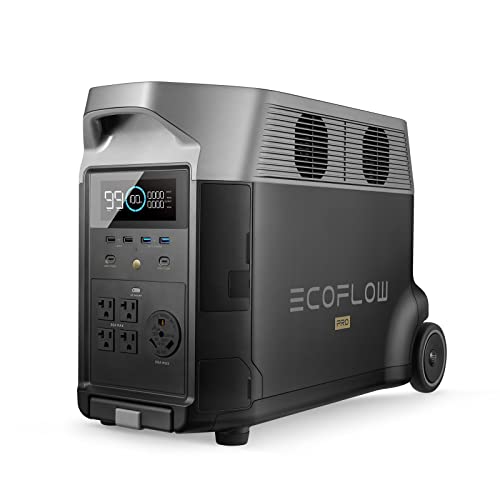
This is the pick for someone who wants 3000W now and suspects they will want more within a few years. The 3600W continuous inverter clears the class on the rating that counts, and the same cabinet scales from 3.6kWh to 25kWh without being replaced. The trade-off is 99 lb and a slow refill unless you can reach a 240V outlet.
What we like about the EcoFlow DELTA Pro
- 3600W continuous output clears the 3000W bar on the rated figure rather than a peak number
- 3600Wh covers a 150W fridge for a full 24 hours on rated capacity
- Expands from 3.6kWh to 25kWh with extra batteries or smart generators, so the cabinet outlives the requirement
- 5-year warranty is the longest cover in this shortlist, against the Generac's 3 years residential and the Jackery's 90 days
Where it falls short for the EcoFlow DELTA Pro
- At 99 lb it carries 36.4Wh per pound, well under the 47.3Wh per pound of the Jackery Explorer 3000 Pro, so you pay for the expansion path in dead weight
- The 1.8-hour recharge needs a 240V outlet; on an ordinary 1800W wall socket it takes 2.7 hours, which is nearly twice the F3800's 1.5 hours
- The 4500W X-Boost figure is reached by lowering output voltage, so it does not apply to a motor such as a pump, compressor or corded saw
- The cabinet ships as 3.6kWh and every step towards 25kWh is a separate expansion battery or smart generator, each with its own bulk, so the headline expansion figure is a shopping list rather than a capability you own on day one
Key specifications
- Capacity
- 3600Wh
- AC output
- 3600W (4500W X-Boost)
- Weight
- 99 lb (44.9 kg)
- AC recharge time
- 1.8 hours on a 240V outlet, 2.7 hours on a 1800W wall outlet
- Expandable
- Yes, from 3.6kWh to 25kWh with extra batteries or smart generators
- Warranty
- 5 years
The DELTA Pro is the only unit in this shortlist that treats 3000W as a starting point rather than a finished product.
Why 3600W matters more than 4500W
EcoFlow prints two numbers on this unit. The one that governs what you can plug in is 3600W continuous. The 4500W X-Boost figure is achieved by reducing output voltage so current stays inside the inverter’s limit.
Lower voltage is harmless for a resistive load. A kettle simply boils more slowly. A motor is different: it needs full voltage to develop starting torque, so a well pump, a fridge compressor or a corded circular saw sees only the 3600W figure. Buy on 3600W and treat X-Boost as a bonus that applies to heaters and kettles.
The arithmetic that decides it
Take a full-size refrigerator averaging 150W across its compressor duty cycle, which works out at roughly 3.6kWh a day. At 3600Wh the DELTA Pro covers that fridge for about 24 hours on rated capacity, before you add lighting, a router or phone charging. Real usable capacity is always lower than rated, so treat 24 hours as the ceiling rather than the plan.
Divide capacity by weight and the picture changes. 3600Wh across 99 lb is 36.4Wh per pound. The Jackery Explorer 3000 Pro manages 47.3Wh per pound. You are carrying about 30 percent more weight per stored watt-hour here, and the reason is the expansion hardware.
What the expansion path actually buys
The unit scales from 3.6kWh to 25kWh with extra batteries or smart generators. At the 3.6kWh a day a fridge consumes, a fully expanded system covers roughly a week of refrigeration alone. That is the whole argument for the extra weight: you buy the inverter and the cabinet once and add storage later, rather than replacing a unit you have outgrown.
Where it frustrates
Charging. The 1.8-hour figure assumes a 240V outlet, which most people do not have in the room where a 99 lb cabinet lives. On an ordinary 1800W wall socket you get 2.7 hours, or about 1,333W of average delivered charge. The Anker SOLIX F3800 pushes 3840Wh in 1.5 hours, an average of roughly 2,560W. If your outages arrive in short bursts with brief grid windows between them, that gap decides how much stored energy you actually have when the next cut lands.
Who should buy it
People whose load list is going to grow. If you know exactly what you need to run and that list is fixed, a lighter unit stores the same energy for less weight and less complication.
- Best for
- Buyers who want a 3000W-class unit today but expect to add batteries as loads grow, and who have somewhere permanent to park a 99 lb cabinet on wheels.
- Choose something else if
- You need to lift the unit into a vehicle or up steps regularly, or your only charging point is a standard 120V wall outlet and you need the pack refilled inside two hours.
Best for 3000W at the lowest carry weight
Jackery Explorer 3000 Pro (Renewed)
Jackery
Nothing else here stores this much energy for this little weight. 3024Wh in 63.9 lb works out at 47.3Wh per pound, the highest ratio in the shortlist, and the inverter is a flat 3000W rather than a peak figure. The catch is the 90-day warranty on this renewed listing, which is a real risk on a battery.
What we like about the Jackery Explorer 3000 Pro (Renewed)
- 47.3Wh per pound is the best energy-to-weight ratio here, 30 percent better than the DELTA Pro
- 3000W continuous is a rated inverter figure, not a peak or surge number that collapses under a motor load
- Half the weight of the Anker SOLIX F3800 while holding 79 percent of its capacity
- Refills in 2.4 hours to full, roughly 1,260W of average delivered charge
Where it falls short for the Jackery Explorer 3000 Pro (Renewed)
- The 90-day limited warranty is a twentieth of the DELTA Pro's five years, and a battery pack failing in month four is entirely your problem
- This is a renewed unit, so its cell history is unknown and the 3024Wh rating describes a new pack rather than the one you receive
- The recorded port list is only 2 x 100W PD ports, with no 12V car socket or USB-A among them, so DC gear that plugs straight into the other units here has to run off the AC outlets instead
- No expansion path is recorded, so 3024Wh is the permanent ceiling rather than a starting point
Key specifications
- Capacity
- 3024Wh
- AC output
- 3000W
- Weight
- 63.9 lb (29.0 kg)
- AC recharge time
- 2.4 hours to full
- Warranty
- 90 days limited warranty
- Dimensions
- 18.6 x 14.1 x 14.7 in
Everything in the 3000W class is heavy. This one is the least heavy, and the gap is not marginal.
The weight arithmetic
Divide rated capacity by rated weight and the four units here separate cleanly:
- Explorer 3000 Pro: 3024Wh across 63.9 lb, 47.3Wh per pound
- Generac GB2000: 2106Wh across 48.8 lb, 43.2Wh per pound
- EcoFlow DELTA Pro: 3600Wh across 99 lb, 36.4Wh per pound
- Anker SOLIX F3800: 3840Wh across 132 lb, 29.1Wh per pound
The F3800 stores 27 percent more energy and weighs 107 percent more. If the unit lives on a garage floor and never moves, that does not matter. If it goes in and out of a vehicle, it decides whether you use the thing at all.
The rating is honest
3000W here is the continuous inverter figure. That distinction matters in this class because several units marketed as 3000W are 1500W inverters with a 3000W peak, and a peak rating describes a fraction of a second at start-up, not what you can run.
At 3000W continuous you can hold a 1500W space heater and a 1200W kettle at the same time with headroom left. At 150W, the average draw of a full-size fridge across its duty cycle, 3024Wh runs for about 20 hours on rated capacity.
The warranty is the reason to hesitate
This is a renewed listing carrying a 90-day limited warranty. The DELTA Pro carries five years, the Generac three years residential. Lithium packs mostly fail gradually rather than suddenly, so a 90-day window covers dead-on-arrival faults and very little else.
You are also buying an unknown cycle history. The 3024Wh figure describes a new pack. A pack that has already been through a few hundred cycles delivers less, and no specification sheet will tell you how many that is.
Who should buy it
Someone who genuinely needs to carry 3kWh. That is a narrower group than it sounds, and for everyone else in this shortlist the extra warranty cover on the DELTA Pro is worth the extra 35 lb.
- Best for
- Buyers who need to move a 3000W-class unit between a garage, a truck bed and a worksite on their own, and who accept a short warranty in exchange for that.
- Choose something else if
- You want long-term warranty cover on a battery pack, or you expect to add storage later, because this unit has no recorded expansion path beyond 3024Wh.
Best for solar refills and 240V appliances
Anker SOLIX F3800
Anker
The F3800 overshoots the 3000W class deliberately. A 6000W inverter, 240V split phase and a 2400W solar ceiling put it in a different job entirely: it is the only unit here that can drive a well pump and the only one that can refill itself from panels inside a working day. It also weighs 132 lb.
What we like about the Anker SOLIX F3800
- 2400W maximum solar input can push 3840Wh back into the pack in about 1.6 hours of ideal full sun
- 120V/240V split phase covers well pumps and electric ranges, which none of the other three can touch
- 3,000 rated cycles across a 3840Wh pack works out at roughly 11.5MWh of lifetime throughput
- Refills in about 1.5 hours from AC, an average of roughly 2,560W, the fastest here
- Expands to 26.9kWh, enough for about a week of refrigeration at 3.6kWh a day
Where it falls short for the Anker SOLIX F3800
- At 132 lb it is a two-person lift or a wheeled unit that stays where you put it, and it stores only 29.1Wh per pound against the Jackery's 47.3Wh
- Reaching the 2400W solar ceiling means a large panel array, which is a separate purchase, a mounting problem and a wiring job most buyers have not costed
- Driving 240V loads properly means a transfer switch installed by an electrician, so the unit alone does not deliver whole-home backup
- The 6000W inverter can empty the 3840Wh pack in about 38 minutes at full rated draw, so the headline output is a burst figure unless you buy expansion batteries behind it
Key specifications
- Capacity
- 3840Wh
- AC output
- 6000W
- Max solar input
- 2400W
- AC recharge time
- About 1.5 hours to full
- Weight
- 132 lb (60 kg)
- Rated cycle life
- 3,000 cycles to 80%
- Expandable
- Yes, to 26.9kWh with expansion batteries
The F3800 answers a different question from the rest of this shortlist. Not “how do I get 3000W”, but “how do I get off the grid for a day without a fuel can”.
Solar input is the specification that earns it a place
Most units in this size class accept a few hundred watts of panel input. This one accepts 2400W. That single number changes what a solar generator can do.
Divide 3840Wh of capacity by 2400W of input and you get 1.6 hours to refill the pack in ideal full sun. Panels almost never deliver their rated output once you account for angle, temperature and haze, so plan on roughly 70 percent and call it about two and a quarter hours. Compare that with the Generac GB2000’s 468W ceiling, which needs about 4.5 hours of ideal sun to refill a much smaller 2106Wh pack.
For anyone running the same battery down every day and recharging it every afternoon, that is the whole game.
The 240V line
A 120V-only unit will run a fridge, lighting, a router, a CPAP and a gas furnace blower. It will not run a well pump, an electric range, a dryer or a central air handler, because those need 240V split phase.
The F3800 provides it, and none of the other three do. If you are on a well, this shortlist has exactly one entry on it. If you are not, this is the one pick you can safely ignore.
What 3,000 cycles means in years
Multiply the 3,000-cycle rating by 3840Wh and you get roughly 11.5MWh of energy through the pack before it drops to 80 percent of capacity. Cycled once a week, that is decades. Cycled once a day in an off-grid cabin, it is about eight years.
Set that against the Generac GB2000’s 1,000 cycles: a paired GB2000 system carries 4212Wh, so its rated lifetime throughput is about 4.2MWh. The F3800 delivers roughly two and three quarter times as much energy over its rated life.
The weight is not negotiable
132 lb. It has wheels and a pull handle, and it still is not going up a flight of stairs without help or into a truck bed without a ramp. At 29.1Wh per pound it is the least weight-efficient unit here by a distance.
That is the deal: you accept a machine that stays put in exchange for split phase, a serious solar ceiling and a 26.9kWh expansion path.
- Best for
- Households on a well or with 240V appliances, and anyone building a genuine solar setup where panel input ceiling matters more than how easily the unit moves.
- Choose something else if
- You have no 240V loads and no plan to buy panels, because the 132 lb weight and the 6000W inverter are then capacity you have paid for and will never use.
Best for reaching 3000W in two one-person loads
Generac GB2000
Generac
One GB2000 is not a 3000W unit and we are not going to pretend otherwise. Two of them plus the 30A parallel kit are: 3200W continuous and 4212Wh, which is more stored energy than the DELTA Pro, split into 48.8 lb halves anyone can carry. The trade-off for that flexibility is NMC cells rated for only 1,000 cycles.
What we like about the Generac GB2000
- Paired with the optional 30A kit the system reaches 3200W continuous and 4212Wh, the largest capacity in this shortlist
- Each half weighs 48.8 lb, so a 3000W-class system arrives in loads one person can lift without a ramp
- 4212Wh covers a 150W fridge for about 28 hours on rated capacity, the longest fridge runtime here
- A single unit is useful on its own, so the second half can be bought later rather than up front
Where it falls short for the Generac GB2000
- The 1,000-cycle rating is a third of the F3800's 3,000 cycles, so a paired system carries about 4.2MWh of rated lifetime throughput against the F3800's 11.5MWh
- A single GB2000 delivers only 1600W continuous, so anyone buying one unit expecting 3000W-class output has bought the wrong thing
- 3.3 hours from 0 to 80 percent is about 511W of average delivered charge, less than a quarter of the F3800's rate, and that is per unit rather than for the pair
- Lithium-ion NMC cells rather than the LiFePO4 used by the DELTA Pro and F3800, which is the main reason the cycle rating is so much lower
Key specifications
- Capacity
- 2106Wh
- AC output
- 1600W (3200W peak)
- Weight
- 48.8 lb (22.1 kg)
- AC recharge time
- 3.3 hours from 0% to 80%
- Max solar input
- 468W
- Rated cycle life
- 1,000 cycles to 80%
- Expandable
- Yes, to 4212Wh and 3200W continuous with a second unit and the optional 30A parallel kit
- Warranty
- 3-year residential / 1-year commercial limited
This is the only pick here that reaches the 3000W class by addition rather than by being built that way, and that is the entire reason to consider it.
Read the qualifying spec carefully
A single GB2000 is a 1600W inverter over a 2106Wh pack. It has a 3200W peak figure, and a peak figure is not a class. What puts this on the list is the published expansion path: with a second unit and the optional 30A parallel kit the system runs at 3200W continuous over 4212Wh.
So the honest description is that two GB2000s are a 3000W-class solar generator. One is not. Anyone buying a single unit off the back of this guide will be disappointed, and that is worth stating plainly.
Why anyone would want it in halves
4212Wh is more capacity than the DELTA Pro’s 3600Wh and more than the Jackery’s 3024Wh. At 150W, the average draw of a full-size fridge across its duty cycle, that is about 28 hours of refrigeration on rated capacity, the longest figure in this shortlist.
It arrives as two 48.8 lb boxes. The DELTA Pro is a single 99 lb cabinet and the F3800 is a single 132 lb one. Per pound the Generac stores 43.2Wh, second only to the Jackery, and no lift is worse than 48.8 lb.
For a second-floor apartment, a boat, or anyone who has to load a unit into a car without a tailgate ramp, that changes what is realistic to own.
The cycle life is the real cost
The cells are lithium-ion NMC, rated for 1,000 cycles to 80 percent. The F3800 uses LiFePO4 rated for 3,000.
Multiply through and a paired GB2000 system carries about 4.2MWh of rated lifetime throughput. The F3800 carries about 11.5MWh. Cycled once a day, 1,000 cycles is under three years. Cycled once a month for storm season, it is a lifetime.
That is the sorting question. Occasional backup duty and the cycle rating never matters. Daily off-grid use and it is the most expensive specification on the sheet.
Charging is slow
3.3 hours from 0 to 80 percent, about 511W of average delivered charge per unit. Solar input tops out at 468W per unit, so a pair takes roughly 4.5 hours of ideal full sun to refill 4212Wh. That is workable for a daily cycle but useless for grabbing a twenty-minute grid window mid-outage.
- Best for
- Buyers who need 3000W-class output but cannot handle a single heavy cabinet, and who are happy to build the system in two purchases rather than one.
- Choose something else if
- You will cycle the battery daily, because 1,000 rated cycles works out at under three years of daily use where the F3800's 3,000-cycle LiFePO4 pack lasts about eight.
How we researched this guide
Four units were compared using published manufacturer specifications and aggregated owner reports. Every runtime, weight-efficiency and lifetime figure on this page is arithmetic performed on those published numbers, with the assumption stated each time. None of these units were tested by us, and each review names its sources.
The full process is on our how we test portable power stations page, including what counts as hands-on use.
- Units evaluated
- 4
- Used hands-on
- 0
- Assessed from documentation and owner reports
- 4
Evaluation methods used: specification comparison
Which one should you buy?
Match your situation on the left to the recommendation on the right.
-
You have a well pump, an electric range or a central air handler
Recommendation: Buy the Anker SOLIX F3800, the only unit here with 120V/240V split phase output
-
You are building a panel array and want to refill from sun rather than the grid
Recommendation: Buy the Anker SOLIX F3800 for its 2400W solar input ceiling
-
You have to lift the unit into a vehicle or carry it upstairs on your own
Recommendation: Buy the Jackery Explorer 3000 Pro at 63.9 lb, and accept its 90-day warranty
-
You cannot manage a single heavy cabinet but still need 3000W-class output
Recommendation: Buy two Generac GB2000 units and the 30A parallel kit for 3200W across two 48.8 lb halves
-
You want 3000W now and expect your load list to grow within a few years
Recommendation: Buy the EcoFlow DELTA Pro for its 3.6kWh to 25kWh expansion path
Mistakes buyers make
- Buying a unit whose 3000W figure is a peak rating on a 1500W inverter, then finding it trips on the appliance it was bought for
- Treating a boost mode such as X-Boost as usable headroom for a fridge, pump or power tool rather than for heaters and kettles
- Sizing on watt-hours alone and ending up with a 132 lb cabinet that never leaves the spot it was unboxed in
- Calling a unit a solar generator without checking its solar input ceiling, which can be the difference between a 1.6-hour refill and a 4.5-hour one
- Paying for 240V split phase in a house with no 240V appliances, which is weight and capacity that will never be used
- Assuming the second half of a modular system can be added any time, without confirming the parallel kit is still sold
Our final recommendation
If you want one answer rather than a shortlist, this is the unit that suits the widest range of readers in this category.
Best for growing past 3000W later
Buyers who want a 3000W-class unit today but expect to add batteries as loads grow, and who have somewhere permanent to park a 99 lb cabinet on wheels.
Questions buyers ask
Is 3000W the same as 3000Wh?
No, and confusing them is the most common sizing error in this class. Watts describe how much you can draw at once, so they decide whether an appliance starts. Watt-hours describe how much energy is stored, so they decide how long it runs. A unit can be 3000W and 1000Wh, or 1500W and 3000Wh, and those are entirely different products.
Do these come with solar panels?
Usually not. Most are sold as the battery unit alone, with panels offered as a separate bundle. The word generator in the marketing refers to what the unit can do with panels attached, not to anything included in the box. Budget for the panels, the cables and somewhere to put them.
Is it safe to run one of these indoors?
Yes. A battery power station burns no fuel and produces no exhaust, so there is no carbon monoxide risk and nothing here needs to live outside. Keep the vents clear, because units this size run their cooling fans hard while fast charging and under heavy load.
Do they lose capacity in cold weather?
Yes, every lithium pack does. LiFePO4 cells also refuse to charge below freezing to protect themselves. A unit stored in an unheated garage over winter will deliver noticeably less than its rating and may not accept a charge at all until it warms up, which matters because winter storms are when most people need it.
Can I take a 3000W power station on a plane?
No. Airlines cap spare lithium batteries at 100Wh in the cabin, with 160Wh allowed by prior approval on some carriers. The smallest unit here holds 2106Wh, more than twenty times the 100Wh limit and thirteen times the 160Wh one, so nothing in this class flies as baggage on a passenger aircraft.
About the author