We Compared 4 Portable Power Stations for Tailgating

Off-grid power editor
Published
Updated
Last fact-checked
This guide is for people who tailgate out of a vehicle in a lot with no shore power, and who are replacing a gas generator or a cigarette lighter inverter with a battery. We compared four units on the four specifications that decide a tailgate: inverter output, rated capacity, watt-hours per pound and refill speed. We did not test any of them, and every review states exactly what its recommendation rests on. What you get here is the arithmetic a retail listing will not do for you. We build a real tailgate load list in watts, divide capacity by it, rank the shortlist by how much energy each pound of carrying weight actually buys, and explain why the 12V socket in your truck cannot refill any of these on the drive to the stadium.
What is the best portable power station for tailgating?
The OUPES Mega 1 suits the widest range of tailgates because its 2000W inverter is the only one here with real headroom over a 1500W electric griddle, and it returns to 80% in 36 minutes. If your tailgate is a television and a speaker rather than cooking, the lighter Jackery Explorer 1000 v2 stores more energy per pound and is the better carry.
Key takeaways
- Inverter output decides whether an electric griddle runs at all; capacity only decides how long everything runs afterwards
- A realistic electronics-only tailgate draws about 200W, which turns every capacity figure into a simple division you can do before buying
- Watt-hours per pound is the specification nobody publishes, and it ranges from 36.8 to 45.0 across these four units
- A 12V vehicle accessory socket supplies roughly 120W, so the drive to the venue adds a fraction of a charge, not a full one
- Cooking on propane changes the scale of the problem, because a 1024Wh pack lasts about 41 minutes under a 1500W griddle and about 5.1 hours on a 200W electronics list
Our picks at a glance
Every unit below wins a specific situation rather than a place in a ranking. Pick the row that matches how you will actually use it.
-
Best for griddles and high-draw cooking

OUPES Mega 1
Tailgates built around an electric griddle, roaster or blender, where the peak draw of the appliance matters more than the total number of hours.
-
Best for a long carry from the parking spot

Jackery Explorer 1000 v2
Tailgaters who park where they can and walk, and want the most stored energy they can comfortably carry in one hand across a lot.
-
Best for all-day and back-to-back tailgates

VTOMAN FlashSpeed 1500
Long tailgates, doubleheaders and race weekends where the vehicle parks close enough that 41.5 lb is a short carry rather than a hike.
-
Best for a TV and the whole group's devices
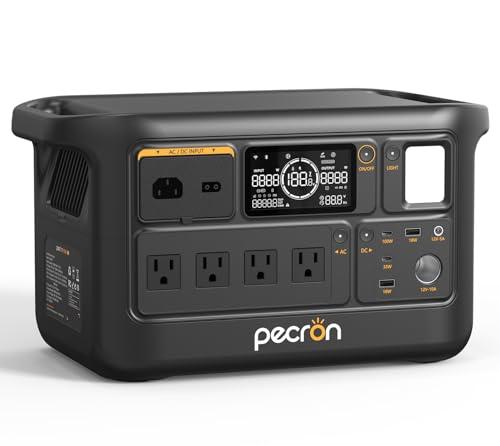
Pecron F1000LFP
Electronics-led tailgates with several people plugging in at once, where outlet count and carrying weight matter more than raw capacity.
How they compare
Scroll the table sideways to see every column.
| Product | Where to buy | Award | Capacity | AC output | Weight | AC recharge time | Ports | Rated cycle life | Best for |
|---|---|---|---|---|---|---|---|---|---|
| OUPES Mega 1 | Best for griddles and high-draw cooking | 1024Wh | 2000W (4500W surge) | 27.8 lb (12.6 kg) | 36 minutes to 80% on AC, 26 minutes with AC and solar together | 2x USB-C 100W PD, 4x USB-A QC3.0, 12V DC outputs, AC outlets | 3,500+ cycles to 80% | Tailgates built around an electric griddle, roaster or blender, where the peak draw of the appliance matters more than the total number of hours. | |
| Jackery Explorer 1000 v2 | Best for a long carry from the parking spot | 1070Wh | 1500W (3000W surge) | 23.8 lb (10.8 kg) | 1.7 hours to full | 7 total, 3 AC outlets | 4,000 cycles to 70% | Tailgaters who park where they can and walk, and want the most stored energy they can comfortably carry in one hand across a lot. | |
| VTOMAN FlashSpeed 1500 | Best for all-day and back-to-back tailgates | 1548Wh | 1500W (3000W peak) | 41.5 lb (18.8 kg) | 1 hour to full on 1500W AC input, 45 minutes with AC, solar and DC combined | 12 total, 3 AC outlets, 4x USB-A, 2x USB-C, 2x DC5521, car port | 3,000+ cycles to 80% | Long tailgates, doubleheaders and race weekends where the vehicle parks close enough that 41.5 lb is a short carry rather than a hike. | |
| Pecron F1000LFP | Best for a TV and the whole group's devices | 960Wh | 1500W pure sine wave | 23.9 lb (10.8 kg) | 50 minutes to 80%, 70 minutes to full at 1000W AC | 10 total, 4 AC outlets, 2x USB-A 18W, 1x USB-C 33W, 1x USB-C 100W, DC 5525, car port | -- | Electronics-led tailgates with several people plugging in at once, where outlet count and carrying weight matter more than raw capacity. |
The full reviews
Best for griddles and high-draw cooking
OUPES Mega 1
OUPES
The Mega 1 is the only unit on this shortlist rated 2000W continuous, and that single number decides whether a full-size electric griddle runs or trips the inverter on the first press of the switch. What it does not give you is endurance: 1024Wh is a burst of cooking, not an afternoon of it.
What we like about the OUPES Mega 1
- 2000W continuous with a 4500W surge rating clears the 1500W nameplate of a full-size electric griddle with headroom left for a speaker
- Reaches 80% charge in 36 minutes on AC, or 26 minutes with AC and solar together, so a top-up between a lunchtime and an evening event is realistic
- Expandable to 5120Wh with two B2 batteries if the cooking side of the tailgate grows
- Rated for 3,500+ cycles to 80%, far more charge cycles than a seasonal tailgate schedule will ever consume
Where it falls short for the OUPES Mega 1
- At 1024Wh a 1500W griddle drains the pack in roughly 41 minutes of continuous cooking, so this unit sears and reheats rather than holding a buffet warm
- 36.8 watt-hours per pound is the worst ratio of the four here, meaning you carry 27.8 lb for less stored energy than the 23.8 lb Jackery Explorer 1000 v2 holds
- The published port list names USB and 12V DC outputs but never states how many AC outlets there are, so if you need four sockets at once the specification does not confirm it
Key specifications
- Capacity
- 1024Wh
- AC output
- 2000W (4500W surge)
- Weight
- 27.8 lb (12.6 kg)
- AC recharge time
- 36 minutes to 80% on AC, 26 minutes with AC and solar together
- Ports
- 2x USB-C 100W PD, 4x USB-A QC3.0, 12V DC outputs, AC outlets
- Rated cycle life
- 3,500+ cycles to 80%
Almost every disappointing tailgate power station story starts the same way. The unit was bought on capacity, the griddle was plugged in, and the inverter shut down before the burgers went on. The Mega 1 exists to make that conversation short.
Why 2000W is the line
Electric cooking appliances are the highest-wattage things most people ever plug into a battery. A full-size electric griddle is commonly rated 1500W. An electric roaster sits close to that. A blender’s motor pulls a brief spike well above its running figure when the blades hit ice.
A 1500W inverter can run a 1500W griddle only in theory, with zero margin. The Mega 1’s 2000W continuous rating leaves 500W of genuine headroom, which is enough for the griddle plus a TV, or the griddle plus a blender’s start-up spike. The 4500W surge figure is the reason a compressor cooler or a shop vac starts here without a fight.
That is a different specification from the three units that follow, all of which are rated 1500W or below.
The arithmetic that limits it
Headroom does not create energy. At 1024Wh, a 1500W griddle running flat out consumes the whole pack in 1024 divided by 1500, or 0.68 hours. That is about 41 minutes.
In practice a griddle thermostat cycles rather than drawing continuously, so call it half duty and you get roughly 80 minutes of griddle time before everything else on the table goes dark. Add a 100W TV and a 40W speaker running alongside and it comes down again.
The honest way to use this unit is to cook in a defined window rather than leaving the appliance on. Sear the food, unplug the griddle, and the remaining capacity carries the electronics for hours.
Getting it back to full
The 36-minute figure to 80% is the fastest refill in this guide. Eighty percent of 1024Wh is 819Wh, which means the unit accepts energy at an average of roughly 1,360W across that window. For a Saturday with a noon and an evening event, that is the difference between one charge and two.
Who should pick something else
If the tailgate is a television, a Bluetooth speaker, string lights and phone charging, the peak rating is irrelevant and you are carrying weight for nothing. The Jackery Explorer 1000 v2 stores more energy in a lighter case, and the VTOMAN FlashSpeed 1500 stores considerably more. Buy the Mega 1 when there is an electric cooking appliance in the plan.
- Best for
- Tailgates built around an electric griddle, roaster or blender, where the peak draw of the appliance matters more than the total number of hours.
- Choose something else if
- You want a single unit to carry a TV, speaker and lights through six straight hours, or the walk from your parking spot is long enough that every pound counts.
Best for a long carry from the parking spot
Jackery Explorer 1000 v2
Jackery
Nothing else here packs 1070Wh into a 23.8 lb case, which is the specification that matters when the good spot is four rows from where you parked. The cost of that density is patience: 1.7 hours to full is the slowest refill of the four, and the pack cannot be expanded later.
What we like about the Jackery Explorer 1000 v2
- 45.0 watt-hours per pound, the best ratio on this shortlist and about 22% better energy density than the OUPES Mega 1
- 1500W continuous with a 3000W surge rating handles a 900W coffee maker, a slow cooker or a compressor cooler start
- Three AC outlets across seven ports cover a TV, a speaker and a charger without a power strip on wet grass
- 400W maximum solar input means a panel laid on the truck bed can offset most of a daytime load at an early kickoff
Where it falls short for the Jackery Explorer 1000 v2
- 1.7 hours to full is the slowest recharge in this guide; the OUPES Mega 1 reaches 80% in 36 minutes, so a same-day turnaround between two events is realistic on that unit and marginal on this one
- The pack is not expandable, so 1070Wh is a permanent ceiling and a longer day means buying a second unit rather than a battery
- Three AC outlets against the four on the Pecron F1000LFP, which weighs almost the same 23.9 lb, so a fourth mains appliance means running a power strip off the unit on the ground
Key specifications
- Capacity
- 1070Wh
- AC output
- 1500W (3000W surge)
- Weight
- 23.8 lb (10.8 kg)
- AC recharge time
- 1.7 hours to full
- Ports
- 7 total, 3 AC outlets
- Rated cycle life
- 4,000 cycles to 70%
Weight is the specification tailgaters underestimate, because the unit only feels heavy on the walk back to the car at the end of a long day. The Explorer 1000 v2 wins this guide’s density contest outright, and the maths is not close.
The ratio, in full
Divide rated capacity by rated weight and the four units here rank like this:
- Jackery Explorer 1000 v2: 1070Wh over 23.8 lb is 45.0Wh per pound
- Pecron F1000LFP: 960Wh over 23.9 lb is 40.2Wh per pound
- VTOMAN FlashSpeed 1500: 1548Wh over 41.5 lb is 37.3Wh per pound
- OUPES Mega 1: 1024Wh over 27.8 lb is 36.8Wh per pound
The Jackery carries 0.1 lb less than the Pecron and stores 110Wh more. Against the Mega 1 it is four pounds lighter and 46Wh larger. Those are small absolute differences that stop being small when the lot is full and you parked at the far end.
What 1070Wh actually covers
Take a realistic electronics-only tailgate: a 55-inch television at about 100W, a powered speaker at 40W, LED string lights at 25W and a shared charging brick pulling 30W. That is 195W, call it 200W.
1070Wh divided by 200W is 5.35 hours. That covers a pre-game setup, a full football game and the traffic afterwards. Add a slow cooker at 250W and the same pack drops to roughly 2.4 hours, which is the point at which you either cook on propane or buy the VTOMAN.
Where it costs you
The recharge figure is the genuine weakness. At 1.7 hours to full, refilling 1070Wh implies an average input around 630W. That is fine overnight and useless between a noon kickoff and an evening race meeting.
The lack of expansion is the second one, and it is permanent. The OUPES and the VTOMAN both accept extra batteries. This does not, so whatever you buy is what you own.
Who it suits
Buy this if the tailgate is electronics and light appliances, if you carry the unit rather than wheeling it, and if you charge it the night before. If you cook electrically, the 1500W rating leaves no headroom for anything else on the circuit, and the OUPES Mega 1 is the better inverter.
- Best for
- Tailgaters who park where they can and walk, and want the most stored energy they can comfortably carry in one hand across a lot.
- Choose something else if
- You run two events in a day and need the unit back to full between them, or you expect to grow the setup with an expansion battery later.
Best for all-day and back-to-back tailgates
VTOMAN FlashSpeed 1500
VTOMAN
1548Wh is the largest pack in this guide and the only one that carries a full tailgate load list from setup through to the drive home without rationing. It weighs 41.5 lb to do that, so this is a unit you plan a route for rather than one you sling out of the truck bed.
What we like about the VTOMAN FlashSpeed 1500
- 1548Wh stores about 51% more energy than the 1024Wh OUPES Mega 1, which is about two and a half extra hours on a 200W electronics load
- Refills to full in one hour on a 1500W AC input, or 45 minutes with AC, solar and DC running together
- 12 ports including three AC outlets, four USB-A, two USB-C and a car socket, so a group charges without anyone unplugging anyone else
- Expandable to 3096Wh with one extra battery, which is over 15 hours at the same 200W load
Where it falls short for the VTOMAN FlashSpeed 1500
- At 41.5 lb it weighs 17.7 lb more than the Jackery Explorer 1000 v2 for only 478Wh more capacity, and no wheeled option is published, so it is a deliberate two-handed carry
- 37.3 watt-hours per pound puts it behind both 24 lb units here despite having the biggest battery, so the extra capacity is bought entirely with weight
- The 1500W inverter is 500W below the OUPES Mega 1, so a 1500W electric griddle sits at the rated limit with nothing left over for a television or a cooler
- Solar input is capped at 400W on the largest pack here, against 600W on the 960Wh Pecron F1000LFP, so an hour of sun replaces a much smaller share of this battery than of a smaller one and daytime solar cannot keep up with a heavy load
Key specifications
- Capacity
- 1548Wh
- AC output
- 1500W (3000W peak)
- Weight
- 41.5 lb (18.8 kg)
- AC recharge time
- 1 hour to full on 1500W AC input, 45 minutes with AC, solar and DC combined
- Ports
- 12 total, 3 AC outlets, 4x USB-A, 2x USB-C, 2x DC5521, car port
- Rated cycle life
- 3,000+ cycles to 80%
Every other unit in this guide is a compromise between capacity and carrying weight. The FlashSpeed 1500 stops compromising on the first and pays for it entirely with the second.
What the extra capacity buys
Using the same tailgate load list as the rest of this guide, a 55-inch television at roughly 100W, a powered speaker at 40W, string lights at 25W and shared phone charging at 30W comes to about 200W.
1548Wh divided by 200W is 7.7 hours. The 1024Wh Mega 1 gives 5.1 hours on the same list and the 960Wh Pecron gives 4.8. That gap is the whole argument for this unit: it is the only one that covers a morning setup, a long game, a post-game hour in the lot and the wait for traffic to clear without you turning anything off.
Add the expansion battery and 3096Wh at 200W is 15.5 hours, which is a full race weekend day.
What it costs to carry
41.5 lb is not a casual figure. The Jackery Explorer 1000 v2 in this guide is 23.8 lb, so you are carrying 17.7 lb more for 478Wh more energy. Expressed as a ratio, that extra weight arrives at 27Wh per pound, well below the 45Wh per pound the Jackery averages across its whole mass.
Practically, this means the FlashSpeed 1500 belongs to tailgaters who back the truck up to the spot. If your venue puts you in a lot and makes you walk, this is the wrong unit and the arithmetic above will not comfort you at the end of the night.
The inverter limit to understand
At 1500W continuous with a 3000W peak, this covers a coffee maker, a slow cooker, a compressor cooler and a television comfortably. It does not comfortably cover a full-size 1500W electric griddle, because that appliance alone consumes the entire continuous rating.
You can run the griddle. You cannot run the griddle and anything else. If electric cooking is central to your tailgate, the 2000W OUPES Mega 1 is the correct inverter and this is the correct battery, which is an uncomfortable answer but an honest one.
Who should buy it
Buy this for duration. Twelve ports across a group, an hour to refill and 1548Wh of stored energy is the specification that fits a full day out of a vehicle. If the day is short or the walk is long, buy lighter.
- Best for
- Long tailgates, doubleheaders and race weekends where the vehicle parks close enough that 41.5 lb is a short carry rather than a hike.
- Choose something else if
- You walk any distance from the parking spot to the tailgate, or the main load is a 1500W electric griddle that would leave the inverter no margin.
Best for a TV and the whole group's devices
Pecron F1000LFP
Pecron
Four AC outlets on a 23.9 lb case make the F1000LFP the practical pick when the tailgate is a screen, a speaker and a crowd of phones rather than a cooking operation. The 960Wh pack is the smallest here, and Pecron publishes no surge figure for the inverter, which matters more than it looks.
What we like about the Pecron F1000LFP
- Four AC outlets, more than any other unit in this guide, so a television, speaker, lights and a slow cooker all plug in without a power strip lying on wet grass
- Reaches 80% in 50 minutes and full in 70 minutes at 1000W AC, quick enough to refill over lunch before an evening kickoff
- 40.2 watt-hours per pound is second only to the Jackery here, so it stays a genuine one-hand carry across a lot
- 600W maximum solar input is the highest of the four, enough for a panel on the truck bed to cover most of a daytime electronics load
Where it falls short for the Pecron F1000LFP
- At 960Wh it holds 588Wh less than the VTOMAN FlashSpeed 1500, which is roughly three fewer hours on a 200W tailgate load list
- Pecron publishes no surge or peak rating alongside the 1500W continuous figure, so there is no stated headroom for the compressor start on a plug-in cooler or kegerator, where the Jackery quotes 3000W
- Only one of the ten ports is a 100W USB-C; the other USB-C is 33W and both USB-A ports are 18W, so a group with modern phones and a laptop will queue for the fast socket
Key specifications
- Capacity
- 960Wh
- AC output
- 1500W pure sine wave
- Weight
- 23.9 lb (10.8 kg)
- AC recharge time
- 50 minutes to 80%, 70 minutes to full at 1000W AC
- Ports
- 10 total, 4 AC outlets, 2x USB-A 18W, 1x USB-C 33W, 1x USB-C 100W, DC 5525, car port
- Max solar input
- 600W
Most tailgate power problems are not about wattage at all. They are about the moment four people want a socket and there are two. The F1000LFP is the unit on this shortlist that solves that specific problem.
Outlet count is a real specification
Across these four units, the published port lists give three AC outlets on the Jackery Explorer 1000 v2, three on the VTOMAN FlashSpeed 1500, an unstated number on the OUPES Mega 1, and four here. The F1000LFP is the only one that confirms four in writing.
That matters at a tailgate more than at home, because the alternative is an extension strip sitting on grass in the weather next to a battery. Ten ports total, including a 100W USB-C, means a television, a powered speaker, string lights and a warming appliance all connect at the source.
The 1500W pure sine wave output is also the right kind of power for a modern television and audio gear, which is worth stating plainly since cheap modified sine inverters are still sold into this category.
The capacity ceiling
960Wh is the smallest pack in this guide, and the arithmetic follows. Take the same load list used throughout: a 55-inch television at about 100W, a speaker at 40W, string lights at 25W and shared phone charging at 30W, roughly 200W in total.
960Wh divided by 200W is 4.8 hours. That is a comfortable game plus setup. It is not a doubleheader, and it is not a load list with a slow cooker on it. Add a 250W cooker and the same pack lasts around 2.1 hours.
The 50-minute refill to 80% partly compensates, provided you have somewhere to plug in between events.
The surge question
Pecron states 1500W continuous and stops there. The Jackery quotes 3000W surge, the OUPES quotes 4500W. A plug-in cooler or a kegerator compressor draws a brief spike well above its running wattage at start-up, and the specification here gives you no number to check that against.
That is not evidence the unit will fail. It is a gap in the published data, and if a compressor is on your list you should buy a unit that publishes a figure.
Who it suits
Take this one if your tailgate is a screen, sound and a lot of people charging things, if you carry the unit yourself, and if the day ends within about five hours. If it runs longer, buy the VTOMAN. If you cook electrically, buy the OUPES.
- Best for
- Electronics-led tailgates with several people plugging in at once, where outlet count and carrying weight matter more than raw capacity.
- Choose something else if
- Your setup includes a plug-in cooler or kegerator whose compressor needs a stated surge margin, or a tailgate that regularly runs past five hours.
How we researched this guide
Four units were compared using published manufacturer specifications and the nameplate wattage of common tailgate appliances. None of the units in this guide were tested by us, and every review names the sources its recommendation rests on and the limits of what a specification comparison can tell you.
The full process is on our how we test portable power stations page, including what counts as hands-on use.
- Units evaluated
- 4
- Used hands-on
- 0
- Assessed from documentation and owner reports
- 4
Evaluation methods used: specification comparison
Which one should you buy?
Match your situation on the left to the recommendation on the right.
-
Your tailgate is built around an electric griddle, roaster or blender
Recommendation: Buy the OUPES Mega 1, the only unit here rated 2000W continuous with a 4500W surge figure
-
You park where you can and carry the unit across a full lot
Recommendation: Buy the Jackery Explorer 1000 v2 at 45.0 watt-hours per pound, the best ratio in this guide
-
You run doubleheaders or race weekends that last most of a day
Recommendation: Buy the VTOMAN FlashSpeed 1500 for its 1548Wh pack and 3096Wh expansion path
-
Four or more people need to plug in at the same time
Recommendation: Buy the Pecron F1000LFP, the only unit here that publishes four AC outlets
-
You need the unit back to full between a noon and an evening event
Recommendation: Buy the OUPES Mega 1 for its 36-minute refill to 80%, and skip the Jackery, which takes 1.7 hours
Mistakes buyers make
- Sizing by watt-hours alone and buying a unit whose inverter cannot start the electric griddle it was bought for
- Assuming the drive to the venue will recharge the unit through the 12V socket, which supplies a small fraction of what these packs hold
- Reading manufacturer runtime charts as a plan, when they assume one modest constant load rather than a television, a speaker, lights and a cooker together
- Cooking electrically when propane is allowed, which consumes in half an hour what the electronics would have used all afternoon
- Buying the biggest pack available without checking how far you actually have to carry it from the parking spot
- Leaving the unit on wet grass or in the rain, because none of these are enclosed weatherproof cases
Our final recommendation
If you want one answer rather than a shortlist, this is the unit that suits the widest range of readers in this category.
Best for griddles and high-draw cooking
Tailgates built around an electric griddle, roaster or blender, where the peak draw of the appliance matters more than the total number of hours.
Questions buyers ask
Can a portable power station run an electric griddle?
Only if the inverter is rated above the griddle. A full-size electric griddle is commonly 1500W, which means a 1500W inverter is running at its limit with nothing left for anything else. The 2000W OUPES Mega 1 is the only unit here with real margin. Capacity is the second question, and the answer is short: 1024Wh divided by 1500W is about 41 minutes of continuous cooking.
Are battery power stations allowed at stadium tailgates that ban generators?
Usually, because the ban is normally written against fuel-burning generators, open flame and exhaust rather than batteries. A lithium power station produces no exhaust and no noise. Rules are set per venue and change, so check the current tailgating policy for your stadium rather than assuming.
Can I recharge it from my truck on the drive to the game?
Barely. A 12V accessory socket is typically fused around 10 to 15 amps, so assume about 120W. At that rate a 1024Wh pack needs over eight hours of driving to fill from empty. Treat vehicle charging as a top-up that slows the drain, not as a way to arrive full. Charge from a wall outlet the night before.
Do I need pure sine wave output for a television?
Yes. Modified sine inverters, still sold cheaply for vehicles, can cause buzzing in audio equipment and are hard on switching power supplies. Of the four units compared here, only the Pecron F1000LFP states pure sine wave output in its published specification, so if a listing does not say it, ask the manufacturer before you buy.
Will these survive being used outdoors in the rain?
None of the four are enclosed weatherproof cases, and none publish an ingress protection rating. Keep the unit under the tailgate or a canopy, off wet ground, and remember these run cooling fans that draw air through the case while charging and under heavy load.
About the author