Portable Power Stations for a Tesla: 4 Units, and the Miles They Really Add

Off-grid power editor
Published
Updated
Last fact-checked
This guide is for Tesla owners considering a portable power station as an emergency reserve, and it starts by taking something away. A power station is not a range extender. Even the largest unit here delivers about eleven miles, and the ones you can actually lift deliver about six. We compared four units on capacity, inverter output, weight, recharge time and solar input, then converted every capacity figure into miles using a consumption and efficiency assumption we state openly so you can substitute your own. We did not charge a car with any of them, and each review says exactly what its recommendation rests on. What you get here is the arithmetic no product listing shows: watt-hours to miles, inverter rating against the 1440W a Mobile Connector actually draws, and how long each unit takes to empty itself into a car.
What is the best portable power station for charging a Tesla?
The Jackery Explorer 2000 v2 is the right buy for most Tesla owners. Its 2200W inverter sustains the 1440W a Mobile Connector draws at 12A without the car being dialled back, and at 39.5 lb one person can put it in a frunk. Be clear about what it buys you: 2042Wh is roughly six miles. If you want the top-up done in 40 minutes rather than 85, the Anker SOLIX F3800 is the only unit here with 240V output.
Key takeaways
- A 2000Wh power station adds roughly six miles of Tesla range, not sixty, once charging losses are counted
- A Mobile Connector on a 120V outlet draws 1440W at 12A, so the inverter rating decides whether you charge at full current
- 240V split-phase output changes how fast the energy arrives, not how much of it there is
- Charging a battery to charge another battery loses roughly a fifth of the energy against plugging the car straight into the same outlet
- The only unit that keeps producing miles after the first cycle is one you can refill from solar
Our picks at a glance
Every unit below wins a specific situation rather than a place in a ranking. Pick the row that matches how you will actually use it.
-
Best for running the Mobile Connector at full current

Jackery Explorer 2000 v2
Tesla owners who want one battery in the trunk that will run the Mobile Connector at its full 12A setting without any fiddling, and who can lift about 40 lb.
-
Best for charging at more than trickle speed

Anker SOLIX F3800
Owners who want one machine that backs up the house and can also put a fast top-up into the car on a driveway, and who have somewhere permanent to keep 132 lb.
-
Best for refilling from panels in a unit one person can carry

BLUETTI AC200L
Owners who spend time away from mains power and want a battery that can be refilled by panels, or who intend to expand past 2000Wh rather than live with six miles.
-
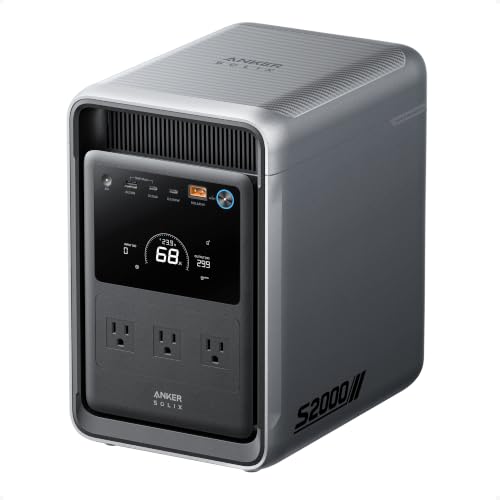
Best for a unit that gets cycled every week
Anker SOLIX S2000
Owners who will actually use the unit regularly rather than storing it charged, and who want the most watt-hours they can lift with one hand on each handle.
How they compare
Scroll the table sideways to see every column.
| Product | Where to buy | Award | Capacity | AC output | Weight | AC recharge time | Max solar input | Ports | Warranty | Best for |
|---|---|---|---|---|---|---|---|---|---|---|
| Jackery Explorer 2000 v2 | Best for running the Mobile Connector at full current | 2042Wh | 2200W across 3 AC ports | 39.5 lb (17.9 kg) | 66 minutes to 80% | -- | 3 AC outlets, 1 USB-C PD 100W | 5 year manufacturer | Tesla owners who want one battery in the trunk that will run the Mobile Connector at its full 12A setting without any fiddling, and who can lift about 40 lb. | |
| Anker SOLIX F3800 | Best for charging at more than trickle speed | 3840Wh | 6000W | 132 lb (60 kg) | About 1.5 hours to full | 2400W | 13 total, including 30A RV and 120V/240V split phase | -- | Owners who want one machine that backs up the house and can also put a fast top-up into the car on a driveway, and who have somewhere permanent to keep 132 lb. | |
| BLUETTI AC200L | Best for refilling from panels in a unit one person can carry | 2048Wh | 2400W | 61.41 lb (27.9 kg) | 0-80% in 45 minutes (2400W AC input) | 1200W | 11 ports, including a 30A RV port and a 48V/8A DC port | 4-year warranty | Owners who spend time away from mains power and want a battery that can be refilled by panels, or who intend to expand past 2000Wh rather than live with six miles. | |
| Anker SOLIX S2000 | Best for a unit that gets cycled every week | 2010Wh | 1500W (3000W peak) | 35.7 lb (16.2 kg) | -- | 400W | 8 outlets, front and rear, no 12V DC port | 5 years | Owners who will actually use the unit regularly rather than storing it charged, and who want the most watt-hours they can lift with one hand on each handle. |
The full reviews
Best for running the Mobile Connector at full current
Jackery Explorer 2000 v2
Jackery
The Explorer 2000 v2 is the unit that does the job without an argument. Its 2200W inverter sustains the 1440W a Mobile Connector draws at 12A with room left over, and at 39.5 lb it is still a unit one person can lift into a frunk. What it cannot do is change the arithmetic: 2042Wh is about six miles of Model 3 range.
What we like about the Jackery Explorer 2000 v2
- 2200W across three AC ports leaves 760W of headroom over the 1440W a Mobile Connector pulls at 12A, so you never have to dial the car back
- At 2042Wh in 39.5 lb it carries 51.7 watt-hours per pound, second only to the S2000 on this shortlist
- Refills to 80% in 66 minutes, so an overnight stop or a long lunch puts most of it back
- Five-year manufacturer warranty, matched only by the Anker SOLIX S2000 and a year longer than the BLUETTI AC200L's four
Where it falls short for the Jackery Explorer 2000 v2
- 2042Wh converts to roughly six miles of Tesla range after charging losses, which is enough to reach a charger and nothing more
- No expansion battery support in the published specification, so six miles is a permanent ceiling, unlike the AC200L's 8192Wh path or the F3800's 26.9kWh
- The published port set is three AC outlets and a single 100W USB-C, so it doubles poorly as a general camp battery
- Jackery does not publish a solar input figure in the specification set we compared, so we cannot tell you how long a panel takes to refill it
Key specifications
- Capacity
- 2042Wh
- AC output
- 2200W across 3 AC ports
- Weight
- 39.5 lb (17.9 kg)
- AC recharge time
- 66 minutes to 80%
- UPS switchover
- 20ms
- Ports
- 3 AC outlets, 1 USB-C PD 100W
- Warranty
- 5 year manufacturer
Most people arriving at this category want a range extender. This is the unit that comes closest to behaving like one, and it still is not one.
What the 2200W rating actually buys
A Tesla Mobile Connector on a standard 120V outlet draws up to 12A, which is 1440W. That single number decides whether a power station is usable at all. The Explorer 2000 v2 is rated 2200W across three AC ports, so it carries that load with 760W spare. You plug in, you leave the car set to 12A, and nothing trips.
That sounds unremarkable until you look at the alternative. The Anker SOLIX S2000 in this guide is rated 1500W, which is 60W of headroom over the same draw. It works, but it works with no margin and most owners end up reducing the car’s charge current. Paying attention to inverter rating is the difference between plugging in and troubleshooting.
The miles, stated plainly
Assume a Model 3 or Model Y uses about 250Wh per mile in mixed driving, and assume Level 1 charging is about 75% efficient once the onboard charger and battery conditioning have taken their share. That second figure is generous, and it gets worse in the cold.
2042Wh multiplied by 0.75 is 1532Wh. Divided by 250Wh per mile, that is 6.1 miles.
Six miles. Not sixty. At 1440W the pack drains in roughly 85 minutes, so you spend an hour and a half to gain the distance a Tesla covers in about five minutes at highway speed. This is a get-to-the-next-charger device, and it should be bought as one.
Weight is the specification that decides ownership
A unit only helps if it is in the car when you need it, which means it has to be light enough that you leave it there and lift it out without planning.
At 39.5 lb the Explorer 2000 v2 carries 51.7 watt-hours per pound. The BLUETTI AC200L in this guide holds six more watt-hours and weighs 61.41 lb, which is 21.9 lb more for no extra range. That trade only makes sense if you want the AC200L’s solar input and expansion path, neither of which appears in this unit’s published specification.
Where it runs out
The port set is thin. Three AC outlets and one 100W USB-C is fine for a charging cable and a laptop, and poor for anything else. There is no published solar figure, so if you are stranded somewhere without an outlet, this unit gives you six miles once and then becomes luggage.
The published specification also lists no expansion battery support, which the AC200L and the F3800 both have. Six miles is not a starting point you can build on here. It is the number you own for the life of the unit.
If that matters, read the AC200L section. If it does not, this is the straightforward pick.
- Best for
- Tesla owners who want one battery in the trunk that will run the Mobile Connector at its full 12A setting without any fiddling, and who can lift about 40 lb.
- Choose something else if
- You expect meaningful range from it, you need solar recharging away from the grid, or you want the unit to double as a camp battery with a broad port selection.
Best for charging at more than trickle speed
Anker SOLIX F3800
Anker
The F3800 is the only unit in this guide with 120V/240V split-phase output, which is the one specification that changes charging from a trickle into something closer to a real session. It also weighs 132 lb, so it is a garage or truck-bed machine rather than anything you carry.
What we like about the Anker SOLIX F3800
- The only unit here with 120V/240V split-phase output, so a Tesla can draw at 240V rather than being capped at a 120V trickle
- 3840Wh is the largest single-unit capacity on this shortlist, roughly 11.5 miles of Model 3 range after charging losses
- 6000W continuous means the charging cable is never the thing the inverter struggles with
- 2400W of solar input, twice the next best figure here, so a decent array refills it inside a working day
- Expandable to 26.9kWh if it is doing double duty as home backup
Where it falls short for the Anker SOLIX F3800
- At 132 lb it cannot be lifted into a frunk or trunk by one person, so as an in-car emergency reserve it is not a realistic option
- 3840Wh in 132 lb is 29.1 watt-hours per pound, the worst ratio here and a little over half the S2000's 56.3
- Even the largest unit in this guide delivers about 11.5 miles, so the 240V advantage buys speed rather than distance
- You need the correct adapter between whatever 240V receptacle the split-phase output presents and your charging cable, and the published specification does not say which receptacle that is
Key specifications
- Capacity
- 3840Wh
- AC output
- 6000W
- Weight
- 132 lb (60 kg)
- AC recharge time
- About 1.5 hours to full
- Max solar input
- 2400W
- Ports
- 13 total, including 30A RV and 120V/240V split phase
- Expandable
- Yes, to 26.9kWh with expansion batteries
Every other unit in this guide charges a Tesla at 120V, which means about 1440W and a long wait. The F3800 is the exception, and it is worth understanding exactly what the exception is worth.
Why split phase is the only meaningful upgrade
A 120V charge is capped by the outlet, not the battery. Move to 240V and the same current delivers twice the power, so a car that was gaining a few miles an hour starts gaining several times that.
Anker rates this unit at 6000W continuous with 120V/240V split-phase output. Held to a conservative 24A at 240V, that is 5760W, and 3840Wh at 5760W empties in about 40 minutes. The same 3840Wh delivered through a 120V outlet at 1440W would take about two hours and 40 minutes. Four times faster, same energy.
Which brings us to the part manufacturers do not put on the box.
The distance is still small
Assume 250Wh per mile and 75% Level 1 charging efficiency, both stated openly because both are assumptions rather than measurements.
3840Wh multiplied by 0.75 is 2880Wh. Divided by 250 is 11.5 miles.
That is the largest number in this guide and it is still under twelve miles. What you are buying with 240V is not more range, it is the same modest range delivered in 40 minutes instead of nearly three hours. For someone stuck on a driveway with a flat car and a charger appointment to reach, that difference is real. For someone hoping to add a hundred miles, nothing here will help.
The weight problem
132 lb settles the question of where this unit lives. It has wheels and a pull handle, so it moves across a garage floor fine. It does not go into a frunk, and one person is not loading it into a hatchback.
Divide the capacity by the weight and you get 29.1 watt-hours per pound. The Anker SOLIX S2000 in this guide manages 56.3, nearly double, in a package that weighs 35.7 lb, just over a quarter as much. If your only goal is a reserve you carry, the F3800 is the wrong shape of answer.
Who it actually suits
Buy this if the car is the secondary job. With 3840Wh, 2400W of solar input and expansion to 26.9kWh, this is a home backup system that happens to be able to feed a Tesla faster than anything else here. Bought that way, the 11.5 miles is a useful bonus.
Bought purely to solve range anxiety, it is 132 lb of overkill for a distance you could walk in an afternoon.
- Best for
- Owners who want one machine that backs up the house and can also put a fast top-up into the car on a driveway, and who have somewhere permanent to keep 132 lb.
- Choose something else if
- You want something that lives in the car, or you are buying purely to solve range anxiety, because 11.5 miles does not justify a unit at this weight and size.
Best for refilling from panels in a unit one person can carry
BLUETTI AC200L
BLUETTI
The AC200L is the carryable answer to sun but no socket. Its 1200W of solar input is three times the S2000's, the Jackery publishes none at all, and only the 132 lb F3800 takes more, so this is as much panel input as you get in something one person moves. Add expansion to 8192Wh and it keeps producing miles instead of delivering six and going flat. The trade is 61.41 lb, a two-hands, plant-your-feet lift.
What we like about the BLUETTI AC200L
- 1200W of solar input, three times the S2000's and the most of any unit here you can carry, so it generates miles rather than just storing them
- Expandable to 8192Wh, which is the only route on this shortlist to a reserve above ten miles without moving to a 132 lb machine
- 2400W inverter carries the 1440W a Mobile Connector draws at 12A with 960W to spare
- Refills 0-80% in 45 minutes on a 2400W AC input, the fastest wall recharge published among these four
- 11 ports including a 30A RV port, so it works as a general trip battery rather than a single-purpose one
Where it falls short for the BLUETTI AC200L
- At 61.41 lb it holds just 6Wh more than the 39.5 lb Jackery Explorer 2000 v2, so you carry 21.9 extra pounds for no extra range
- As bought, 2048Wh is about six miles of Tesla range, and reaching a useful figure means buying expansion batteries and finding somewhere to put them
- The four-year warranty is a year shorter than the Jackery Explorer 2000 v2 and the Anker SOLIX S2000, both of which are covered for five
- BLUETTI does not publish a rated cycle life in the specification set we compared, which matters if you intend to cycle it deeply and often
Key specifications
- Capacity
- 2048Wh
- AC output
- 2400W
- Weight
- 61.41 lb (27.9 kg)
- AC recharge time
- 0-80% in 45 minutes (2400W AC input)
- Max solar input
- 1200W
- Expandable
- Yes, to 8192Wh with expansion batteries
- Ports
- 11 ports, including a 30A RV port and a 48V/8A DC port
Two units in this guide have the same failure mode. You use the Jackery or the S2000, you get your six miles, and then it is a heavy empty box until you find an outlet. The Jackery publishes no solar input at all and the S2000 publishes 400W. The AC200L publishes 1200W, and that is the difference.
The F3800 publishes more still, 2400W, so it is not that this unit has a monopoly on panels. It is that the F3800 weighs 132 lb. If the requirement is solar recharging in something a person can put in a car, this is the top of the list.
Solar turns a fixed reserve into a rate
1200W of rated solar input is the specification that separates this unit from the two you would otherwise cross-shop it against. Rated input is not real output, though, so treat it honestly. Panels in the field commonly deliver around 70% of their rating once angle, temperature and haze are accounted for, which turns 1200W into roughly 840W.
At 840W, refilling 2048Wh takes about 2.4 hours of good sun. Convert that using the same assumptions we apply everywhere on this page, 250Wh per mile and 75% Level 1 charging efficiency, and 2048Wh becomes 6.1 miles. So the unit produces roughly 2.5 miles of Tesla range per hour of decent sunshine.
That is not fast. It is, however, the only number on this page that keeps going after the first cycle, and it is the difference between a battery that solves one problem and one that keeps solving it.
The expansion path is the real argument
As bought, 2048Wh is 6.1 miles, which is the same six miles the Jackery and the S2000 deliver. Nothing about the base unit is special.
Expanded to 8192Wh it becomes 8192 multiplied by 0.75, divided by 250, or about 24.6 miles. That is more than double the F3800’s 11.5 miles and it comes without a 132 lb single chassis. It is the only route on this shortlist to a genuinely useful reserve that a normal car can carry, even if it now takes several trips to load.
What it takes back in weight
61.41 lb. The Jackery Explorer 2000 v2 stores 2042Wh in 39.5 lb, six watt-hours less in nearly 22 fewer pounds. On a pure capacity-per-pound basis that is 33.3 watt-hours per pound here against 51.7 for the Jackery.
If you never intend to attach panels or expansion batteries, that trade is simply a loss. Buy the Jackery. The AC200L only earns its weight once the solar input or the expansion is part of the plan.
Charging speed at the wall
The 45-minute 0-80% figure is the fastest published here, but it assumes a 2400W AC input. Plenty of household circuits will not deliver that, and the figure drops accordingly. Read it as a ceiling rather than a promise.
- Best for
- Owners who spend time away from mains power and want a battery that can be refilled by panels, or who intend to expand past 2000Wh rather than live with six miles.
- Choose something else if
- You need to lift it in and out of a car frequently, or you want the highest capacity per pound in the trunk without buying a solar array to go with it.
Best for a unit that gets cycled every week
Anker SOLIX S2000
Anker
The S2000 packs 2010Wh into 35.7 lb, the best capacity-to-weight ratio in this guide, and backs it with a 10,000-cycle rating that no other unit here comes close to. The catch is the 1500W inverter, which is tight enough against a Mobile Connector's draw that you will end up dialling the car back.
What we like about the Anker SOLIX S2000
- 2010Wh in 35.7 lb works out at 56.3 watt-hours per pound, the highest here and nearly double the F3800's 29.1
- Rated for 10,000 cycles, roughly triple the F3800's 3,000, which matters if the unit is drained and refilled rather than kept charged for emergencies
- Under 10ms UPS switchover, the fastest published figure on this shortlist, so it doubles as a desk UPS between trips
- An 8.19 x 11.1 x 12.7 in case occupies about 91 square inches of floor, half the AC200L's 182, which matters more than weight in a frunk
- Five-year warranty
Where it falls short for the Anker SOLIX S2000
- The 1500W inverter leaves only 60W of headroom over the 1440W a Mobile Connector pulls at 12A, so in practice you reduce the car to 10A and accept a longer top-up
- No 12V DC port at all, so the same battery that is meant to rescue you cannot run a 12V tyre inflator or a jump pack
- 400W of solar input is the lowest here, a third of the AC200L's, so refilling from panels is slow
- Anker does not publish an AC recharge time in the specification set we compared, so wall turnaround is an unknown
Key specifications
- Capacity
- 2010Wh
- AC output
- 1500W (3000W peak)
- Weight
- 35.7 lb (16.2 kg)
- Rated cycle life
- 10,000 cycles
- Max solar input
- 400W
- UPS switchover
- Under 10ms
- Dimensions
- 8.19 x 11.1 x 12.7 in
This is the unit for people who will use it, not store it. Most emergency batteries spend their life sitting at 100% and get cycled a handful of times a year. If yours is going to work harder than that, the specification that matters changes.
What a 10,000-cycle rating is worth
Cycle ratings are usually academic. Drain a 3,000-cycle unit once a week and you get about 57 years, which is not a real constraint.
Charge a car with it every day and the maths changes. At 365 cycles a year, a 3,000-cycle rating like the F3800’s is about eight years. The S2000’s 10,000-cycle rating is over 27. If you are buffering a commute, running a work van, or using the unit as a daily desk UPS between trips, that is the difference between one purchase and three.
The best weight ratio here, by a distance
2010Wh in 35.7 lb is 56.3 watt-hours per pound. For comparison, the Jackery Explorer 2000 v2 manages 51.7, the BLUETTI AC200L 33.3 and the Anker SOLIX F3800 29.1.
Its footprint helps too. At 8.19 x 11.1 x 12.7 in it stands on about 91 square inches of floor, against 182 for the BLUETTI AC200L’s 16.5 x 11 in base. Shape matters more than weight in a frunk, where the constraint is usually the opening rather than the lift.
Then the inverter
A Tesla Mobile Connector on a 120V outlet pulls up to 12A, which is 1440W. The S2000 is rated 1500W continuous. That is 60W of margin, four percent, before you plug anything else in.
Inverters derate as they get hot, and a sealed unit sitting in a sunny car park gets hot. The practical answer is to reduce the car’s charge current to 10A, which is 1200W and leaves a sensible 300W of margin. Do that and 2010Wh takes about 100 minutes to deliver rather than 84.
Either way the destination is the same. 2010Wh at 75% Level 1 efficiency is 1508Wh into the pack, and at 250Wh per mile that is 6.0 miles. The S2000 does not deliver less range than the Jackery, it just takes longer and needs a setting changed first.
The port omission
There is no 12V DC output. On a unit sold partly on vehicle use, that is a strange gap: a 12V tyre inflator, a compressor or a 12V fridge all need one, and here they would have to run through the AC inverter with the conversion loss that implies, if they can run at all. If your kit is 12V, look elsewhere.
- Best for
- Owners who will actually use the unit regularly rather than storing it charged, and who want the most watt-hours they can lift with one hand on each handle.
- Choose something else if
- You want to leave the car at its default 12A charge current, or you need a 12V outlet for an inflator or other vehicle accessories.
How we researched this guide
Four units were compared on published manufacturer specifications, then every capacity figure was converted into miles of range using a stated 250Wh per mile consumption assumption and a stated 75% Level 1 charging efficiency assumption. We did not charge a vehicle with any of these units, and each review states which sources it relies on.
The full process is on our how we test portable power stations page, including what counts as hands-on use.
- Units evaluated
- 4
- Used hands-on
- 0
- Assessed from documentation and owner reports
- 4
Evaluation methods used: specification comparison
Which one should you buy?
Match your situation on the left to the recommendation on the right.
-
You want one battery in the trunk that just works at the car's default 12A setting
Recommendation: Buy the Jackery Explorer 2000 v2, whose 2200W inverter carries the 1440W draw with 760W spare
-
You need the top-up finished in well under an hour on a driveway
Recommendation: Buy the Anker SOLIX F3800, the only unit here with 120V/240V split-phase output
-
You spend time away from mains power and need to refill the unit from panels
Recommendation: Buy the BLUETTI AC200L, whose 1200W solar input is the most of any unit here one person can carry and works out at roughly 2.5 miles of range per hour of good sun
-
You want a reserve above ten miles without a 132 lb machine
Recommendation: Buy the BLUETTI AC200L and expand it toward 8192Wh, which works out at about 24.6 miles
-
The unit will be drained and refilled most days rather than stored charged
Recommendation: Buy the Anker SOLIX S2000 for its 10,000-cycle rating, but set the car to 10A because the inverter is only 1500W
-
You need to lift the unit in and out of a frunk single-handed and often
Recommendation: Buy the Anker SOLIX S2000 at 35.7 lb and 56.3 watt-hours per pound, the best ratio here
Mistakes buyers make
- Buying a power station expecting a meaningful range extension, when the honest figure is single-digit miles
- Sizing on capacity alone and ending up with an inverter too close to the 1440W a Mobile Connector pulls at 12A
- Reading a 240V-capable unit as a bigger unit, when split phase changes charging speed and not stored energy
- Charging the power station from the car's own 12V outlet, which loses energy on both conversions and drains the pack you are trying to protect
- Assuming any inverter output will satisfy the ground check a charging cable runs before it energises
- Buying the heaviest unit on the shortlist and then leaving it in the garage, where it protects nothing
Our final recommendation
If you want one answer rather than a shortlist, this is the unit that suits the widest range of readers in this category.
Best for running the Mobile Connector at full current
Tesla owners who want one battery in the trunk that will run the Mobile Connector at its full 12A setting without any fiddling, and who can lift about 40 lb.
Questions buyers ask
Can a portable power station actually charge a Tesla?
Yes, through the Mobile Connector on a standard AC outlet, provided the inverter sustains the draw. On a 120V circuit at 12A that is 1440W, so a unit rated 1500W is cutting it fine and one rated 2200W is comfortable. What it will not do is replace a charging session.
Why do these add so few miles when the capacity looks large?
Because a car is a much bigger battery than a power station. A 2000Wh unit holds roughly a fortieth of a long-range Tesla pack, and about a quarter of what it does hold is lost to the onboard charger and battery conditioning before it becomes range. That is how 2000Wh becomes six miles.
Will my charging cable definitely work on an inverter?
Not automatically. Charging cables run a ground and fault check before they energise, and some inverter outputs are not configured in a way that satisfies it. Check the power station manufacturer's own guidance on EV charging before you buy, because the failure shows up as a fault light rather than a slow charge.
Should I get a 240V unit instead?
Only if speed is the problem you are solving. The Anker SOLIX F3800 delivers its 3840Wh in about 40 minutes at 240V rather than nearly three hours at 120V, but it is still 11.5 miles either way. It also weighs 132 lb, so it is a driveway machine rather than something you carry.
Why not just carry a small gasoline generator instead?
A generator produces energy rather than storing it, so on distance it wins easily. It also cannot be run indoors or in a garage, needs fuel that degrades in storage, and is loud. The battery case rests on it being silent, maintenance-free and safe to keep in a car for a year without being touched.
How cold does it have to get before these figures fall apart?
Sooner than most owners expect. Lithium packs lose usable capacity in the cold, and a Tesla will also spend part of the incoming power heating its own battery before charging begins. In freezing conditions treat the six-mile figure as closer to four, and expect a slower start.
About the author